Farkas Andreas M, Mariz Segundo, Stoyanova-Beninska Violeta, Celis Patrick, Vamvakas Spiros, Larsson Kristina, Sepodes Bruno
Human Medicines Research and Development Support Division, Product Development Scientific Support Department, European Medicines Agency, London, UK.
College ter Beoordeling van Geneesmiddelen, Utrecht, Netherlands.
Front Med (Lausanne). 2017 May 16;4:53. doi: 10.3389/fmed.2017.00053. eCollection 2017.
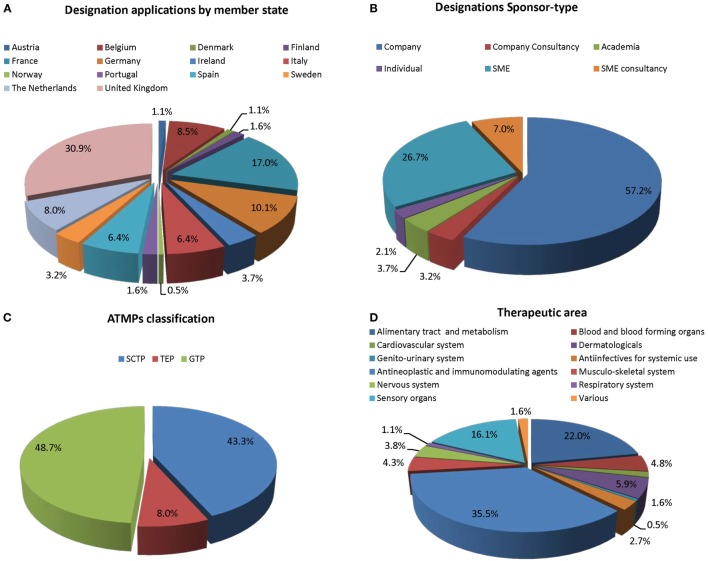
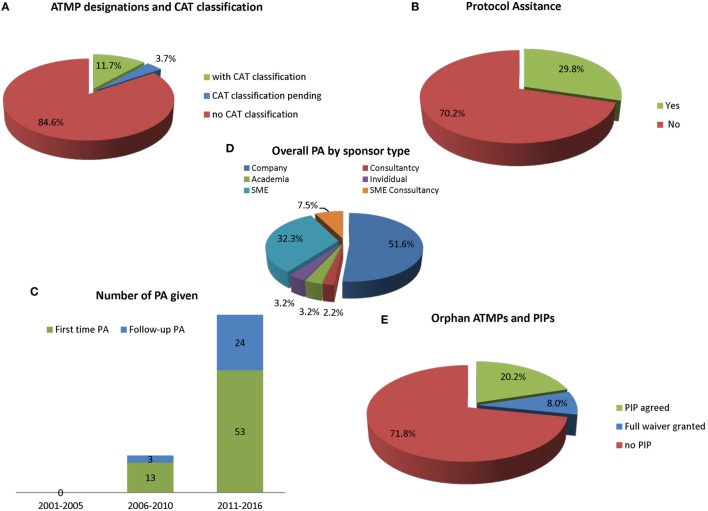
In 2008, the European Union introduced the Advanced Medicines Regulation aiming to improve regulation of advanced therapy medicinal products (ATMPs). We applied the ATMPs classification definitions in this Regulation to understand the link of this emerging group of medicinal products and the use of the Orphan Regulation. A total of 185 products that can be classified as ATMPs based on this Regulation have been submitted for orphan designation. Prior to its introduction in 2008, 4.5% of the products submitted for orphan designation met these criteria. This percentage went up to 15% after 2008. We analyzed several parameters associated with active ATMP ODDs focusing on sponsor type and EU-Member State origin, therapeutic area targeted, and ATMP classification [i.e., somatic cell therapy medicinal product, tissue-engineered product (TEP), or gene therapy medicinal product (GTMP)] and the use of regulatory services linked to incentives such as the use of protocol assistance (PA) and other Committees [Committee for Advanced Therapies (CAT) and the Pediatric Committee]. The aim here was to gain insight on the use of different services. The UK submits the largest number of ATMPs for ODD representing ~30% of the total to date. Few submissions have been received from central and Eastern European Member States as well as some of the larger Member States such as Germany (3.6%). ATMPs ODDs were primarily GTMPs (48.7%) and SCTMPs (43.3%). TEPs only represented 8% of all submissions for this medicinal class. This is different from non-ODDs ATMPs where GTMPs make only 20% of ATMPs. A total of 11.7% of ATMP ODDs had received formal CAT classification. A total of 29.8% of all orphan drug (OD) ATMPs requested PA. A total of 71.8% did not have an agreed pediatric investigation plan (PIP). Four products (Glybera one PA; Zalmoxis two; Holoclar one; Strimvelis three) have received a marketing authorization (MAA) and a 10-year market exclusivity. Strimvelis also completed their PIP, which was compliant and received the additional 2-year extension to their 10-year market exclusivity. One OD ATMP (Cerepro) received a negative opinion for MAA. The use of services linked to incentives offered by different legislations for ATMP ODDs is low, indicating a need for increasing awareness.
2008年,欧盟出台了《高级药品法规》,旨在加强对高级治疗用药品(ATMPs)的监管。我们应用该法规中的ATMPs分类定义,以了解这一新兴药品类别与《孤儿药法规》使用情况之间的联系。根据该法规,共有185种可归类为ATMPs的产品已提交孤儿药认定申请。在2008年该法规出台之前,提交孤儿药认定申请的产品中有4.5%符合这些标准。2008年之后,这一比例升至15%。我们分析了与活跃的ATMP孤儿药认定申请(ODDs)相关的几个参数,重点关注申办方类型和欧盟成员国来源、靶向治疗领域以及ATMP分类[即体细胞治疗用药品、组织工程产品(TEP)或基因治疗用药品(GTMP)],以及与激励措施相关的监管服务的使用情况,如方案协助(PA)的使用以及其他委员会[高级治疗委员会(CAT)和儿科委员会]。目的是深入了解不同服务的使用情况。英国提交的ATMPs孤儿药认定申请数量最多,占迄今为止总数的约30%。中欧和东欧成员国以及一些较大的成员国(如德国,占3.6%)提交的申请较少。ATMPs孤儿药认定申请主要是GTMPs(48.7%)和体细胞治疗用药品(SCTMPs,43.3%)。TEPs仅占该药品类所有申请的8%。这与非孤儿药认定的ATMPs不同, 在非孤儿药认定的ATMPs中,GTMPs仅占ATMPs的20%。共有11.7%的ATMP孤儿药认定申请获得了CAT的正式分类。所有孤儿药(OD)ATMPs中,共有29.8%申请了PA。共有71.8%没有商定的儿科研究计划(PIP)。有四种产品(Glybera一项PA;Zalmoxis两项;Holoclar一项;Strimvelis三项)获得了上市许可(MAA)并享有10年的市场独占期。Strimvelis还完成了其PIP,该PIP符合要求,并在其10年市场独占期的基础上额外获得了2年的延期。一种OD ATMP(Cerepro)的上市许可申请获得了否定意见。针对ATMPs孤儿药认定申请,不同法规提供的与激励措施相关的服务使用比例较低,这表明有必要提高认识。