Gao Xiaoying, Liu Yun, Xie Yuying, Wang Ying, Qi Sihua
Department of Anesthesiology, The Fourth Affiliated Hospital of Harbin Medical University, Harbin, Heilongjiang 150001, P.R. China.
Mol Med Rep. 2017 Jul;16(1):515-522. doi: 10.3892/mmr.2017.6652. Epub 2017 May 30.
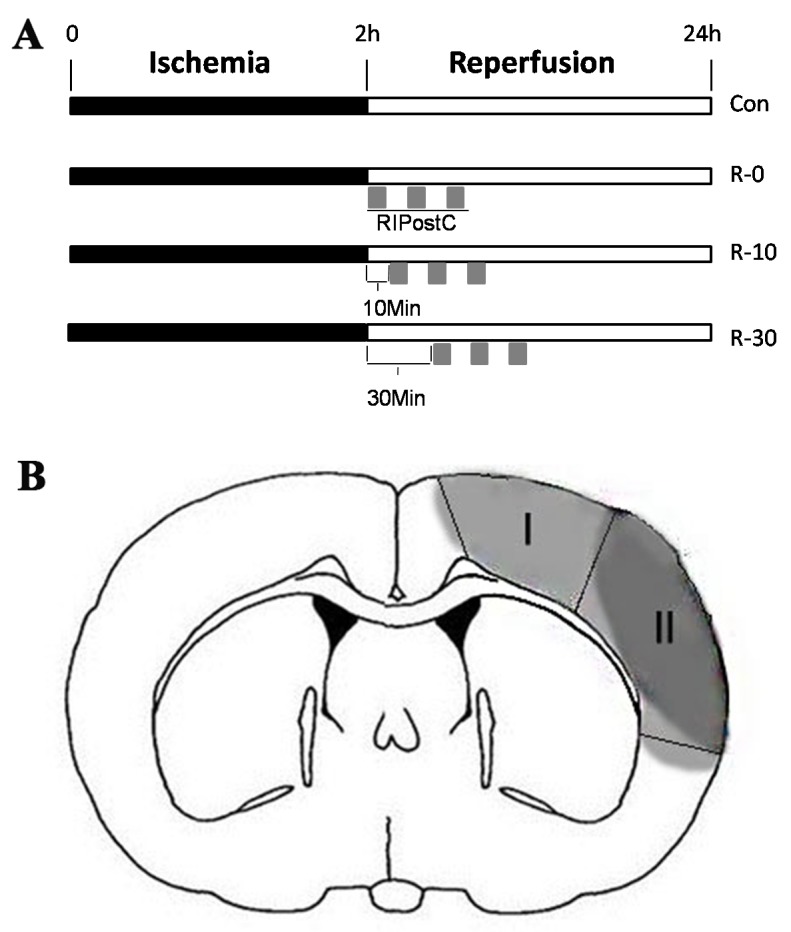
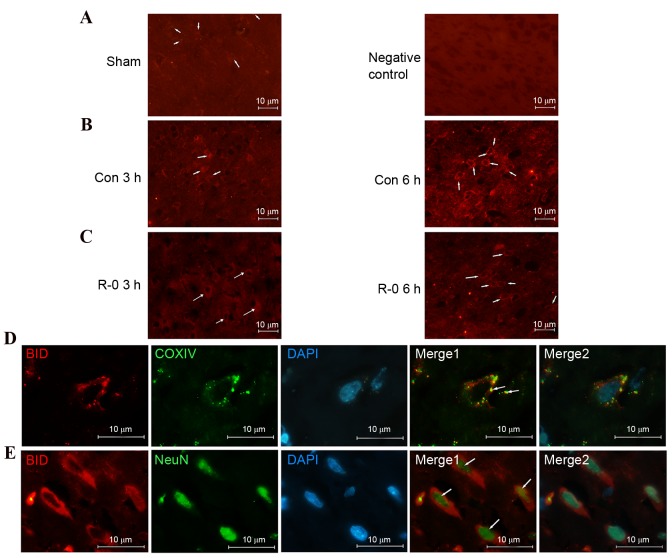
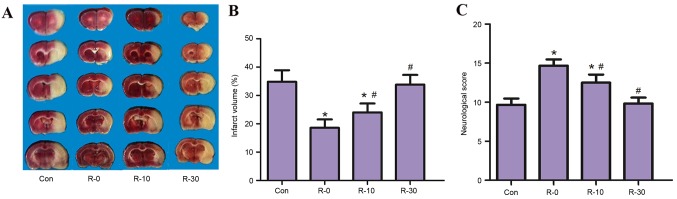
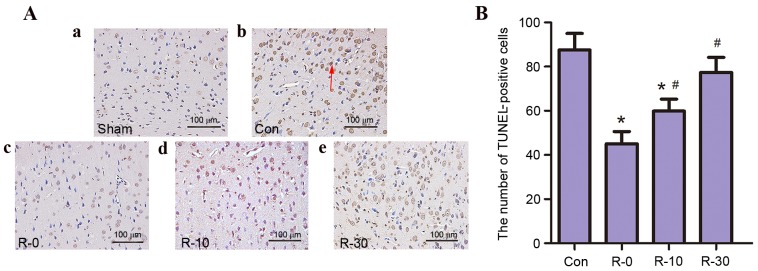
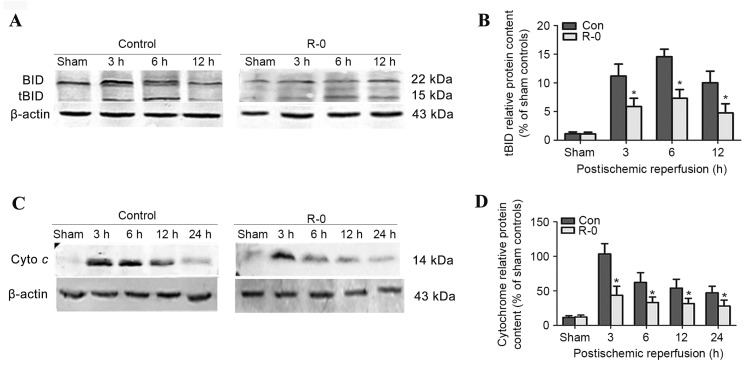
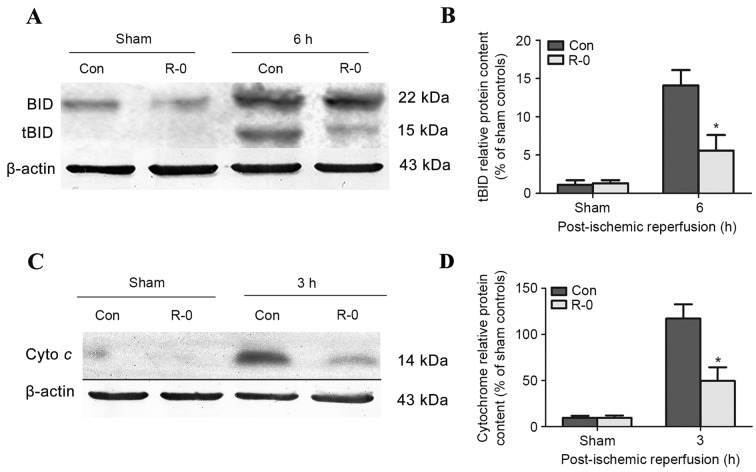
Ischemic postconditioning has been demonstrated to alleviate brain ischemia/reperfusion-induced neuronal apoptosis; however, the protective mechanisms underlying the improved and more convenient method of remote ischemic postconditioning (RIPostC) are only recently beginning to be elucidated. Mitochondria are important in the regulation of cell apoptosis, and the B‑cell lymphoma 2 (Bcl‑2) homology 3 interacting‑domain death agonist (BID) promotes the insertion/oligomerization of Bcl‑2‑associated X protein into the mitochondrial outer membrane, leading to the release of proapoptotic proteins from the mitochondria. The present study hypothesized that RIPostC targets the BID‑mediated mitochondrial apoptotic pathway to exert neuroprotective effects, and the optimal time window for RIPostC application was investigated. RIPostC was conducted as follows: Three 10‑min cycles of bilateral femoral artery occlusion with intervals of 10 min reperfusion after 0, 10 or 30 min of brain reperfusion. The results revealed that reperfusion induced significant activation of BID, via proteolytic cleavage and translocation to the mitochondria, as determined using western blot analysis and immunofluorescence staining. Mitochondrial release of cytochrome c was additionally detected during BID activation, all of which were inhibited by the application of RIPostC. When RIPostC was applied during reperfusion, it demonstrated a significant protective effect. Furthermore, the infarct volume, neurological function and the degree of neuronal apoptosis were improved with application of RIPostC. These results suggested that the protective mechanisms of RIPostC may be associated with inhibition of the BID‑mediated mitochondrial apoptotic pathway, which may act as a potential molecular target for therapeutic intervention in the future.
缺血后处理已被证明可减轻脑缺血/再灌注诱导的神经元凋亡;然而,更简便的远程缺血后处理(RIPostC)改善后的保护机制直到最近才开始被阐明。线粒体在细胞凋亡调控中起重要作用,B细胞淋巴瘤2(Bcl-2)同源结构域相互作用死亡激动剂(BID)促进Bcl-2相关X蛋白插入/寡聚化到线粒体外膜,导致促凋亡蛋白从线粒体释放。本研究假设RIPostC靶向BID介导的线粒体凋亡途径发挥神经保护作用,并研究了RIPostC应用的最佳时间窗。RIPostC操作如下:在脑再灌注0、10或30分钟后,进行三个10分钟的双侧股动脉闭塞周期,每次闭塞后间隔10分钟再灌注。结果显示,通过蛋白质印迹分析和免疫荧光染色测定,再灌注诱导了BID的显著激活,即通过蛋白水解切割并转位到线粒体。在BID激活过程中还检测到细胞色素c从线粒体释放,而这些均被RIPostC的应用所抑制。当在再灌注期间应用RIPostC时,显示出显著的保护作用。此外,应用RIPostC可改善梗死体积、神经功能和神经元凋亡程度。这些结果表明,RIPostC的保护机制可能与抑制BID介导的线粒体凋亡途径有关,这可能成为未来治疗干预的潜在分子靶点。