Lord James D, Shows Donna M
James D Lord, Donna M Shows, Translational Research Program, Benaroya Research Institute, Seattle, WA 98101, United States.
World J Gastroenterol. 2017 May 14;23(18):3240-3251. doi: 10.3748/wjg.v23.i18.3240.
To identify which blood and mucosal lymphocyte populations are specifically depleted by thiopurine use .
The thiopurines azathioprine and 6-mercaptopurine have been a mainstay of inflammatory bowel disease (IBD) therapy for decades, but their mechanism of action remains obscure. Although thiopurines are lymphotoxic at high doses, and have been reported to cause T cell apoptosis , their ability to control IBD at lower doses suggests that they may selectively deplete particular lymphocyte populations. Blood cells from 19 IBD patients on a thiopurine, 19 IBD patients not on a thiopurine, and 38 matched healthy control subjects were analyzed by multiple multi-color flow cytometry panels to quantify the immune cell subsets contained therein, both as a percent of cells, and as an absolute cell count. Similar analyses were performed on colon biopsies from 17 IBD patients on a thiopurine, 17 IBD patients not on a thiopurine, and 49 healthy screening colonoscopy recipients.
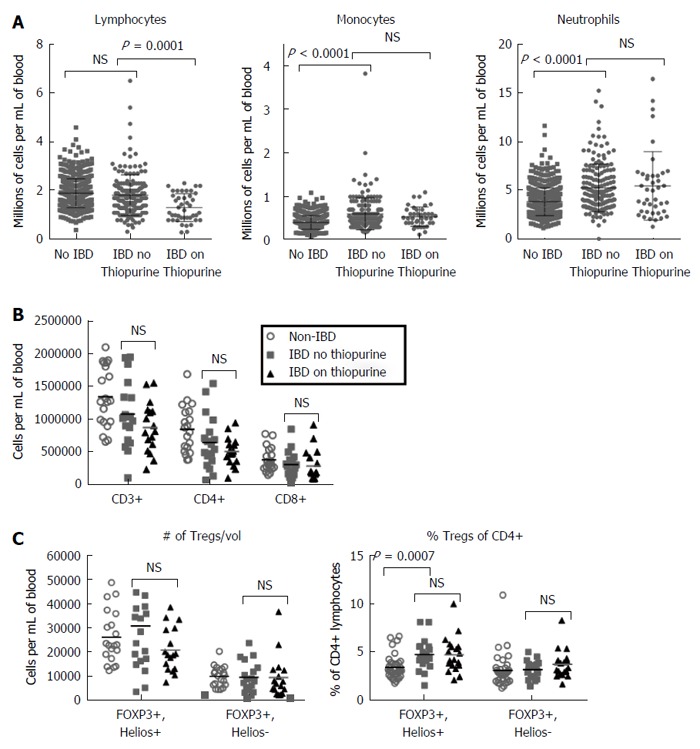
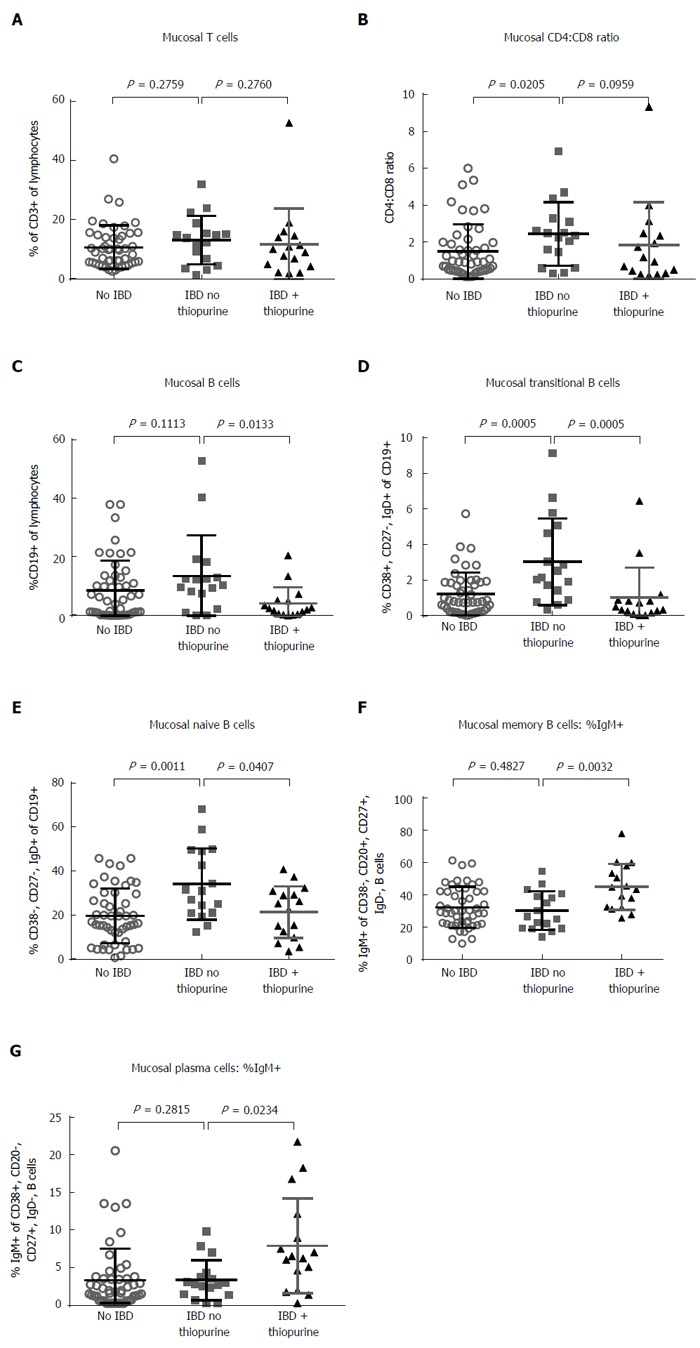
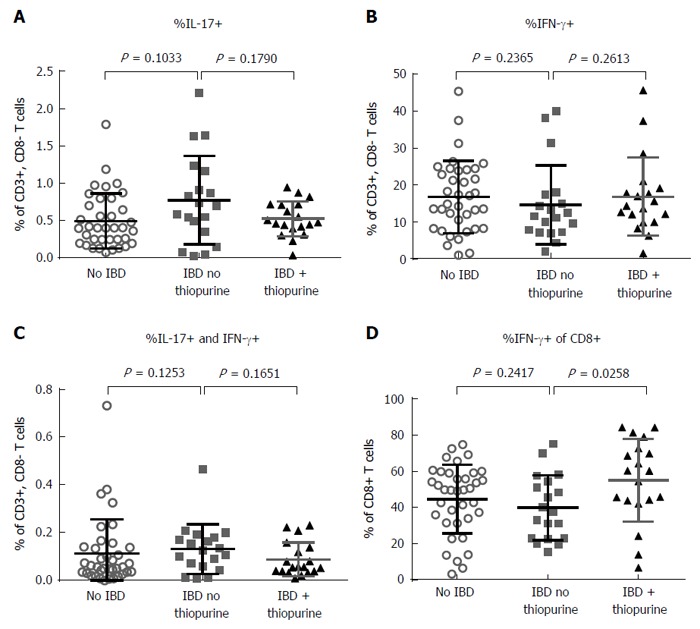
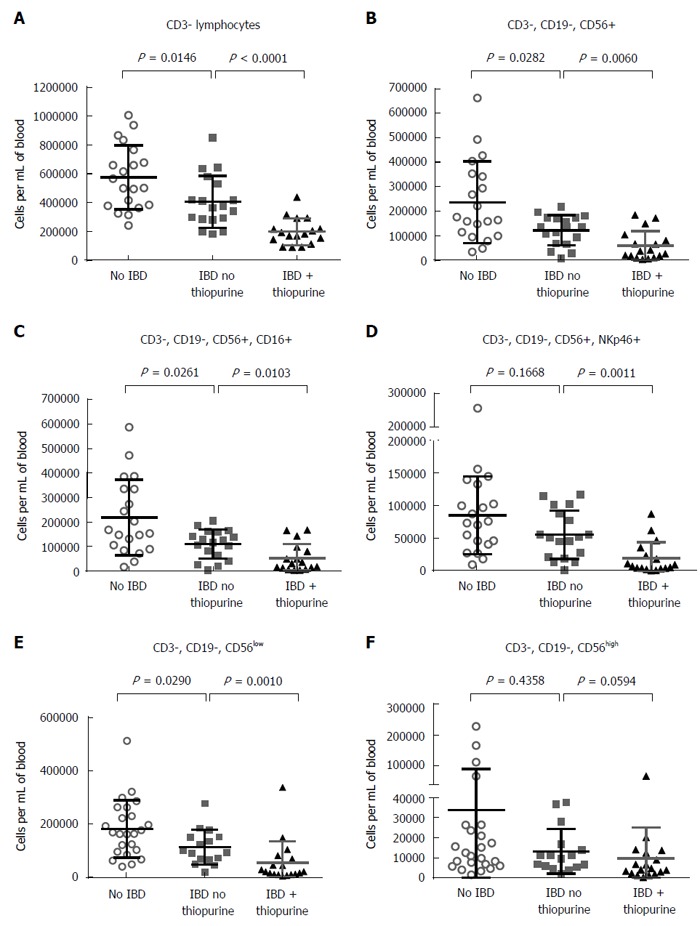
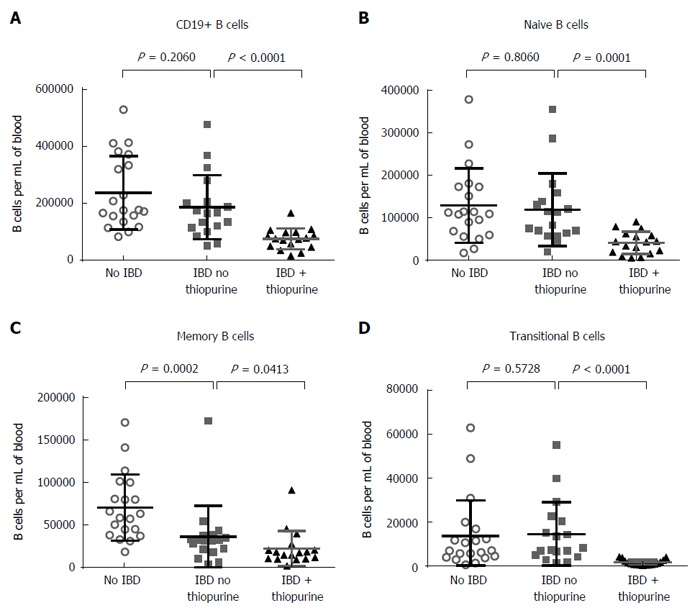
Complete blood counts revealed lower lymphocyte, but not monocyte or granulocyte, counts in IBD patients who were taking thiopurines at the time of sampling. This reduction was restricted to CD3-negative lymphocytes, wherein both natural killer (NK) and B cells were significantly reduced among thiopurine recipients. Among CD19+ B cells, the transitional B cells were particularly depleted, being nearly absent in both blood and colon biopsies of thiopurine recipients. No differences were associated with thiopurine use in CD8+ T cells, mucosa-associated invariant T (MAIT) cells, invariant natural killer T (iNKT) cells, gamma/delta T cells, Th1, Th17, regulatory T cells (Tregs) or naïve CD4+ T cells. However, patients with IBD had significantly more circulating FOXP3+, Helios+ Tregs and fewer iNKT and MAIT cells than healthy controls.
Thiopurine use is associated with reduced B and NK cell, but not T cell, subpopulations in the blood of IBD patients.
确定硫嘌呤的使用会特异性消耗哪些血液和黏膜淋巴细胞群体。
硫唑嘌呤和6-巯基嘌呤作为炎症性肠病(IBD)的治疗药物已达数十年之久,但其作用机制仍不清楚。尽管硫嘌呤在高剂量时具有淋巴细胞毒性,且有报道称其可导致T细胞凋亡,但其在较低剂量下控制IBD的能力表明它们可能会选择性地消耗特定的淋巴细胞群体。通过多个多色流式细胞术面板对19名正在使用硫嘌呤的IBD患者、19名未使用硫嘌呤的IBD患者以及38名匹配的健康对照者的血细胞进行分析,以量化其中所含免疫细胞亚群,包括细胞百分比和绝对细胞计数。对17名正在使用硫嘌呤的IBD患者、17名未使用硫嘌呤的IBD患者以及49名接受健康筛查结肠镜检查者的结肠活检组织进行了类似分析。
全血细胞计数显示,在采样时正在服用硫嘌呤的IBD患者中,淋巴细胞计数较低,但单核细胞或粒细胞计数无变化。这种减少仅限于CD3阴性淋巴细胞,其中硫嘌呤接受者的自然杀伤(NK)细胞和B细胞均显著减少。在CD19+B细胞中,过渡性B细胞尤其减少,在硫嘌呤接受者的血液和结肠活检组织中几乎不存在。硫嘌呤的使用与CD8+T细胞、黏膜相关恒定T(MAIT)细胞、恒定自然杀伤T(iNKT)细胞、γ/δT细胞、Th1、Th17、调节性T细胞(Tregs)或初始CD4+T细胞无差异。然而,与健康对照相比,IBD患者的循环中FOXP3+、Helios+Tregs显著增多,iNKT和MAIT细胞减少。
使用硫嘌呤与IBD患者血液中B细胞和NK细胞亚群减少有关,但与T细胞亚群无关。