Lim Chong Hong, Chen Hsin-Hua, Chen Yi-Hsing, Chen Der-Yuan, Huang Wen-Nan, Tsai Jaw-Ji, Hsieh Tsu-Yi, Hsieh Chia-Wei, Hung Wei-Ting, Lin Ching-Tsai, Lai Kuo-Lung, Tang Kuo-Tung, Tseng Chih-Wei, Chen Yi-Ming
Rheumatology Unit, Department of Internal Medicine, Pulau Pinang General Hospital, Georgetown, Malaysia.
Division of Allergy, Immunology and Rheumatology, Department of Internal Medicine, Taichung Veterans General Hospital, Taichung, Taiwan.
PLoS One. 2017 Jun 1;12(6):e0178035. doi: 10.1371/journal.pone.0178035. eCollection 2017.
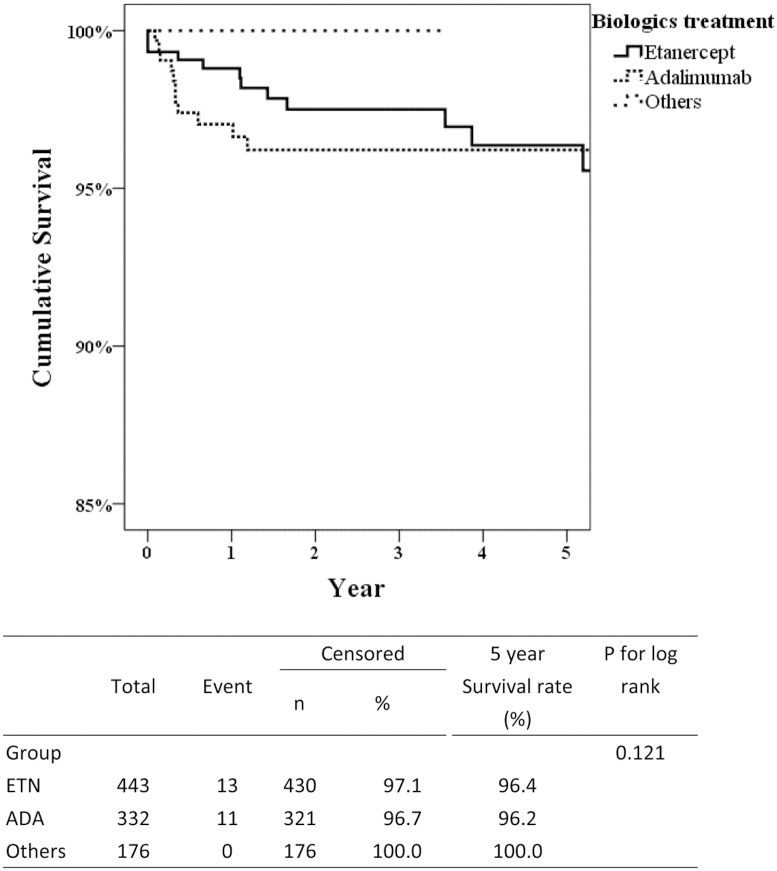
The objective of this study is to determine the risk of tuberculosis (TB) disease in biologics users among rheumatoid arthritis (RA) patients in Taiwan from 2000 to 2015. This retrospective cohort study enrolled adult RA patients initiated on first biologics at Taichung Veterans General Hospital. TB risks were determined as hazard ratio (HR) with 95% confidence interval (CI) using cox regression. A total of 951 patients were recruited; etanercept (n = 443), adalimumab (n = 332), abatacept (n = 74), golimumab (n = 60), tocilizumab (n = 31) and tofacitinib (n = 11). Twenty-four TB cases were identified; 13 in etanercept and 11 in adalimumab group with the TB incidence rate of 889.3/ 100,000 and 1055.6/ 100,000 patient-years respectively. There was no significant difference in TB risk between adalimumab and etanercept users with an incidence rate ratio of 1.27 (p = 0.556 by Poisson model). Significant 2-year TB risk factors included elderly patient >65 year-old (HR: 2.72, 95% CI: 1.06-6.99, p = 0.037), history of TB (HR: 6.24, 95% CI: 1.77-22.00, p = 0.004) and daily glucocorticoid use ≥5mg (HR:5.01, 95% CI: 1.46-17.21, p = 0.010). Sulfasalazine treatment appeared to be protective (HR: 0.32, 95% CI: 0.11-0.97, p = 0.043). Risk management plan (RMP) for TB before initiation of biologics commenced in 2012. The 2-year TB risks after RMP was compared with that before 2012 (HR:0.67, 95% CI: 0.30-1.49, p = 0.323). Elderly RA patients with a history of previous TB infection and concomitant moderate dose glucocorticoid were at higher risk of TB disease. Concurrent sulfasalazine treatment appeared to be a protective factor against TB disease.
本研究的目的是确定2000年至2015年台湾类风湿关节炎(RA)患者中使用生物制剂者患结核病(TB)的风险。这项回顾性队列研究纳入了在台中荣民总医院开始使用第一种生物制剂的成年RA患者。使用Cox回归将结核病风险确定为风险比(HR)及95%置信区间(CI)。共招募了951名患者;其中依那西普(n = 443)、阿达木单抗(n = 332)、阿巴西普(n = 74)、戈利木单抗(n = 60)、托珠单抗(n = 31)和托法替布(n = 11)。确定了24例结核病病例;依那西普组13例,阿达木单抗组11例,结核病发病率分别为889.3/100,000患者-年和1,055.6/100,000患者-年。阿达木单抗和依那西普使用者之间的结核病风险无显著差异,发病率比为1.27(泊松模型p = 0.556)。2年结核病显著风险因素包括年龄>65岁的老年患者(HR:2.72,95%CI:1.06 - 6.99,p = 0.037)、结核病病史(HR:6.24,95%CI:1.77 - 22.00,p = 0.004)和每日使用糖皮质激素≥5mg(HR:5.01,95%CI:1.46 - 17.21,p = 0.010)。柳氮磺胺吡啶治疗似乎具有保护作用(HR:0.32,95%CI:0.11 - 0.97,p = 0.043)。2012年开始在使用生物制剂前制定结核病风险管理计划(RMP)。将实施RMP后的2年结核病风险与2012年前进行比较(HR:0.67,95%CI: 0.30 - 1.49,p = 0.323)。有结核病既往感染史且同时使用中等剂量糖皮质激素的老年RA患者患结核病的风险更高。同时使用柳氮磺胺吡啶治疗似乎是预防结核病的一个保护因素。