
基于生理的器官模型的开发,用于评估药物在睾丸和甲状腺中的药代动力学。
Development of Physiologically Based Organ Models to Evaluate the Pharmacokinetics of Drugs in the Testes and the Thyroid Gland.
作者信息
Pilari S, Gaub T, Block M, Görlitz L
机构信息
Bayer Aktiengesellschaft, Berlin, Germany.
Bayer Aktiengesellschaft, Leverkusen, Germany.
出版信息
CPT Pharmacometrics Syst Pharmacol. 2017 Aug;6(8):532-542. doi: 10.1002/psp4.12205. Epub 2017 Jul 29.
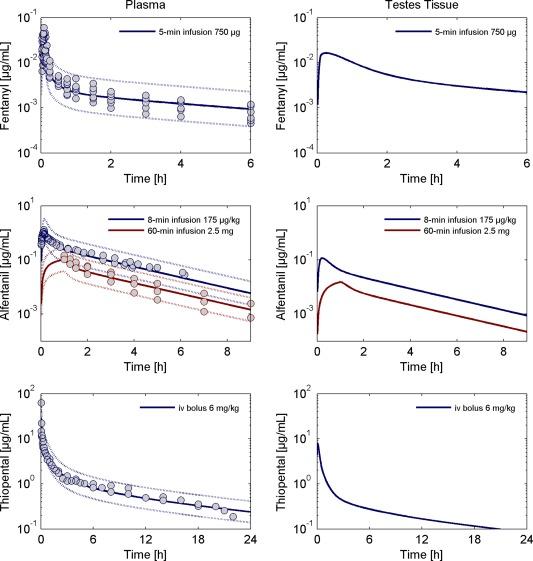
We extended a generic whole-body physiologically based pharmacokinetic (PBPK) model for rats and humans for organs of the reproductive and endocrine systems (i.e., the testes and the thyroid gland). An extensive literature search was performed, first, to determine the most generic organ model structures for testes and thyroid across species, and, second, to identify the corresponding anatomic and physiological parameters in rats and humans. The testes and thyroid organ models were implemented in the PBPK modeling software PK-Sim and MoBi. The capability of the PBPK approach to simulate the testes and thyroid tissue concentration data was demonstrated using a series of test compounds. The presented organ model structures and parameterization yielded a close agreement between observed and simulated tissue concentrations over time. The organ models are ready to be used to predict the pharmacokinetics of passively entering drugs in the testes and thyroid tissue in a generic PBPK modeling framework.
我们扩展了一个适用于大鼠和人类的通用全身生理药代动力学(PBPK)模型,该模型涵盖生殖和内分泌系统的器官(即睾丸和甲状腺)。首先进行了广泛的文献检索,以确定跨物种的睾丸和甲状腺最通用的器官模型结构,其次是识别大鼠和人类相应的解剖学和生理学参数。睾丸和甲状腺器官模型在PBPK建模软件PK-Sim和MoBi中实现。使用一系列测试化合物证明了PBPK方法模拟睾丸和甲状腺组织浓度数据的能力。所呈现的器官模型结构和参数化使得观察到的和模拟的组织浓度随时间变化呈现出密切的一致性。这些器官模型已准备好在通用的PBPK建模框架中用于预测被动进入睾丸和甲状腺组织的药物的药代动力学。


 Zotero 插件