Horie Masanori, Nara Kazuhiro, Sugino Sakiko, Umeno Aya, Yoshida Yasukazu
Health Research Institute (HRI) National Institute of Advanced Industrial Science and Technology (AIST) Takamatsu Kagawa Japan.
Faculty of Human Life Sciences Jissen Women's University Hino Tokyo Japan.
Food Sci Nutr. 2016 Nov 22;5(3):639-645. doi: 10.1002/fsn3.442. eCollection 2017 May.
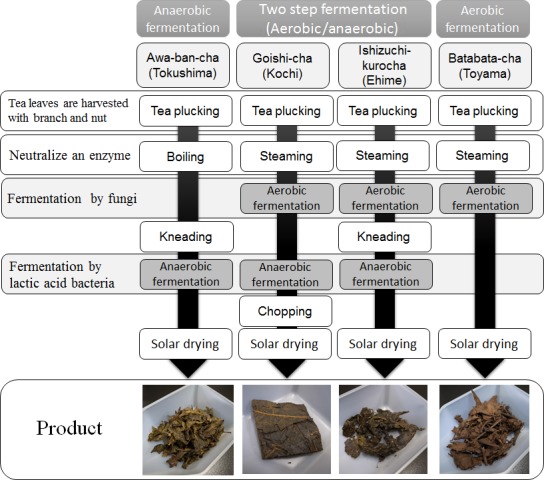
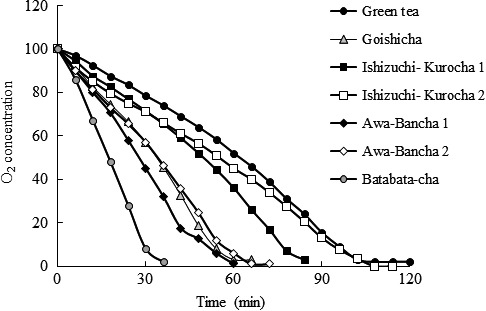
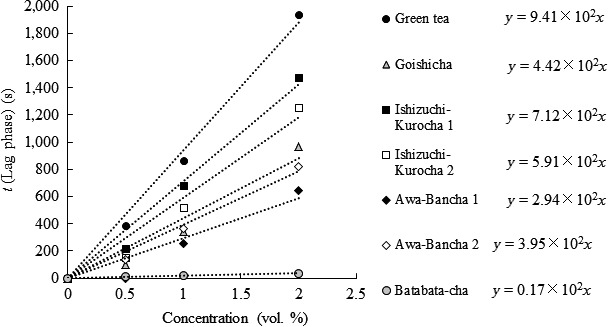
Antioxidant activities of four kinds of Japanese traditional fermented tea, Gishi-cha, Ishizuchi-kurocha, Awa-bancha, and Batabatacha, were compared. Antioxidant activity was evaluated by three parameters: copper ion reduction ability, radical trapping ability, and oxygen consumption rate. Processes of fermentation of these fermented teas are different. Goichi-cha and Ishizuchi-kurocha are produced by a two-stage fermentation process, aerobic fermentation and subsequent anaerobic fermentation. Awa-bancha is produced by anaerobic fermentation. And batabata-cha is produced by aerobic fermentation. Additionally, unfermented green tea was also employed as control. These tea leaves were extracted by boiling water and measured antioxidant activities. And concentrations of caffeine and catechins were measured in green tea and in the four kinds of fermented tea: Ishizuchi-kurocha, Goishi-cha, Awa-Bancha, and Batabata-cha. Concentrations of caffeine and catechins were lower in the fermented teas than in green tea. Among the fermented teas, epigallocatechin content was the highest in Ishizuchi-kurocha, whereas Batabata-cha hardly contained any epigallocatechin. Goichi-cha, Ishizuchi-kurocha, and Awa-bancha showed antioxidative activity regardless of measurement method. Batabatacha had hardly any antioxidative activity. Among the fermented teas, Ishizuchi-kurocha had the strongest antioxidant activity. The antioxidative activities of green tea and the four kinds of fermented tea were significantly different among each other (<.01). Implication of this study is as follows: although contents of catechins were lower than that of green tea, three kinds of fermented tea showed antioxidative activity comparable to green tea. The results suggest that anaerobic fermentation process is beneficial at least for antioxidative activity.
比较了四种日本传统发酵茶——吉士茶、石锤黑茶、阿波番茶和巴塔巴茶的抗氧化活性。通过三个参数评估抗氧化活性:铜离子还原能力、自由基捕获能力和耗氧率。这些发酵茶的发酵过程各不相同。吉士茶和石锤黑茶是通过两阶段发酵过程生产的,即有氧发酵和随后的厌氧发酵。阿波番茶是通过厌氧发酵生产的。而巴塔巴茶是通过有氧发酵生产的。此外,未发酵的绿茶也用作对照。将这些茶叶用沸水提取并测量抗氧化活性。并测定了绿茶以及四种发酵茶(石锤黑茶、吉士茶、阿波番茶和巴塔巴茶)中咖啡因和儿茶素的浓度。发酵茶中咖啡因和儿茶素的浓度低于绿茶。在发酵茶中,表没食子儿茶素含量在石锤黑茶中最高,而巴塔巴茶几乎不含表没食子儿茶素。无论采用何种测量方法,吉士茶、石锤黑茶和阿波番茶都表现出抗氧化活性。巴塔巴茶几乎没有抗氧化活性。在发酵茶中,石锤黑茶的抗氧化活性最强。绿茶和四种发酵茶的抗氧化活性彼此之间存在显著差异(<.01)。本研究的意义如下:尽管儿茶素含量低于绿茶,但三种发酵茶表现出与绿茶相当的抗氧化活性。结果表明,厌氧发酵过程至少对抗氧化活性有益。