Purba Endang R, Saita Ei-Ichiro, Maruyama Ichiro N
Information Processing Biology Unit, Okinawa Institute of Science and Technology Graduate University, Okinawa 904-0495.
Cells. 2017 Jun 2;6(2):13. doi: 10.3390/cells6020013.
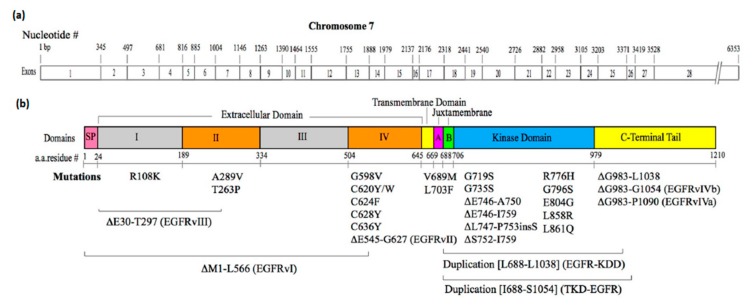
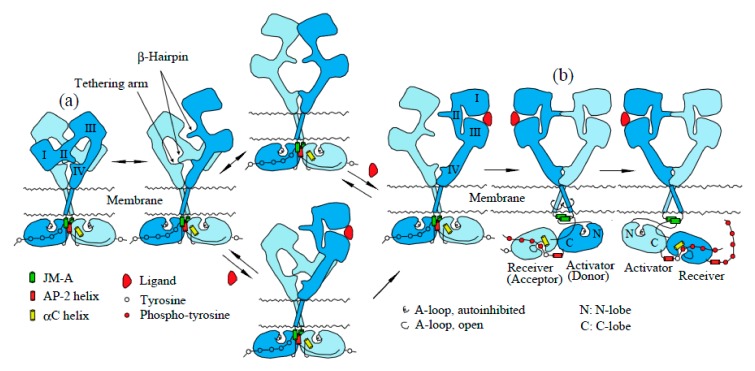
The epidermal growth factor receptor (EGFR) plays vital roles in cellular processes including cell proliferation, survival, motility, and differentiation. The dysregulated activation of the receptor is often implicated in human cancers. EGFR is synthesized as a single-pass transmembrane protein, which consists of an extracellular ligand-binding domain and an intracellular kinase domain separated by a single transmembrane domain. The receptor is activated by a variety of polypeptide ligands such as epidermal growth factor and transforming growth factor α. It has long been thought that EGFR is activated by ligand-induced dimerization of the receptor monomer, which brings intracellular kinase domains into close proximity for -autophosphorylation. An increasing number of diverse studies, however, demonstrate that EGFR is present as a pre-formed, yet inactive, dimer prior to ligand binding. Furthermore, recent progress in structural studies has provided insight into conformational changes during the activation of a pre-formed EGFR dimer. Upon ligand binding to the extracellular domain of EGFR, its transmembrane domains rotate or twist parallel to the plane of the cell membrane, resulting in the reorientation of the intracellular kinase domain dimer from a symmetric inactive configuration to an asymmetric active form (the "rotation model"). This model is also able to explain how oncogenic mutations activate the receptor in the absence of the ligand, without assuming that the mutations induce receptor dimerization. In this review, we discuss the mechanisms underlying the ligand-induced activation of the preformed EGFR dimer, as well as how oncogenic mutations constitutively activate the receptor dimer, based on the rotation model.
表皮生长因子受体(EGFR)在包括细胞增殖、存活、运动和分化在内的细胞过程中发挥着至关重要的作用。该受体的失调激活常与人类癌症有关。EGFR作为一种单次跨膜蛋白合成,它由一个细胞外配体结合结构域和一个细胞内激酶结构域组成,中间隔着一个单一的跨膜结构域。该受体可被多种多肽配体激活,如表皮生长因子和转化生长因子α。长期以来,人们一直认为EGFR是通过配体诱导受体单体二聚化而被激活的,这使得细胞内激酶结构域紧密靠近以进行自磷酸化。然而,越来越多不同的研究表明,EGFR在配体结合之前以预先形成但无活性的二聚体形式存在。此外,结构研究的最新进展为预先形成的EGFR二聚体激活过程中的构象变化提供了深入了解。当配体与EGFR的细胞外结构域结合时,其跨膜结构域会平行于细胞膜平面旋转或扭曲,导致细胞内激酶结构域二聚体从对称的无活性构象重新定向为不对称的活性形式(“旋转模型”)。该模型还能够解释致癌突变如何在没有配体的情况下激活受体,而无需假设突变诱导受体二聚化。在这篇综述中,我们基于旋转模型讨论了预先形成的EGFR二聚体的配体诱导激活的潜在机制,以及致癌突变如何组成性激活受体二聚体。