Huang Meng-Jie, Wei Ri-Bao, Wang Yang, Su Ting-Yu, Di Ping, Li Qing-Ping, Yang Xi, Li Ping, Chen Xiang-Mei
Department of Nephrology, Chinese PLA General Hospital, Chinese PLA Institute of Nephrology, State Key Laboratory of Kidney Diseases, National Clinical Research Center for Kidney Diseases, Beijing Key Laboratory of Kidney Disease Research, Beijing, China.
Department of Clinical Laboratory, Chinese PLA General Hospital, Beijing, China.
BMJ Open. 2017 Jun 1;7(5):e014294. doi: 10.1136/bmjopen-2016-014294.
Thromboembolic events are the major factor affecting the prognosis of patients with chronic kidney disease (CKD). Haemostatic alterations are possible causes of these complications, but their roles remain poorly characterised. In the prospective observational study, we investigated the entire coagulation process in patients with CKD to elucidate the mechanisms of their high thromboembolic risk.
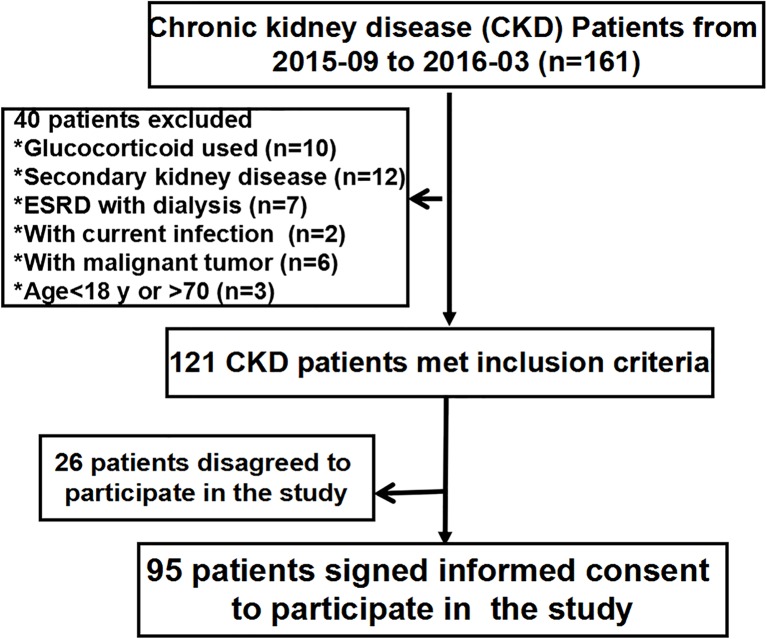
A total of 95 patients with CKD and 20 healthy controls who met the inclusion criteria were consecutively recruited from September 2015 to March 2016. The platelet count, platelet aggregation, von Willebrand factor antigen (vWF:Ag), vWF ristocetin cofactor activity (vWF:RCo), fibrinogen, factor V (FV), FVII, FVIII, antithrombin III, protein C, protein S, D-dimer, standard coagulation tests and thromboelastography were measured in patients with CKD and controls. Associations between the estimated glomerular filtration rate (eGFR) and haemostatic biomarkers were tested using multivariable linear regression.
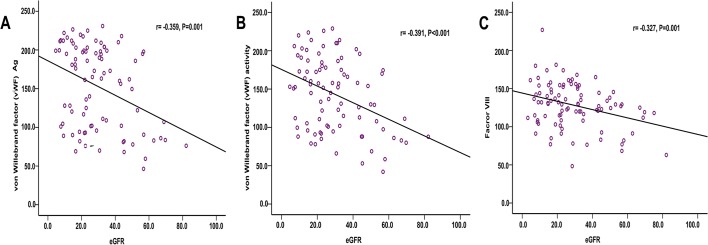
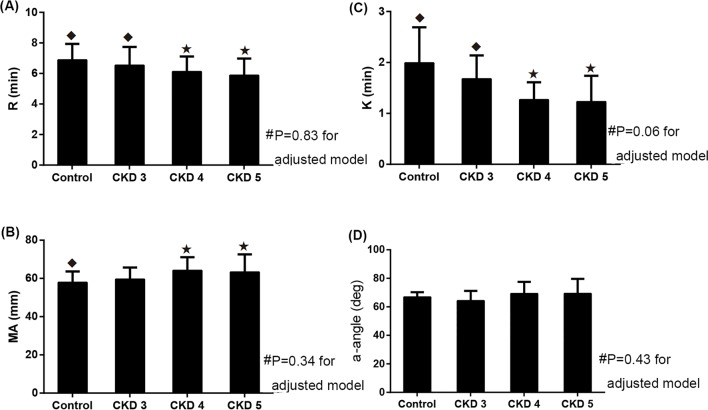
The adjusted and unadjusted levels of vWF:Ag, vWF:RCo, fibrinogen, FVII, FVIII and D-dimer were significantly higher in patients with CKD than that in the healthy controls, and were elevated with CKD progression. However, after adjustment for baseline differences, platelet aggregation and thromboelastography parameters showed no significant differences between patients with CKD and healthy controls. In the correlation analysis, vWF:Ag, vWF:RCo and FVIII were inversely associated with eGFR (r=-0.359, p<0.001; r=-0.391, p<0.001; r=-0.327, p<0.001, respectively). During the 1-year of follow-up, one cardiovascular event occurred in patients with CKD 5 stage, whereas no thromboembolic event occurred in the CKD 3 and 4 and control groups.
Patients with CKD are characterised by endothelial dysfunction and increased coagulation, especially FVIII activity. The abnormal haemostatic profiles may contribute to the elevated risk of thrombotic events but further longer-term study with large samples is still required to more precisely determine the relationship between the elevation of procoagulant factors and clinical outcomes.
血栓栓塞事件是影响慢性肾脏病(CKD)患者预后的主要因素。止血功能改变可能是这些并发症的原因,但其作用仍未得到充分阐明。在这项前瞻性观察研究中,我们调查了CKD患者的整个凝血过程,以阐明其高血栓栓塞风险的机制。
2015年9月至2016年3月,连续招募了95例符合纳入标准的CKD患者和20名健康对照者。对CKD患者和对照者测量血小板计数、血小板聚集、血管性血友病因子抗原(vWF:Ag)、vWF瑞斯托霉素辅因子活性(vWF:RCo)、纤维蛋白原、因子V(FV)、FVII、FVIII、抗凝血酶III、蛋白C、蛋白S、D-二聚体、标准凝血试验和血栓弹力图。使用多变量线性回归测试估计肾小球滤过率(eGFR)与止血生物标志物之间的关联。
CKD患者中vWF:Ag、vWF:RCo、纤维蛋白原、FVII、FVIII和D-二聚体的校正和未校正水平均显著高于健康对照者,并随CKD进展而升高。然而,在调整基线差异后,CKD患者与健康对照者之间的血小板聚集和血栓弹力图参数无显著差异。在相关性分析中,vWF:Ag、vWF:RCo和FVIII与eGFR呈负相关(分别为r=-0.359,p<0.001;r=-0.391,p<0.001;r=-0.327,p<0.001)。在1年的随访期间,CKD 5期患者发生了1次心血管事件,而CKD 3期和4期患者及对照组未发生血栓栓塞事件。
CKD患者的特征是内皮功能障碍和凝血增加,尤其是FVIII活性。止血异常可能导致血栓形成事件风险升高,但仍需要进一步的大样本长期研究,以更精确地确定促凝血因子升高与临床结局之间的关系。