Hu Haili, Wang Guanghui, Li Congying
Department of Otorhinolaryngology, Huaihe Hospital of Henan University.
Department of Otorhinolaryngology, School of Medicine, Kaifeng University, Kaifeng, People's Republic of China.
Onco Targets Ther. 2017 May 23;10:2711-2720. doi: 10.2147/OTT.S135563. eCollection 2017.
Recent studies have demonstrated that microRNA 124 (miR-124) acts as a tumor suppressor in nasopharyngeal carcinoma (NPC); however, the exact molecular mechanism by which miR-124 exerts tumor suppression has not been well elucidated.
We performed quantitative real-time PCR (qRT-PCR) to measure the expression of metastasis associated lung adenocarcinoma transcript 1, miR-124, and calpain small subunit 1 (Capn4) mRNAs in NPC cell lines. We also performed western blot analysis to detect the levels of Capn4. Furthermore, we performed MTT assay and transwell invasion assay to determine the proliferation and invasion ability of two NPC cell lines, namely, HONE1 and CNE2 cells, respectively. The verification of targets of miR-124 was performed using prediction softwares and luciferase reporter analysis.
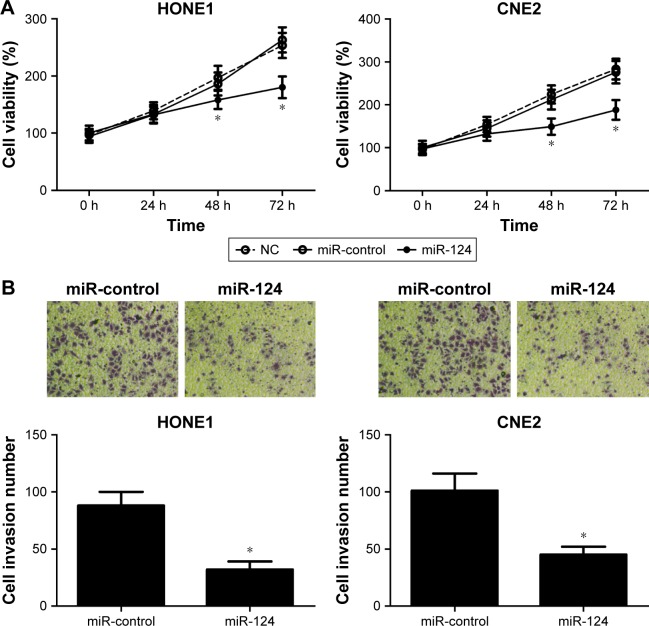
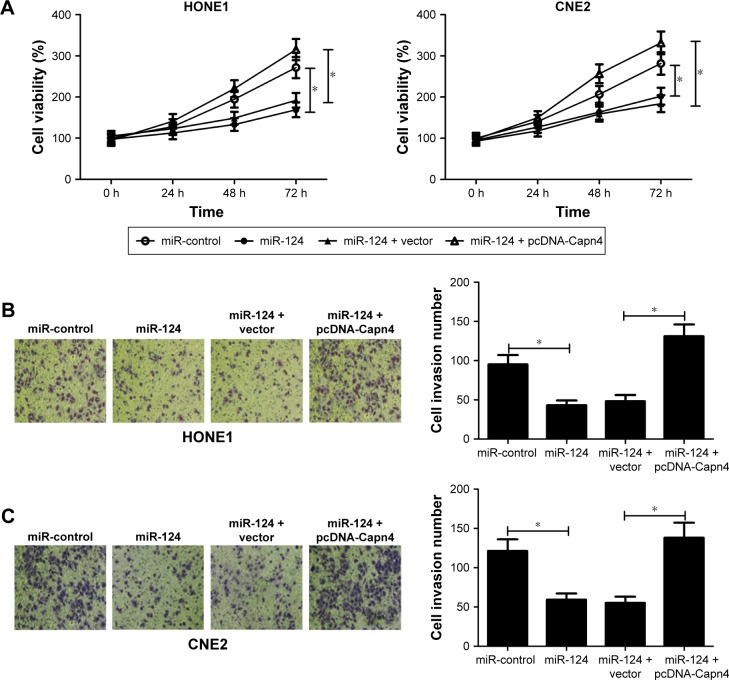
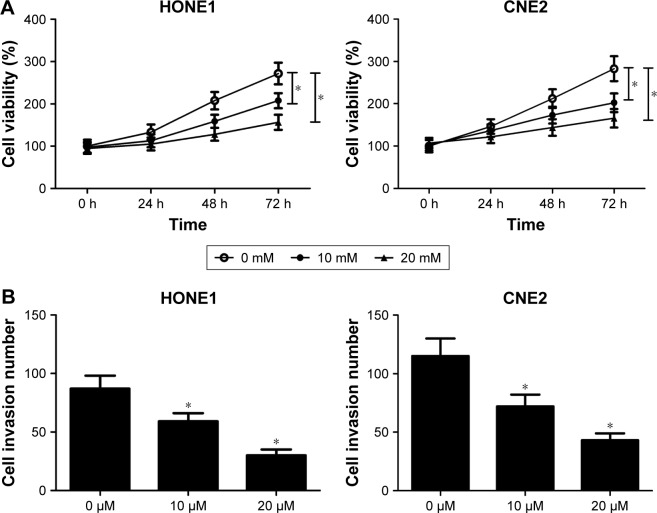
According to our results, the expression of Capn4 was found to be elevated, whereas the expression of miR-124 was lowered in NPC cell lines compared with normal nasopharyngeal cells. When we preformed overexpression of miR-124, it suppressed the proliferation and invasion of NPC cells. Moreover, miR-124 suppressed the expression of Capn4 by targeting Capn4 in HONE1 and CNE2 cells. When we preformed overexpression of Capn4, it reversed the inhibitory effect of miR-124 on the proliferation and invasion of NPC cells. Furthermore, miR-124-Capn4 axis decreased the levels of β-catenin, cyclin D1, and c-Myc, the components of the Wnt/β-catenin signaling pathway.
The suppression of proliferation and invasion of NPC cells by miR-124 were achieved by the regulation of Wnt/β-catenin signaling pathway by targeting Capn4. The results of this study revealed a novel miR-124-Capn4 regulatory axis in NPC cell lines, providing a better understanding of the pathogenesis of NPC and a promising therapeutic target for patients with NPC.
近期研究表明,微小RNA 124(miR-124)在鼻咽癌(NPC)中作为一种肿瘤抑制因子发挥作用;然而,miR-124发挥肿瘤抑制作用的确切分子机制尚未得到充分阐明。
我们进行了定量实时聚合酶链反应(qRT-PCR),以检测转移相关肺腺癌转录本1、miR-124和钙蛋白酶小亚基1(Capn4)mRNA在NPC细胞系中的表达。我们还进行了蛋白质免疫印迹分析,以检测Capn4的水平。此外,我们分别进行了MTT法和Transwell侵袭试验,以确定两种NPC细胞系,即HONE1和CNE2细胞的增殖和侵袭能力。使用预测软件和荧光素酶报告基因分析对miR-124的靶标进行验证。
根据我们的结果,与正常鼻咽细胞相比,NPC细胞系中Capn4的表达升高,而miR-124的表达降低。当我们进行miR-124的过表达时,它抑制了NPC细胞的增殖和侵袭。此外,miR-124通过在HONE1和CNE2细胞中靶向Capn4来抑制Capn4的表达。当我们进行Capn4的过表达时,它逆转了miR-124对NPC细胞增殖和侵袭的抑制作用。此外,miR-124-Capn4轴降低了Wnt/β-连环蛋白信号通路的组成成分β-连环蛋白、细胞周期蛋白D1和c-Myc的水平。
miR-124通过靶向Capn4调节Wnt/β-连环蛋白信号通路,从而实现对NPC细胞增殖和侵袭的抑制。本研究结果揭示了NPC细胞系中一种新的miR-124-Capn4调控轴,有助于更好地理解NPC的发病机制,并为NPC患者提供了一个有前景的治疗靶点。