Cauble Meagan A, Muckley Matthew J, Fang Ming, Fessler Jeffrey A, Welch Kathleen, Rothman Edward D, Orr Bradford G, Duong Le T, Holl Mark M Banaszak
Department of Chemistry, University of Michigan, Ann Arbor, MI, USA.
Department of Biomedical Engineering, University of Michigan, Ann Arbor, MI, USA.
Bone Rep. 2016 Aug 27;5:243-251. doi: 10.1016/j.bonr.2016.08.003. eCollection 2016 Dec.
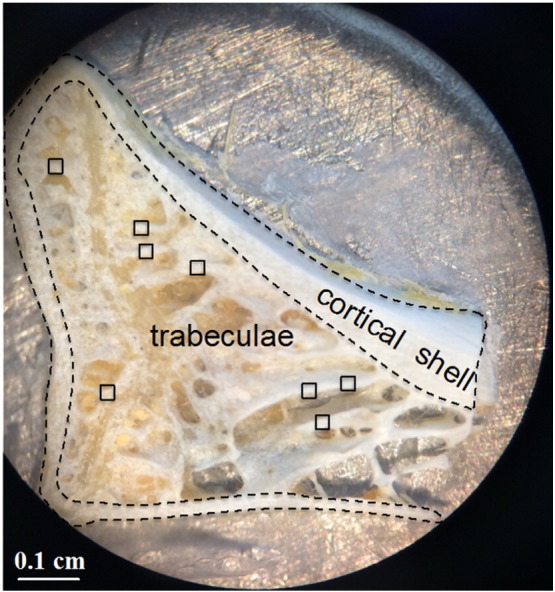
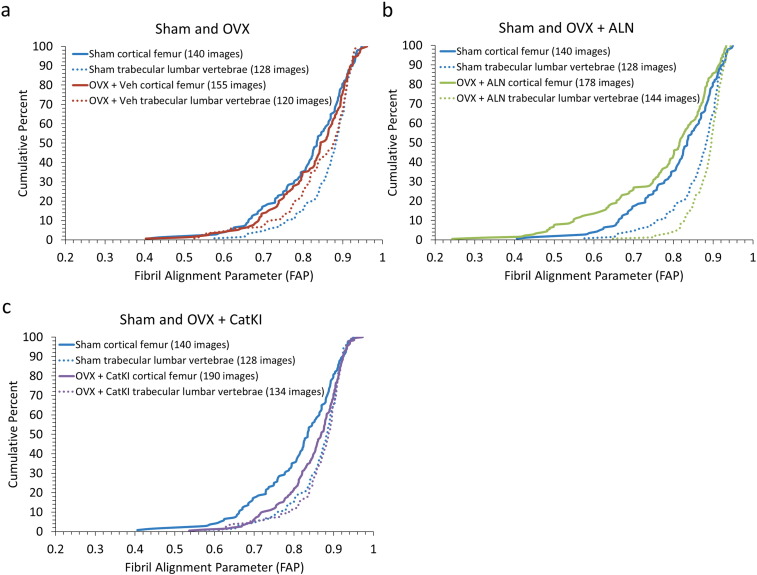
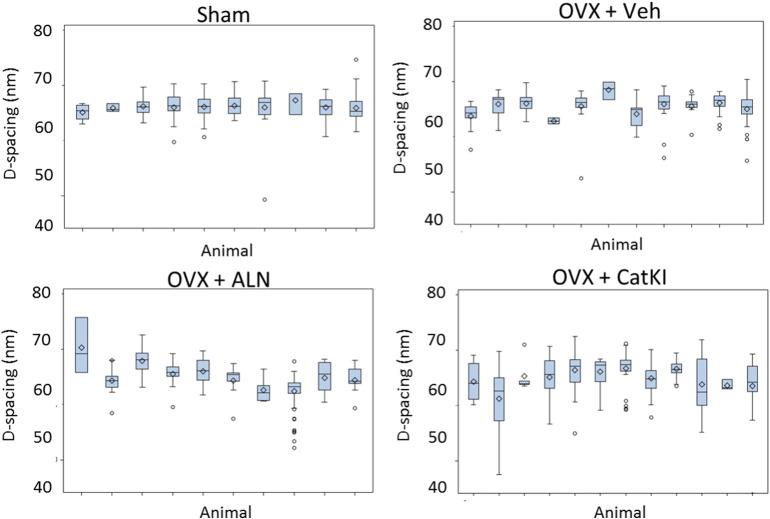
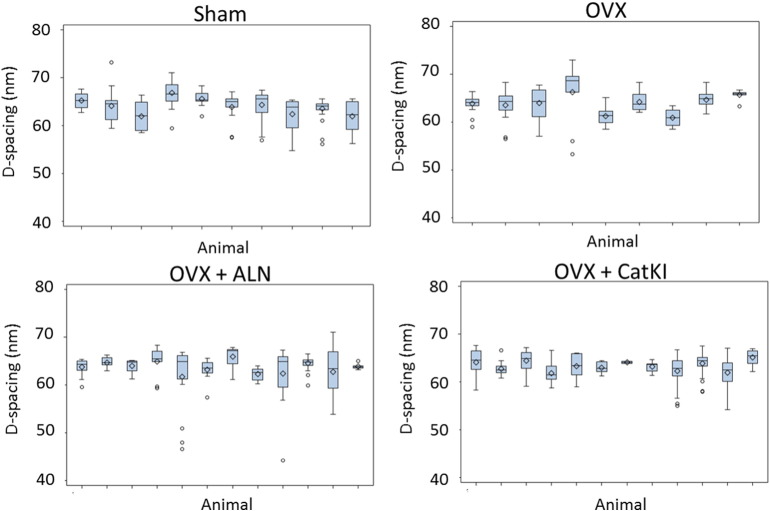
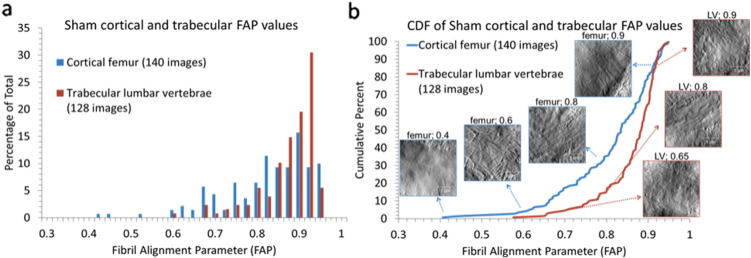
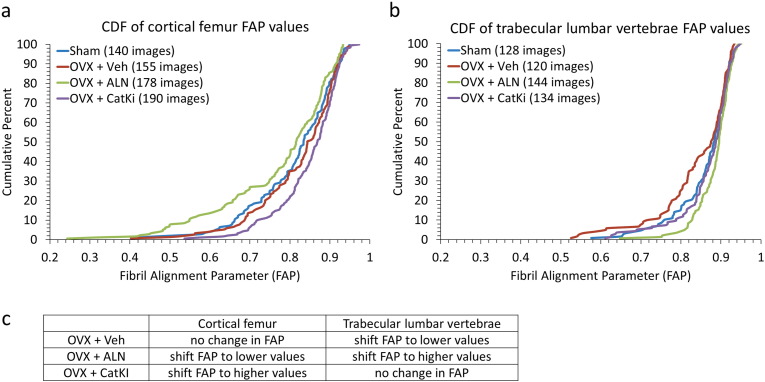
The impact of estrogen depletion and drug treatment on type I collagen fibril nanomorphology and collagen fibril packing (microstructure) was evaluated by atomic force microscopy (AFM) using an ovariectomized (OVX) rabbit model of estrogen deficiency induced bone loss. Nine month-old New Zealand white female rabbits were treated as follows: sham-operated (Sham; = 11), OVX + vehicle (OVX + Veh; = 12), OVX + alendronate (ALN, 600 μg/kg/wk., s.c.; = 12), and OVX + cathepsin-K inhibitor L-235 (CatKI, 10 mg/kg, daily, p.o.; = 13) in prevention mode for 27 weeks. Samples from the cortical femur and trabecular lumbar vertebrae were polished, demineralized, and imaged using AFM. Auto-correlation of image patches was used to generate a vector field for each image that mathematically approximated the collagen fibril alignment. This vector field was used to compute an information-theoretic entropy that was employed as a quantitative fibril alignment parameter (FAP) to allow image-to-image and sample-to-sample comparison. For all samples, no change was observed in the average FAP values; however significant differences in the distribution of FAP values were observed. In particular, OVX + Veh lumbar vertebrae samples contained a tail of lower FAP values representing regions of greater fibril alignment. OVX + ALN treatment resulted in a FAP distribution with a tail indicating greater alignment for cortical femur and less alignment for trabecular lumbar vertebrae. OVX + CatKI treatment gave a distribution of FAP values with a tail indicating less alignment for cortical femur and no change for trabecular lumbar vertebrae. Fibril alignment was also evaluated by considering when a fibril was part of discrete bundles or sheets (classified as ) or not (classified as ). For this analysis, the percentage of fibrils in cortical femur for the OVX group was 17% lower than the Sham group. OVX + ALN treatment partially prevented the proportion of fibrils from decreasing and OVX + CatKI treatment completely prevented a change. In trabecular lumbar vertebrae, there was no difference in the percentage of fibrils between Sham and any of the other treatment groups.
采用去卵巢(OVX)兔雌激素缺乏诱导性骨质流失模型,通过原子力显微镜(AFM)评估雌激素缺乏和药物治疗对I型胶原纤维纳米形态及胶原纤维堆积(微观结构)的影响。将9月龄新西兰雌性白兔按如下方式处理:假手术组(Sham;n = 11)、OVX + 赋形剂组(OVX + Veh;n = 12)、OVX + 阿仑膦酸盐组(ALN,600 μg/kg/周,皮下注射;n = 12)以及OVX + 组织蛋白酶K抑制剂L - 235组(CatKI,10 mg/kg,每日,口服;n = 13),预防模式持续27周。取股骨皮质和腰椎小梁样本进行抛光、脱矿处理,并用AFM成像。利用图像块的自相关为每张图像生成一个向量场,该向量场在数学上近似胶原纤维排列。此向量场用于计算信息论熵,该熵用作定量纤维排列参数(FAP),以便进行图像间和样本间比较。对于所有样本,平均FAP值未观察到变化;然而,FAP值分布存在显著差异。特别是,OVX + Veh腰椎样本包含一条较低FAP值的尾部,代表纤维排列更整齐的区域。OVX + ALN治疗导致FAP分布出现一条尾部,表明股骨皮质排列更整齐,而腰椎小梁排列较差。OVX + CatKI治疗给出的FAP值分布有一条尾部,表明股骨皮质排列较差,腰椎小梁无变化。还通过考虑纤维何时属于离散束或片层(分类为 )或不属于(分类为 )来评估纤维排列。对于此分析,OVX组股骨皮质中 纤维的百分比比Sham组低17%。OVX + ALN治疗部分阻止了 纤维比例的下降,而OVX + CatKI治疗完全阻止了变化。在腰椎小梁中,Sham组与任何其他治疗组之间 纤维的百分比无差异。