The Biotechnology Institute, University of Minnesota, 1479 Gortner Avenue, St Paul, Minnesota 55108, USA.
Department of Ecology, Evolution and Behavior, University of Minnesota, 100 Ecology Building, 1987 Upper Buford Circle, Roseville, Minnesota 55108, USA.
Nat Commun. 2017 Jun 5;8:15707. doi: 10.1038/ncomms15707.
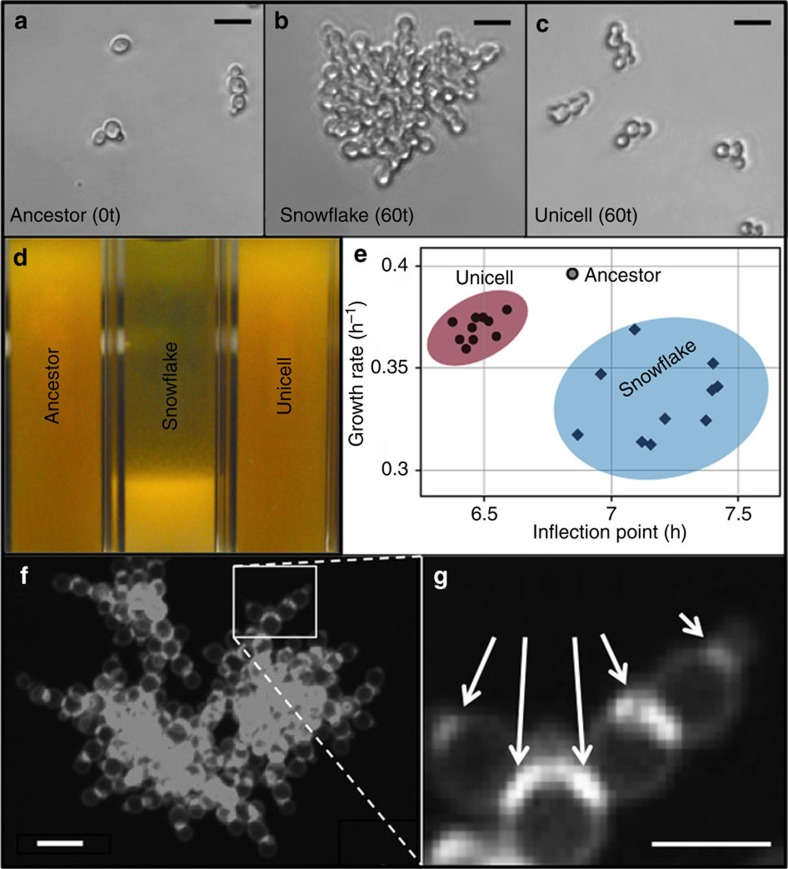
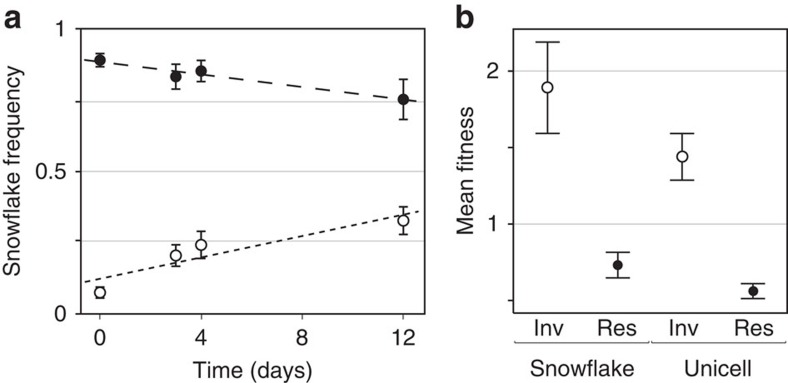
The evolution of multicellular life requires cooperation among cells, which can be undermined by intra-group selection for selfishness. Theory predicts that selection to avoid non-cooperators limits social interactions among non-relatives, yet previous evolution experiments suggest that intra-group conflict is an outcome, rather than a driver, of incipient multicellular life cycles. Here we report the evolution of multicellularity via two distinct mechanisms of group formation in the unicellular budding yeast Kluyveromyces lactis. Cells remain permanently attached following mitosis, giving rise to clonal clusters (staying together); clusters then reversibly assemble into social groups (coming together). Coming together amplifies the benefits of multicellularity and allows social clusters to collectively outperform solitary clusters. However, cooperation among non-relatives also permits fast-growing unicellular lineages to 'free-ride' during selection for increased size. Cooperation and competition for the benefits of multicellularity promote the stable coexistence of unicellular and multicellular genotypes, underscoring the importance of social and ecological context during the transition to multicellularity.
多细胞生命的进化需要细胞之间的合作,但这种合作可能会被群体内自私自利的选择所破坏。理论预测,为了避免非合作者的选择会限制非亲属之间的社会互动,但之前的进化实验表明,群体内的冲突是初生多细胞生命周期的结果,而不是其驱动因素。在这里,我们通过两种不同的单细胞出芽酵母 Kluyveromyces lactis 的群体形成机制报告了多细胞性的进化。细胞在有丝分裂后仍永久附着,形成克隆簇(保持在一起);然后,这些簇可逆地组装成社会群体(聚集在一起)。聚集在一起放大了多细胞的好处,并允许社会群体集体优于单个群体。然而,非亲属之间的合作也允许快速生长的单细胞谱系在选择增加大小时“搭便车”。合作和竞争多细胞的好处促进了单细胞和多细胞基因型的稳定共存,强调了在向多细胞性过渡期间社会和生态背景的重要性。