Bray Janet E, Straney Lahn, Smith Karen, Cartledge Susie, Case Rosalind, Bernard Stephen, Finn Judith
Department of Epidemiology and Preventive Medicine, Monash University, Melbourne, Australia
Prehospital, Resuscitation and Emergency Care Research Unit, Curtin University, Perth, Australia.
J Am Heart Assoc. 2017 Jun 5;6(6):e005972. doi: 10.1161/JAHA.117.005972.
Bystander cardiopulmonary resuscitation (CPR) more than doubles the chance of surviving an out-of-hospital cardiac arrest. Recent data have shown considerable regional variation in bystander CPR rates across the Australian state of Victoria. This study aims to determine whether there is associated regional variation in rates of CPR training and willingness to perform CPR in these communities.
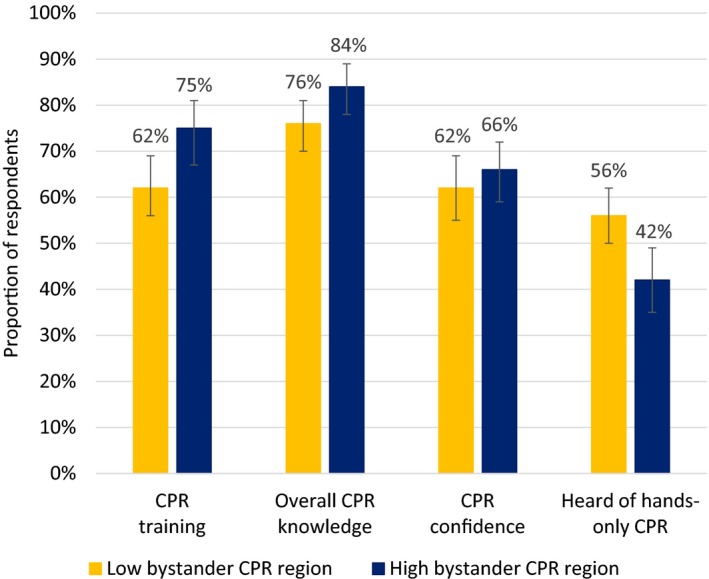
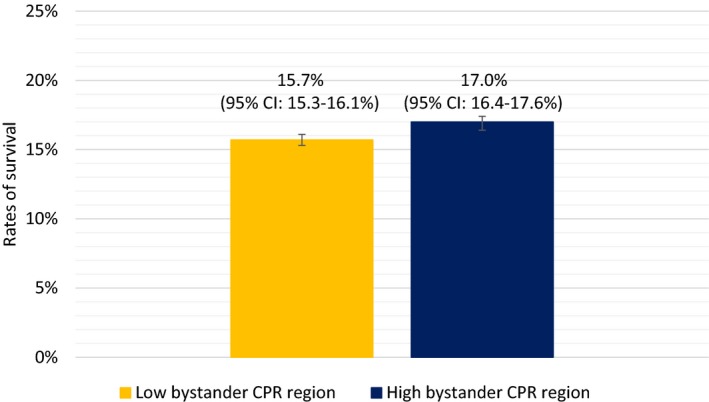
We categorized each Victorian postcode as either a low or high bystander CPR region using data on adult, bystander-witnessed, out-of-hospital cardiac arrests of presumed cardiac etiology (n=7175) from the Victorian Ambulance Cardiac Arrest Registry. We then surveyed adult Victorians (n=404) and compared CPR training data of the respondents from low and high bystander CPR regions. Of the 404 adults surveyed, 223 (55%) resided in regions with low bystander CPR. Compared with respondents from high bystander CPR regions, respondents residing in regions with low bystander CPR had lower rates of CPR training (62% versus 75%, =0.009) and lower self-ratings for their overall knowledge of CPR (76% versus 84%, =0.04). There were no differences between the regions in their reasons for not having undergone CPR training or in their willingness to perform CPR. Rates of survival for bystander-witnessed, out-of-hospital cardiac arrests were significantly lower in low bystander CPR regions (15.7% versus 17.0%, <0.001).
This study found lower rates of CPR training and lower survival in regions with lower rates of bystander CPR in Victoria, Australia. Targeting these regions with CPR training programs may improve bystander CPR rates and out-of-hospital cardiac arrest outcomes.
旁观者实施心肺复苏术(CPR)可使院外心脏骤停患者的存活几率增加一倍以上。近期数据显示,澳大利亚维多利亚州旁观者实施心肺复苏术的比例存在显著的地区差异。本研究旨在确定这些社区中CPR培训率和实施CPR意愿是否也存在相关的地区差异。
我们利用维多利亚州救护车心脏骤停登记处提供的关于成人、旁观者目睹的、推测为心脏病因的院外心脏骤停数据(n = 7175),将维多利亚州的每个邮政编码区域分为旁观者实施心肺复苏术比例低或高的区域。然后,我们对维多利亚州的成年人(n = 404)进行了调查,并比较了旁观者实施心肺复苏术比例低和高的区域中受访者的CPR培训数据。在接受调查的404名成年人中,223人(55%)居住在旁观者实施心肺复苏术比例低的区域。与旁观者实施心肺复苏术比例高的区域的受访者相比,居住在旁观者实施心肺复苏术比例低的区域的受访者CPR培训率较低(62%对75%,P = 0.009),对CPR总体知识的自我评分也较低(76%对84%,P = 0.04)。在未接受CPR培训的原因或实施CPR的意愿方面,各区域之间没有差异。旁观者目睹的院外心脏骤停的存活率在旁观者实施心肺复苏术比例低的区域显著较低(15.7%对17.0%,P < 0.001)。
本研究发现,在澳大利亚维多利亚州,旁观者实施心肺复苏术比例较低的区域CPR培训率较低,存活率也较低。针对这些区域开展CPR培训项目可能会提高旁观者实施心肺复苏术的比例以及改善院外心脏骤停的结局。