Naoum George E, Buchsbaum Donald J, Tawadros Fady, Farooqi Ammad, Arafat Waleed O
Alexandria Comprehensive Cancer Center, Alexandria, Egypt.
Univeristy of Alabama, Birmingham, AL, USA.
Oncol Rev. 2017 Apr 28;11(1):332. doi: 10.4081/oncol.2017.332. eCollection 2017 Mar 3.
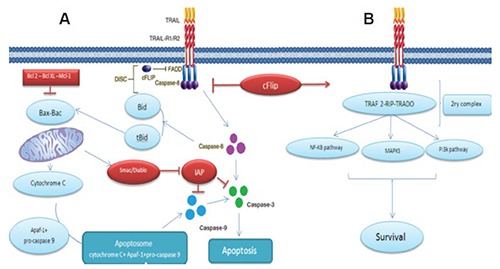
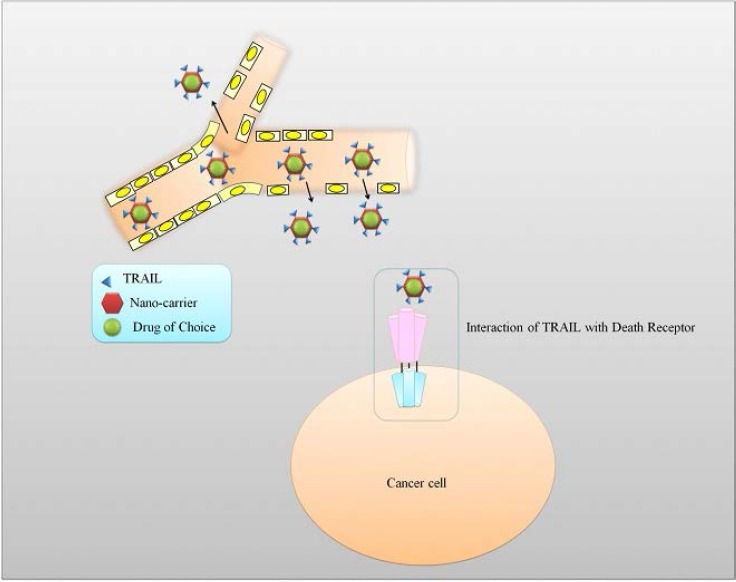
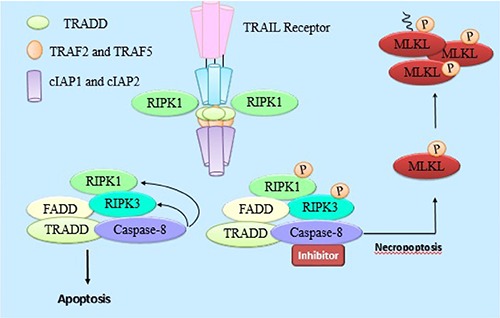
Induction of apoptosis in cancer cells has increasingly been the focus of many therapeutic approaches in oncology field. Since its identification as a TNF family member, TRAIL (TNF-related apoptosis-inducing ligand) paved a new path in apoptosis inducing cancer therapies. Its selective ability to activate extrinsic and intrinsic cell death pathways in cancer cells only, independently from p53 mutations responsible for conventional therapeutics resistance, spotted TRAIL as a potent cancer apoptotic agent. Many recombinant preparations of TRAIL and death receptor targeting monoclonal antibodies have been developed and being tested pre-clinically and clinically both as a single agent and in combinations. Of note, the monoclonal antibodies were not the only type of antibodies developed to target TRAIL receptors. Recent technology has brought forth several single chain variable domains (scFv) designs fused recombinantly to TRAIL as well. Also, it is becoming progressively more understandable that field of nanotechnology has revolutionized cancer diagnosis and therapy. The recent breakthroughs in materials science and protein engineering have helped considerably in strategically loading drugs into nanoparticles or conjugating drugs to their surface. In this review we aim to comprehensively highlight the molecular knowledge of TRAIL in the context of its pathway, receptors and resistance factors. We also aim to review the clinical trials that have been done using TRAIL based therapies and to review various scFv designs, the arsenal of nano-carriers and molecules available to selectively target tumor cells with TRAIL.
诱导癌细胞凋亡日益成为肿瘤学领域许多治疗方法的焦点。自被鉴定为肿瘤坏死因子(TNF)家族成员以来,TRAIL(肿瘤坏死因子相关凋亡诱导配体)为诱导凋亡的癌症治疗开辟了一条新途径。它具有仅在癌细胞中激活外源性和内源性细胞死亡途径的选择性能力,独立于导致传统治疗耐药的p53突变,这使TRAIL成为一种有效的癌症凋亡剂。许多TRAIL重组制剂和靶向死亡受体的单克隆抗体已被开发出来,并正在进行临床前和临床测试,既作为单一药物,也作为联合用药。值得注意的是,单克隆抗体并不是开发用于靶向TRAIL受体的唯一抗体类型。最近的技术还产生了几种与TRAIL重组融合的单链可变区(scFv)设计。此外,纳米技术领域彻底改变了癌症诊断和治疗,这一点也越来越容易理解。材料科学和蛋白质工程方面的最新突破极大地有助于将药物战略性地装载到纳米颗粒中或使其与纳米颗粒表面结合。在本综述中,我们旨在全面强调TRAIL在其信号通路、受体和耐药因子方面的分子知识。我们还旨在回顾使用基于TRAIL的疗法所进行的临床试验,并回顾各种scFv设计、纳米载体库以及可用于用TRAIL选择性靶向肿瘤细胞的分子。