Department of Chemistry and Center for NanoScience (CeNS), University of Munich (LMU) , Butenandtstraße 5-13, 81377 Munich, Germany.
Cavendish Laboratory, University of Cambridge , Cambridge CB3 0HE, United Kingdom.
J Am Chem Soc. 2017 Jun 21;139(24):8194-8199. doi: 10.1021/jacs.7b01631. Epub 2017 Jun 6.
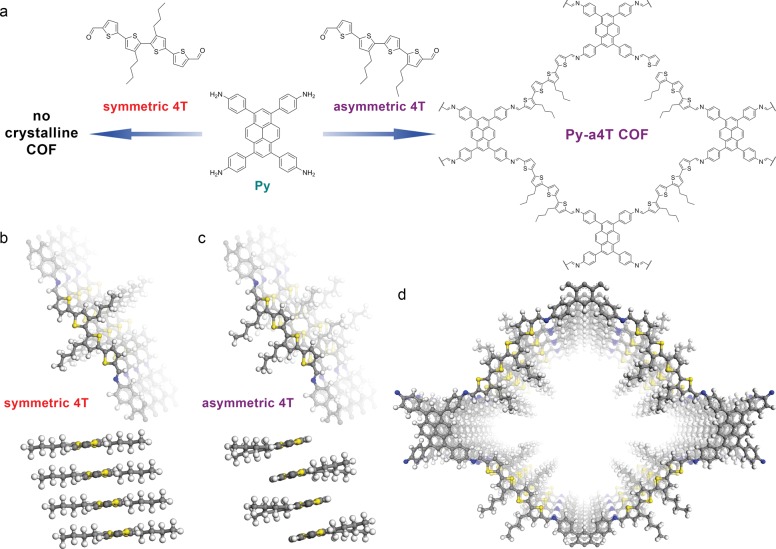
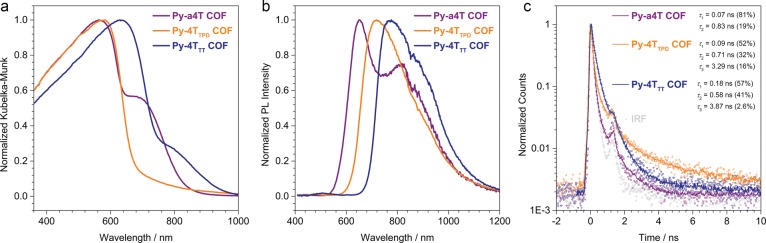
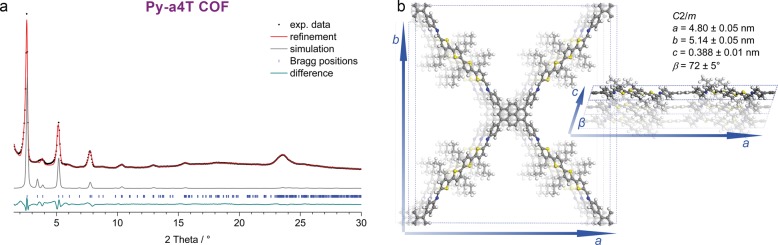
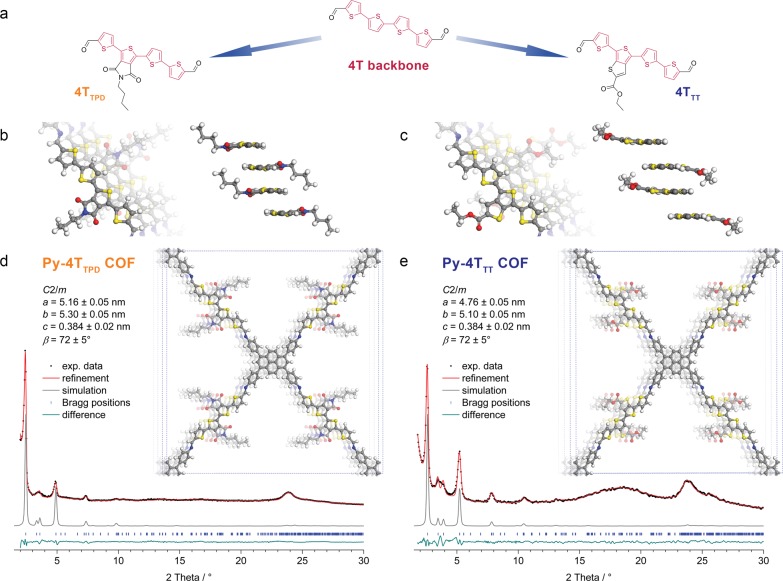
Two-dimensional covalent organic frameworks (2D-COFs) are crystalline, porous materials comprising aligned columns of π-stacked building blocks. With a view toward the application of these materials in organic electronics and optoelectronics, the construction of oligothiophene-based COFs would be highly desirable. The realization of such materials, however, has remained a challenge, in particular with respect to laterally conjugated imine-linked COFs. We have developed a new building block design employing an asymmetric modification on an otherwise symmetric backbone that allows us to construct a series of highly crystalline quaterthiophene-derived COFs with tunable electronic properties. Studying the optical response of these materials, we have observed for the first time the formation of a charge transfer state between the COF subunits across the imine bond. We believe that our new building block design provides a general strategy for the construction of well-ordered COFs from various extended building blocks, thus greatly expanding the range of applicable molecules.
二维共价有机骨架(2D-COFs)是由π堆积的构筑块排列成柱状的结晶多孔材料。为了将这些材料应用于有机电子学和光电子学,非常希望构建基于寡聚噻吩的 COF。然而,这些材料的实现仍然是一个挑战,特别是对于侧向共轭亚胺连接的 COF 而言。我们设计了一种新的构筑块,在原本对称的骨架上进行了不对称修饰,使我们能够构建一系列具有可调电子性质的高度结晶的四噻吩衍生 COF。通过研究这些材料的光学响应,我们首次观察到在亚胺键处 COF 亚单位之间形成了电荷转移态。我们相信,我们的新构筑块设计为构建各种扩展构筑块的有序 COF 提供了一种通用策略,从而极大地扩展了适用分子的范围。