Liu Jixiao, Feng Keke, Zhao Lu, Luo Haining, Zhu Yingjun
Department of Gynecology, Tianjin Obstetrics and Gynecology Center Hospital, Tianjin 300052, P.R. China.
Department of Neurosurgery, Huanhu Hospital, Tianjin 300060, P.R. China.
Exp Ther Med. 2017 Jun;13(6):3275-3280. doi: 10.3892/etm.2017.4385. Epub 2017 Apr 26.
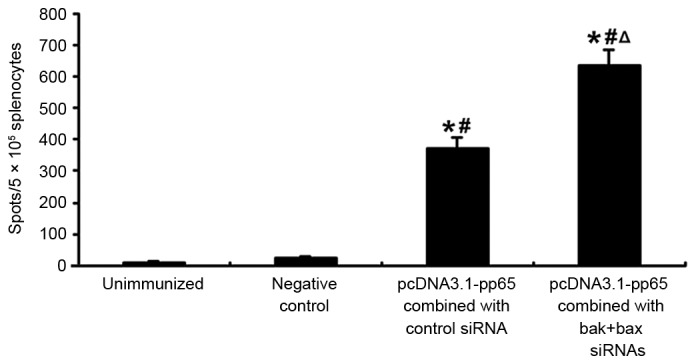
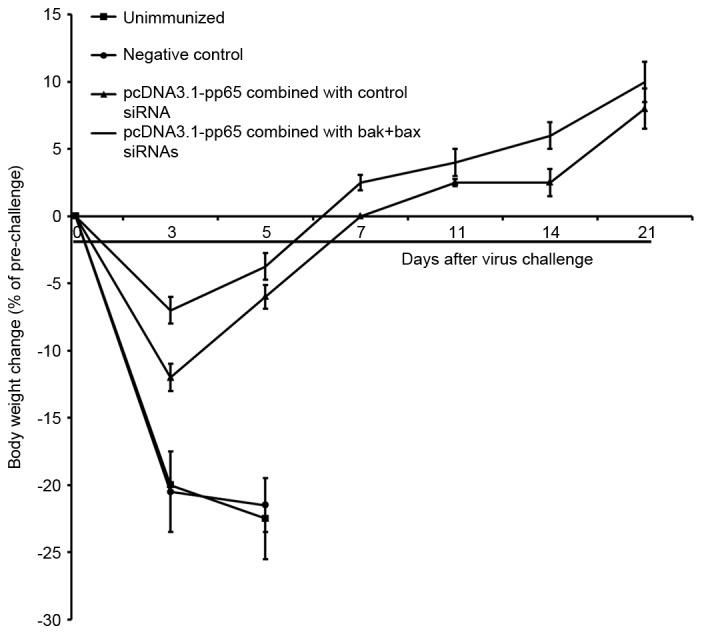
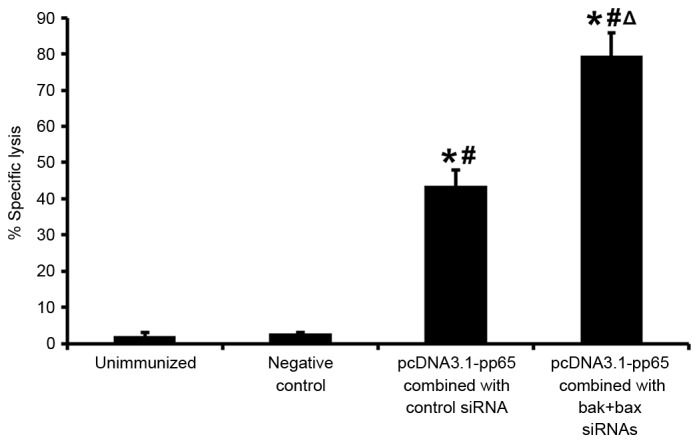
The efficacy of DNA vaccines may be improved by small interfering (si)RNA adjuvants targeting pro-apoptotic genes. The aim of the present study was to investigate the capacity of siRNAs targeting B-cell lymphoma 2 homologous antagonist killer (BAK) and B-cell lymphoma 2-associated X protein (BAX) to improve the efficacy of a cytomegalovirus (CMV) vaccine. BALB/c mice were divided into four groups (n=18 in each): unimmunized and immunized with pcDNA 3.1-pp65 expressing CMV 65 kDa matrix phosphoprotein and BAK + BAX siRNAs, pcDNA 3.1-pp65 and control siRNA, or control pcDNA 3.1 and BAK + BAX siRNAs. Immunizations were performed twice with an interval of 3 weeks. CMV-specific mouse splenocyte interferon (IFN)-γ secretion was assessed by ELISPOT; furthermore, an cytotoxic T lymphocyte assay was performed 2 weeks after the last immunization. After lethal CMV challenge of the mice, body weight, virus titers in the spleens and salivary glands as well as survival were recorded. The amount of splenocytes secreting IFN-γ in response to CMV pp65 peptides and specific lysis of peptide-pulsed target cells were significantly higher in mice administered pcDNA3.1-pp65 and BAK + BAX siRNAs than those in mice administered pcDNA3.1-pp65 and control siRNA (P<0.05 for each). After the virus challenge, the virus titers in the spleens and salivary glands of mice given pcDNA3.1-pp65 and BAK + BAX siRNAs were significantly lower than those in mice immunized with pcDNA3.1-pp65 and control siRNA (P<0.05 for each). Furthermore, mice immunized with pcDNA 3.1-pp65 and control siRNA or BAK + BAX siRNAs survived for longer, and at 21 days after lethal CMV challenge, 66 and 100% of these mice survived, respectively. These mice also experienced less weight loss compared with mice immunized with pcDNA3.1-pp65 and control siRNA (P<0.05). In conclusion, intradermal administration of siRNAs targeting BAK and BAX improved the efficacy of CMV pp65 DNA vaccine.
靶向促凋亡基因的小干扰(si)RNA佐剂可能会提高DNA疫苗的效力。本研究的目的是调查靶向B细胞淋巴瘤2同源拮抗剂杀手(BAK)和B细胞淋巴瘤2相关X蛋白(BAX)的siRNA提高巨细胞病毒(CMV)疫苗效力的能力。将BALB/c小鼠分为四组(每组n = 18):未免疫组、用表达CMV 65 kDa基质磷蛋白和BAK + BAX siRNA的pcDNA 3.1-pp65免疫组、用pcDNA 3.1-pp65和对照siRNA免疫组或用对照pcDNA 3.1和BAK + BAX siRNA免疫组。每隔3周进行两次免疫。通过酶联免疫斑点法评估CMV特异性小鼠脾细胞干扰素(IFN)-γ分泌;此外,在最后一次免疫后2周进行细胞毒性T淋巴细胞检测。对小鼠进行致死性CMV攻击后,记录体重、脾脏和唾液腺中的病毒滴度以及存活率。与给予pcDNA3.1-pp65和对照siRNA的小鼠相比,给予pcDNA3.1-pp65和BAK + BAX siRNA的小鼠中,响应CMV pp65肽分泌IFN-γ的脾细胞数量以及肽脉冲靶细胞的特异性裂解率显著更高(每项P<0.05)。病毒攻击后,给予pcDNA3.1-pp65和BAK + BAX siRNA的小鼠脾脏和唾液腺中的病毒滴度显著低于用pcDNA3.1-pp65和对照siRNA免疫的小鼠(每项P<0.05)。此外,用pcDNA 3.1-pp65和对照siRNA或BAK + BAX siRNA免疫的小鼠存活时间更长,在致死性CMV攻击后21天,这些小鼠的存活率分别为66%和100%。与用pcDNA3.1-pp65和对照siRNA免疫的小鼠相比,这些小鼠体重减轻也更少(P<0.05)。总之,皮内注射靶向BAK和BAX的siRNA提高了CMV pp65 DNA疫苗的效力。