Mahmood Rafia, Altaf Chaudry, Ahmed Parvez, Khan Saleem Ahmed, Malik Hamid Saeed
Armed Forces Institute of Pathology, Department of Hematology, Rawalpindi, Pakistan.
Turk J Haematol. 2018 May 25;35(2):109-115. doi: 10.4274/tjh.2017.0130. Epub 2017 Jun 7.
Myelodysplastic syndrome (MDS) is a group of bone marrow diseases that not only have variable morphological presentation and heterogeneous clinical courses but also have a wide range of cytogenetic abnormalities. Clinicohematological parameters have a significant role in diagnosis and along with identification of cytogenetic abnormalities are important for prognostic scoring and risk stratification of patients to plan management and make treatment decisions. This study aimed to determine the clinicohematological characteristics, cytogenetic abnormalities, and risk stratification of newly diagnosed de novo MDS patients.
This cross-sectional study was conducted in the Department of Hematology, Armed Forces Institute of Pathology, Rawalpindi, from January 2013 to January 2017. Patients were diagnosed on the basis of World Health Organization criteria for MDS, clinicohematological parameters were noted, and cytogenetic analysis was performed. Risk stratification was done using the Revised International Prognostic Scoring System.
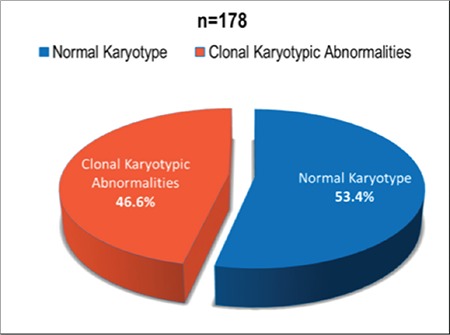
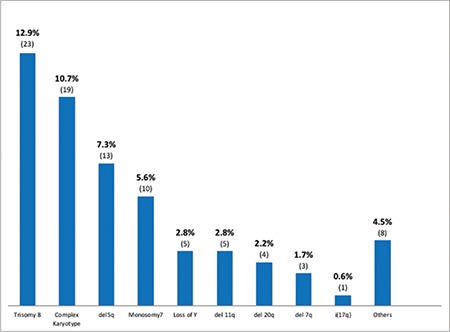
A total of 178 cases of MDS were analyzed, including 119 males (66.9%) and 59 females (33.1%). The median age was 58 years. The most common presenting feature was anemia in 162 (91%) of the patients. MDS with multilineage dysplasia was the most common diagnosis, seen in 103 (57.9%) patients. A normal karyotype was seen in 95 (53.4%), while 83 (46.6%) showed clonal karyotypic abnormalities at diagnosis. Of these, the common abnormalities found were trisomy 8, complex karyotype, and del 5q. Risk stratification revealed low-risk disease in 73 (41%) patients.
Cytogenetic analysis showed the normal karyotype to be the most common while risk stratification revealed a predominance of low-risk disease at the time of presentation.
骨髓增生异常综合征(MDS)是一组骨髓疾病,不仅具有形态学表现多样和临床病程异质性的特点,还存在广泛的细胞遗传学异常。临床血液学参数在诊断中具有重要作用,并且与细胞遗传学异常的识别一起,对于患者的预后评分和风险分层以规划管理和做出治疗决策至关重要。本研究旨在确定新诊断的初发MDS患者的临床血液学特征、细胞遗传学异常和风险分层。
本横断面研究于2013年1月至2017年1月在拉瓦尔品第武装部队病理研究所血液科进行。患者根据世界卫生组织的MDS标准进行诊断,记录临床血液学参数,并进行细胞遗传学分析。使用修订的国际预后评分系统进行风险分层。
共分析了178例MDS病例,其中男性119例(66.9%),女性59例(33.1%)。中位年龄为58岁。最常见的表现特征是162例(91%)患者出现贫血。多系发育异常的MDS是最常见的诊断,见于103例(57.9%)患者。95例(53.4%)患者核型正常,而83例(46.6%)患者在诊断时显示克隆性核型异常。其中,常见的异常为8号染色体三体、复杂核型和5q缺失。风险分层显示73例(41%)患者为低危疾病。
细胞遗传学分析显示核型正常最为常见,而风险分层显示就诊时低危疾病占主导。