Atalay Hasan Anıl, Canat Lutfi, Alkan İlter, Çakir Suleyman Sami, Altunrende Fatih
Department of Urology, Okmeydanı Training and Research Hospital, Sisli, Istanbul, Turkey.
Prostate Int. 2017 Jun;5(2):59-64. doi: 10.1016/j.prnil.2017.03.003. Epub 2017 Mar 22.
To evaluate men, with lower urinary tract symptoms and newly elevated serum prostate specific antigen (PSA) to determine whether a three-week course of ciprofloxacin antibiotics lowers serum PSA levels and affects recommendations for prostate biopsy.
A prospective, controlled, single-center prospective trial of 177 men with a newly elevated PSA and lower urinary tract symptoms was conducted. Patients were randomized to three weeks of ciprofloxacin or observation. After three weeks, patients PSA levels and derivatives were repeated. At the end of 3 weeks, all patients underwent TRUS guided systematic 12-core prostate biopsies regardless of the final PSA value.
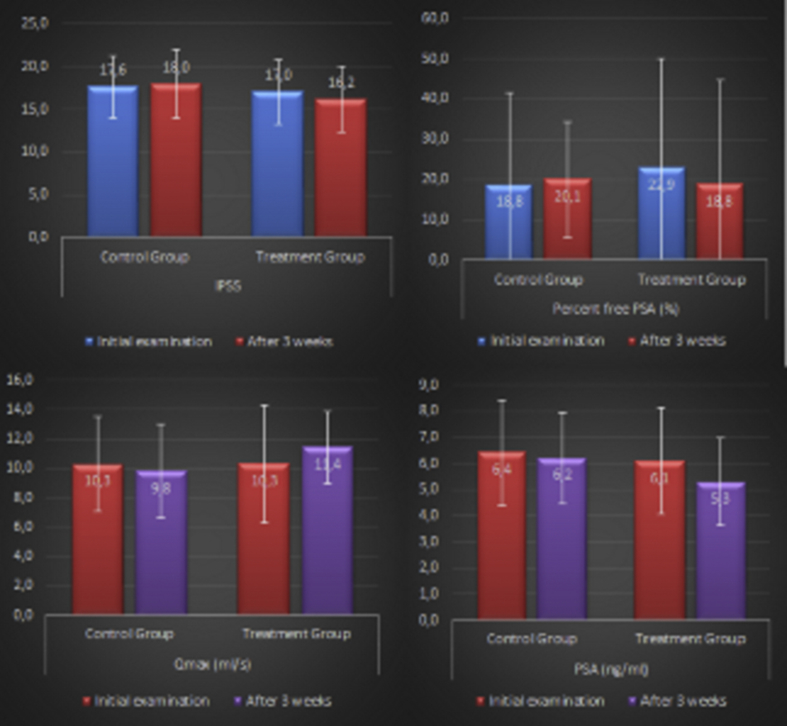
Of 177 men who completed the study, 88 were in the treatment and 89 in the observation group. 46.5% of treatment and %18 of control groups patients PSA levels had decreased after 3 weeks and a significant PSA reduction was observed in the treatment group compare to control group (p: 0.035) but no significant prostate cancer detection rates were observed between the groups (p: 0.418). Also, in the treatment group prostate cancer detection rate was significantly higher in patients whom PSA levels were decreased (p: 0.011).
This study has shown that, use empirical antibiotic treatment decreased the PSA levels but did not have any effect on prostate cancer detection. In addition, prostate cancer detection rates were found to be higher in patients with reduced PSA levels after treatment. Therefore, it may not be safe to rule out biopsies in patients who achieve a satisfactory PSA response to antibiotics.
评估患有下尿路症状且血清前列腺特异性抗原(PSA)新升高的男性,以确定为期三周的环丙沙星抗生素疗程是否会降低血清PSA水平并影响前列腺活检的建议。
对177名PSA新升高且有下尿路症状的男性进行了一项前瞻性、对照、单中心前瞻性试验。患者被随机分为接受三周环丙沙星治疗组或观察组。三周后,重复检测患者的PSA水平及其衍生物。在3周结束时,无论最终PSA值如何,所有患者均接受经直肠超声引导下的系统12针前列腺活检。
在完成研究的177名男性中,88名在治疗组,89名在观察组。治疗组46.5%的患者和对照组18%的患者在3周后PSA水平下降,与对照组相比,治疗组观察到PSA显著降低(p:0.035),但两组之间未观察到显著的前列腺癌检出率差异(p:0.418)。此外,在治疗组中,PSA水平下降的患者前列腺癌检出率显著更高(p:0.011)。
本研究表明,使用经验性抗生素治疗可降低PSA水平,但对前列腺癌检测没有任何影响。此外,发现治疗后PSA水平降低的患者前列腺癌检出率更高。因此,对于对抗生素治疗有满意PSA反应的患者排除活检可能不安全。