Parás-Bravo Paula, Paz-Zulueta María, Alonso-Blanco María Cristina, Salvadores-Fuentes Paloma, Alconero-Camarero Ana Rosa, Santibañez Miguel
Department of Nursing, University of Cantabria, Santander, Spain.
Department of Nursing, University "Rey Juan Carlos", Madrid, Spain.
PLoS One. 2017 Jun 8;12(6):e0178742. doi: 10.1371/journal.pone.0178742. eCollection 2017.
Pain is a common symptom in cancer patients, and its control and management are complex. Despite the high concomitant use of psychotropic drugs among such patients, the association among pain, inadequate pain control, and psychotropic drug use has not been fully determined. This study examined the prevalence of cancer pain and inadequate pain control and the association with psychotropic drug use.
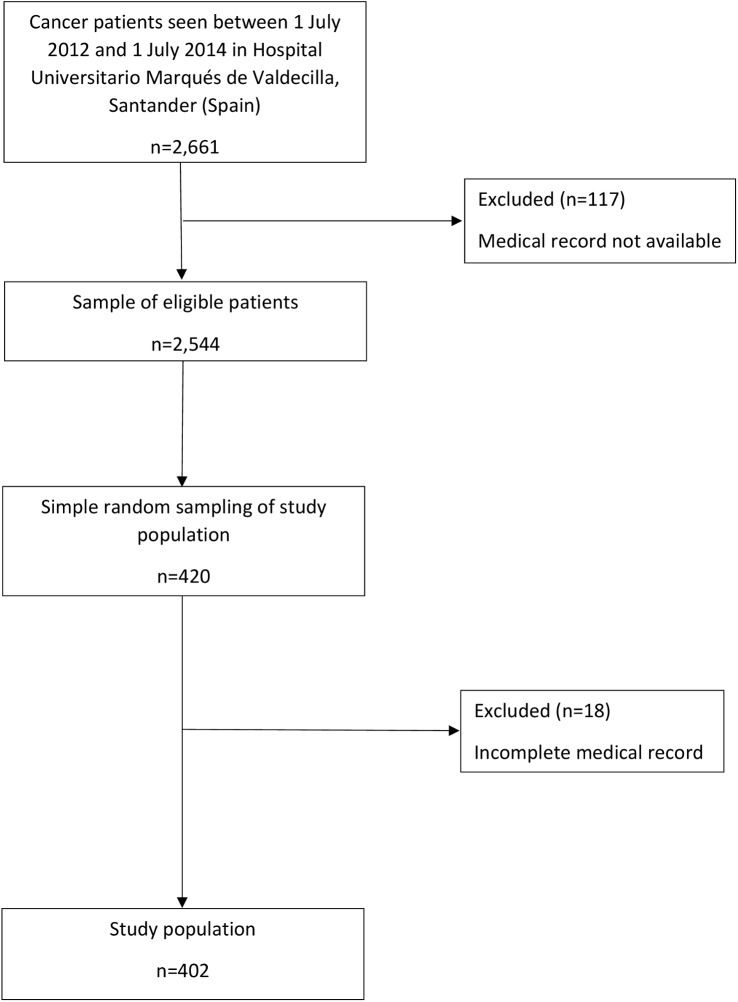
In this cross-sectional study, we investigated 402 medical records obtained by simple random sampling of oncology patients at a hospital in northern Spain from July 2012 to July 2014. Adjusted odds ratios (ORs) were estimated together with their 95% confidence intervals (95% CIs) by unconditional logistic regression for each type of psychotropic drug (anxiolytics, hypnotics, and antidepressants).
The mean patient age was 61.17 (standard deviation ± 13.14) years; 57.5% were women, 42.5% men. Pain was present in 18.4% of patients and inadequate pain control in 54.2%. We found a statistically significant association between the presence of cancer pain and anxiolytic use (adjusted OR, 3.15; 95% CI, 1.49-6.68) and hypnotic use (adjusted OR, 5.19; 95% CI, 1.77-15.25). Inadequate pain control was associated to a greater extent with the use of those drugs: adjusted OR for anxiolytic use, 4.74 (95% CI, 1.91-11.80); adjusted OR for hypnotic use, 6.09 (95% CI, 1.74-21.32). By contrast, no association was found between pain and antidepressant use (adjusted OR, 0.99).
The presence of pain and (to a greater extent) poor pain control were associated with increased use of certain psychotropic drugs, such as anxiolytics and hypnotics. There appeared to be no association between pain and antidepressant use.
疼痛是癌症患者的常见症状,其控制和管理较为复杂。尽管此类患者中精神药物的联合使用率较高,但疼痛、疼痛控制不足与精神药物使用之间的关联尚未完全明确。本研究调查了癌症疼痛和疼痛控制不足的患病率及其与精神药物使用的关联。
在这项横断面研究中,我们调查了2012年7月至2014年7月在西班牙北部一家医院通过简单随机抽样获取的402份肿瘤患者病历。通过无条件逻辑回归对每种精神药物(抗焦虑药、催眠药和抗抑郁药)估计调整后的比值比(OR)及其95%置信区间(95%CI)。
患者平均年龄为61.17(标准差±13.14)岁;57.5%为女性,42.5%为男性。18.4%的患者存在疼痛,54.2%的患者疼痛控制不足。我们发现癌症疼痛的存在与抗焦虑药使用之间存在统计学显著关联(调整后的OR,3.15;95%CI,1.49 - 6.68)以及与催眠药使用之间存在关联(调整后的OR,5.19;95%CI,1.77 - 15.25)。疼痛控制不足与这些药物的使用关联程度更大:抗焦虑药使用的调整后OR为4.74(95%CI,1.91 - 11.80);催眠药使用的调整后OR为6.09(95%CI,1.74 - 21.32)。相比之下,未发现疼痛与抗抑郁药使用之间存在关联(调整后的OR,0.99)。
疼痛的存在以及(在更大程度上)疼痛控制不佳与某些精神药物(如抗焦虑药和催眠药)的使用增加有关。疼痛与抗抑郁药使用之间似乎没有关联。