Kambala Christabel, Lohmann Julia, Mazalale Jacob, Brenner Stephan, Sarker Malabika, Muula Adamson S, De Allegri Manuela
Institute of Public Health, Faculty of Medicine, Heidelberg University, Im Neuenheimer Feld 324, D-69120, Heidelberg, Germany.
School of Public Health and Family Medicine, College of Medicine, University of Malawi, Private Bag 360, Chichiri, Blantyre 3, Malawi.
BMC Health Serv Res. 2017 Jun 8;17(1):392. doi: 10.1186/s12913-017-2329-6.
In 2013, Malawi with its development partners introduced a Results-Based Financing for Maternal and Newborn Health (RBF4MNH) intervention to improve the quality of maternal and newborn health-care services. Financial incentives are awarded to health facilities conditional on their performance and to women for delivering in the health facility. We assessed the effect of the RBF4MNH on quality of care from women's perspectives.
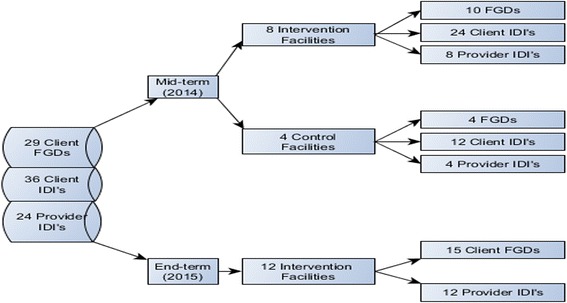
We used a mixed-method prospective sequential controlled pre- and post-test design. We conducted 3060 structured client exit interviews, 36 in-depth interviews and 29 focus group discussions (FGDs) with women and 24 in-depth interviews with health service providers between 2013 and 2015. We used difference-in-differences regression models to measure the effect of the RBF4MNH on experiences and perceived quality of care. We used qualitative data to explore the matter more in depth.
We did not observe a statistically significant effect of the intervention on women's perceptions of technical care, quality of amenities and interpersonal relations. However, in the qualitative interviews, most women reported improved health service provision as a result of the intervention. RBF4MNH increased the proportion of women reporting to have received medications/treatment during childbirth. Participants in interviews expressed that drugs, equipment and supplies were readily available due to the RBF4MNH. However, women also reported instances of neglect, disrespect and verbal abuse during the process of care. Providers attributed these negative instances to an increased workload resulting from an increased number of women seeking services at RBF4MNH facilities.
Our qualitative findings suggest improvements in the availability of drugs and supplies due to RBF4MNH. Despite the intervention, challenges in the provision of quality care persisted, especially with regard to interpersonal relations. RBF interventions may need to consider including indicators that specifically target the provision of respectful maternity care as a means to foster providers' positive attitudes towards women in labour. In parallel, governments should consider enhancing staff and infrastructural capacity before implementing RBF.
2013年,马拉维和其发展伙伴推出了孕产妇和新生儿健康基于结果的融资(RBF4MNH)干预措施,以提高孕产妇和新生儿保健服务的质量。根据医疗机构的表现向其提供经济激励,并向在医疗机构分娩的妇女提供激励。我们从妇女的角度评估了RBF4MNH对护理质量的影响。
我们采用了混合方法的前瞻性序贯对照前后测试设计。在2013年至2015年期间,我们对3060名妇女进行了结构化的客户出院访谈、36次深入访谈和29次焦点小组讨论(FGD),并对卫生服务提供者进行了24次深入访谈。我们使用差异回归模型来衡量RBF4MNH对护理体验和感知质量的影响。我们使用定性数据更深入地探讨这个问题。
我们没有观察到该干预措施对妇女对技术护理、设施质量和人际关系的看法有统计学上的显著影响。然而,在定性访谈中,大多数妇女报告说由于该干预措施,卫生服务提供有所改善。RBF4MNH增加了报告在分娩期间接受药物/治疗的妇女比例。访谈参与者表示,由于RBF4MNH,药品、设备和用品随时可用。然而,妇女们也报告了在护理过程中被忽视、不尊重和言语虐待的情况。提供者将这些负面情况归因于在RBF4MNH设施寻求服务的妇女人数增加导致工作量增加。
我们的定性研究结果表明,由于RBF4MNH,药品和用品的供应有所改善。尽管进行了干预,但提供优质护理方面的挑战仍然存在,特别是在人际关系方面。RBF干预措施可能需要考虑纳入专门针对提供尊重产妇护理的指标,作为培养提供者对分娩妇女积极态度的一种手段。同时,政府在实施RBF之前应考虑加强人员和基础设施能力。