Terry Mary Beth, Keegan Theresa H M, Houghton Lauren C, Goldberg Mandy, Andrulis Irene L, Daly Mary B, Buys Saundra S, Wei Ying, Whittemore Alice S, Protacio Angeline, Bradbury Angela R, Chung Wendy K, Knight Julia A, John Esther M
Department of Epidemiology, Columbia University Mailman School of Public Health, 722 West 168th Street, New York, NY, 10032, USA.
Herbert Irving Comprehensive Cancer Center, Columbia University Medical Center, New York, NY, USA.
Breast Cancer Res. 2017 Jun 8;19(1):69. doi: 10.1186/s13058-017-0849-y.
Pubertal milestones, such as onset of breast development and menstruation, play an important role in breast cancer etiology. It is unclear if these milestones are different in girls with a first- or second-degree breast cancer family history (BCFH).
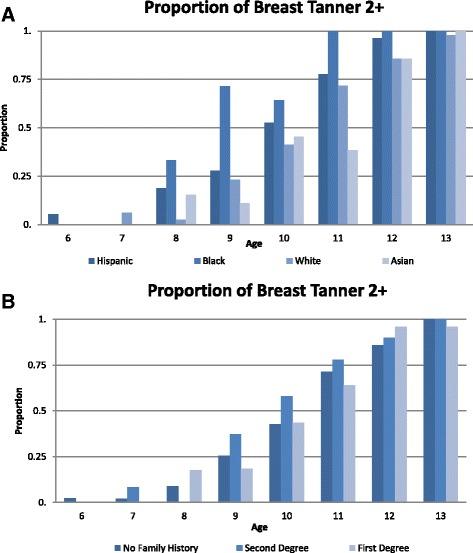
In the LEGACY Girls Study (n = 1040), we examined whether three mother/guardian-reported pubertal milestones (having reached Tanner Stage 2 or higher (T2+) for breast and pubic hair development, and having started menstruation) differed by BCFH. We also examined whether associations between body size and race/ethnicity and pubertal milestones were modified by BCFH. We used mother/guardian reports as the primary measure of pubertal milestones, but also conducted sensitivity analyses using clinical Tanner measurements available for a subcohort (n = 204). We analyzed cross-sectional baseline data with logistic regression models for the entire cohort, and longitudinal data with Weibull survival models for the subcohort of girls that were aged 5-7 years at baseline (n = 258).
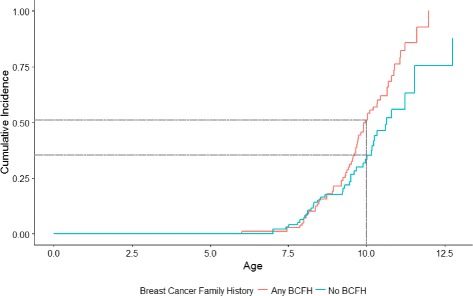
BCFH was modestly, but not statistically significantly, associated with Breast T2+ (odds ratio (OR) = 1.36, 95% confidence interval (CI) = 0.88-2.10), with a stronger association seen in the subcohort of girls with clinical breast Tanner staging (OR = 2.20, 95% CI = 0.91-5.32). In a longitudinal analysis of girls who were aged 5-7 years at baseline, BCFH was associated with a 50% increased rate of having early breast development (hazard ratio (HR) = 1.49, 95% CI = 1.0-2.21). This association increased to twofold in girls who were not overweight at baseline (HR = 2.04, 95% CI = 1.29-3.21). BCFH was not associated with pubic hair development and post-menarche status. The median interval between onset of breast development and menarche was longer for BCFH+ than BCFH- girls (2.3 versus 1.7 years), suggesting a slower developmental tempo for BCFH+ girls. Associations between pubertal milestones and body size and race/ethnicity were similar in girls with or without a BCFH. For example, weight was positively associated with Breast T2+ in both girls with (OR = 1.06 per 1 kg, 95% CI = 1.03-1.10) and without (OR = 1.14 per 1 kg, 95% CI = 1.04-1.24) a BCFH.
These results suggest that BCFH may be related to earlier breast development and slower pubertal tempo independent of body size and race/ethnicity.
青春期发育标志,如乳房发育和月经初潮,在乳腺癌病因学中起着重要作用。目前尚不清楚这些发育标志在有一级或二级乳腺癌家族史(BCFH)的女孩中是否有所不同。
在“传承女孩研究”(n = 1040)中,我们研究了母亲/监护人报告的三个青春期发育标志(乳房和阴毛发育达到坦纳2期或更高阶段(T2+)以及月经初潮)在有无BCFH的女孩中是否存在差异。我们还研究了身体大小与种族/族裔和青春期发育标志之间的关联是否因BCFH而有所改变。我们将母亲/监护人的报告作为青春期发育标志的主要衡量指标,但也使用了亚组(n = 204)中可用的临床坦纳测量值进行敏感性分析。我们使用逻辑回归模型分析了整个队列的横断面基线数据,并使用威布尔生存模型分析了基线时年龄在5至7岁的女孩亚组(n = 258)的纵向数据。
BCFH与乳房T2+有适度关联,但无统计学意义(优势比(OR)= 1.36,95%置信区间(CI)= 0.88 - 2.10),在有临床乳房坦纳分期的女孩亚组中关联更强(OR = 2.20,95% CI = 0.91 - 5.32)。在对基线时年龄为5至7岁的女孩进行的纵向分析中,BCFH与乳房过早发育率增加50%相关(风险比(HR)= 1.49,95% CI = 1.0 - 2.21)。在基线时体重正常的女孩中,这种关联增加到两倍(HR = 2.04,95% CI = 1.29 - 3.21)。BCFH与阴毛发育和初潮后状态无关。BCFH阳性女孩乳房发育开始至月经初潮的中位间隔时间比BCFH阴性女孩更长(2.3年对1.7年),这表明BCFH阳性女孩的发育节奏较慢。在有或无BCFH的女孩中,青春期发育标志与身体大小和种族/族裔之间的关联相似。例如,体重在有BCFH的女孩(每增加1千克OR = 1.06,95% CI = 1.03 - 1.10)和无BCFH的女孩(每增加1千克OR = 1.14,95% CI = 1.04 - 1.24)中均与乳房T2+呈正相关。
这些结果表明,BCFH可能与乳房过早发育和较慢的青春期节奏有关,且独立于身体大小和种族/族裔。