Liu Yazhuo, Wang Ruoyu, Zhang Lichuan, Li Jianhua, Lou Keli, Shi Bingyin
Department of Metabolic Diseases and Nutritional Disorders, Affiliated Zhongshan Hospital of Dalian University, Dalian, Liaoning 116001, P.R. China.
Department of Oncology, Affiliated Zhongshan Hospital of Dalian University, Dalian, Liaoning 116001, P.R. China.
Oncol Lett. 2017 Jun;13(6):4685-4690. doi: 10.3892/ol.2017.6038. Epub 2017 Apr 13.
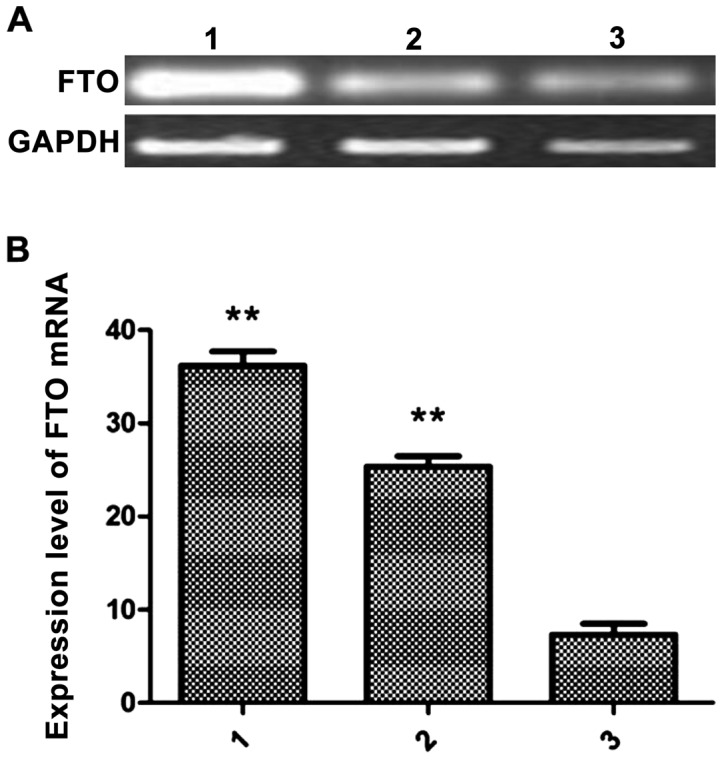
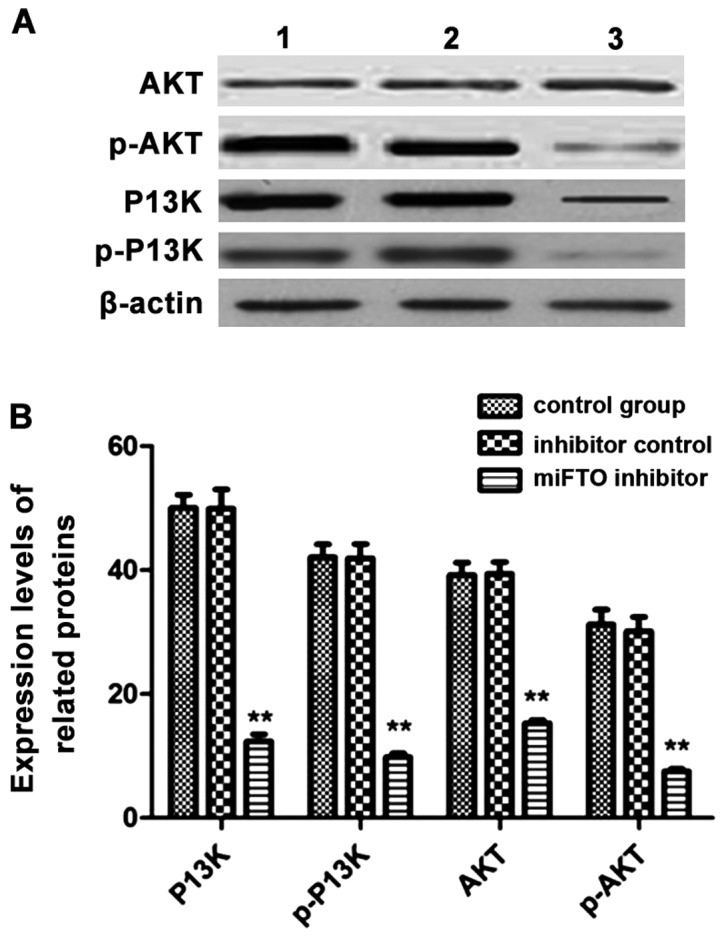
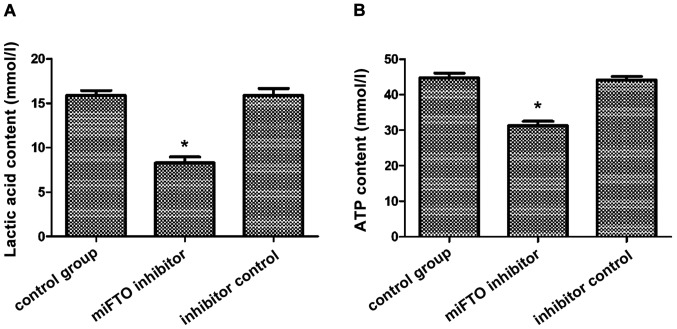
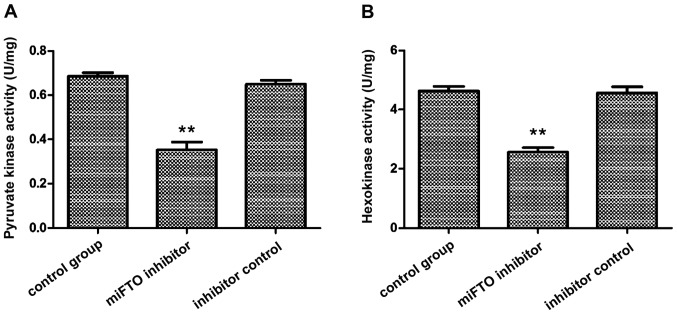
The present study assessed the effect of the lipid metabolism, fat mass and the obesity-associated gene (FTO), on energy metabolism of breast cancer cells. The human breast cancer cell lines, MCF-7 and MDA-MB-231, and HCC1937 human breast cells were studied. Real-time PCR was used to measure the levels of FTO mRNA from breast cancer cells and normal breast cells. MDA-MB-231 cells were transfected with miFTO inhibitor or inhibitor control, and cells were assessed for levels of lactic acid, ATP, pyruvate kinase activity, and hexokinase activity assay using specific kits. Western blot analysis was used to measure the levels of phosphatidylinositol 3-kinase (PI3K), p-PI3K, protein kinase B (Akt) and p-Akt in transfected breast cancer cells. The expression of FTO was significantly increased in MCF-7 and MDA-MB-231 cells compared with HCC1937 cells (P<0.01). The lactic acid content of breast cancer cells transfected with the miFTO inhibitor was significantly lower compared with cells transfected with the miFTO inhibitor control and nontransfected cells (P<0.05). The ATP content of breast cancer cells transfected with the miFTO inhibitor was significantly lower compared with the control group and inhibitor control group (P<0.05). The pyruvate kinase activity and hexokinase activity of breast cancer cells transfected with the miFTO inhibitor were significantly lower compared with the control group and inhibitor control group (P<0.01). Western blot analysis showed that after breast cancer cells were transfected with the miFTO inhibitor, the levels of PI3K, p-PI3K, Akt and p-Akt were significantly lower than in the control group and inhibitor control group. In conclusion, the FTO gene is overexpressed in breast cancer cells. Overexpression of the FTO gene can promote breast cancer cell glycolysis and the mechanism is related to the PI3K/AKT signaling pathway.
本研究评估了脂质代谢、脂肪量及肥胖相关基因(FTO)对乳腺癌细胞能量代谢的影响。对人乳腺癌细胞系MCF-7和MDA-MB-231以及HCC1937人乳腺细胞进行了研究。采用实时定量聚合酶链反应(Real-time PCR)检测乳腺癌细胞和正常乳腺细胞中FTO mRNA的水平。用miFTO抑制剂或抑制剂对照转染MDA-MB-231细胞,并用特定试剂盒评估细胞的乳酸、三磷酸腺苷(ATP)水平、丙酮酸激酶活性和己糖激酶活性。采用蛋白质免疫印迹法(Western blot分析)检测转染后的乳腺癌细胞中磷脂酰肌醇3激酶(PI3K)、磷酸化磷脂酰肌醇3激酶(p-PI3K)、蛋白激酶B(Akt)和磷酸化蛋白激酶B(p-Akt)的水平。与HCC1937细胞相比,MCF-7和MDA-MB-231细胞中FTO的表达显著增加(P<0.01)。与转染miFTO抑制剂对照的细胞和未转染的细胞相比,转染miFTO抑制剂的乳腺癌细胞的乳酸含量显著降低(P<0.05)。与对照组和抑制剂对照组相比,转染miFTO抑制剂的乳腺癌细胞的ATP含量显著降低(P<0.05)。与对照组和抑制剂对照组相比,转染miFTO抑制剂的乳腺癌细胞的丙酮酸激酶活性和己糖激酶活性显著降低(P<0.01)。蛋白质免疫印迹分析表明,乳腺癌细胞转染miFTO抑制剂后,PI3K、p-PI3K、Akt和p-Akt的水平显著低于对照组和抑制剂对照组。总之,FTO基因在乳腺癌细胞中过表达。FTO基因的过表达可促进乳腺癌细胞的糖酵解,其机制与PI3K/AKT信号通路有关。