Harrison Claire N, Schaap Nicolaas, Vannucchi Alessandro M, Kiladjian Jean-Jacques, Tiu Ramon V, Zachee Pierre, Jourdan Eric, Winton Elliott, Silver Richard T, Schouten Harry C, Passamonti Francesco, Zweegman Sonja, Talpaz Moshe, Lager Joanne, Shun Zhenming, Mesa Ruben A
Guy's and St Thomas' NHS Foundation Trust, London, UK.
Radboud University Nijmegen Medical Centre, Nijmegen, Netherlands.
Lancet Haematol. 2017 Jul;4(7):e317-e324. doi: 10.1016/S2352-3026(17)30088-1. Epub 2017 Jun 8.
Myelofibrosis is a chronic myeloproliferative neoplasm characterised by splenomegaly, cytopenias, bone marrow fibrosis, and debilitating symptoms including fatigue, weight loss, and bone pain. Mutations in Janus kinase-2 (JAK2) occur in approximately 50% of patients. The only approved JAK2 inhibitor for myelofibrosis is the dual JAK1 and JAK2 inhibitor, ruxolitinib. 58-71% of patients treated with ruxolitinib in clinical trials so far have not achieved the primary endpoint of 35% or more reduction in spleen volume from baseline assessed by MRI or CT. Furthermore, more than 50% of patients discontinue ruxolitinib treatment after 3-5 years. On the basis of this unmet need, we investigated the efficacy and safety of fedratinib, a JAK2-selective inhibitor, in patients with ruxolitinib-resistant or ruxolitinib-intolerant myelofibrosis.
This single-arm, open-label, non-randomised, phase 2, multicentre study, done at 31 sites in nine countries, enrolled adult patients with a current diagnosis of intermediate or high-risk primary myelofibrosis, post-polycythaemia vera myelofibrosis, or post-essential thrombocythaemia myelofibrosis, found to be ruxolitinib resistant or intolerant after at least 14 days of treatment. Other main inclusion criteria were palpable splenomegaly (≥5 cm below the left costal margin), Eastern Cooperative Oncology Group performance status of 2 or less, and life expectancy of 6 months or less. Patients received oral fedratinib at a starting dose of 400 mg once per day, for six consecutive 28-day cycles. The primary endpoint was spleen response (defined as the proportion of patients with a ≥35% reduction in spleen volume as determined by blinded CT and MRI at a central imaging laboratory). We did the primary analysis in the per-protocol population only (patients treated with fedratinib, for whom a baseline and at least one post-baseline spleen volume measurement was available) and the safety analysis in all patients receiving at least one dose of fedratinib. This trial was registered with ClinicalTrials.gov, number NCT01523171.
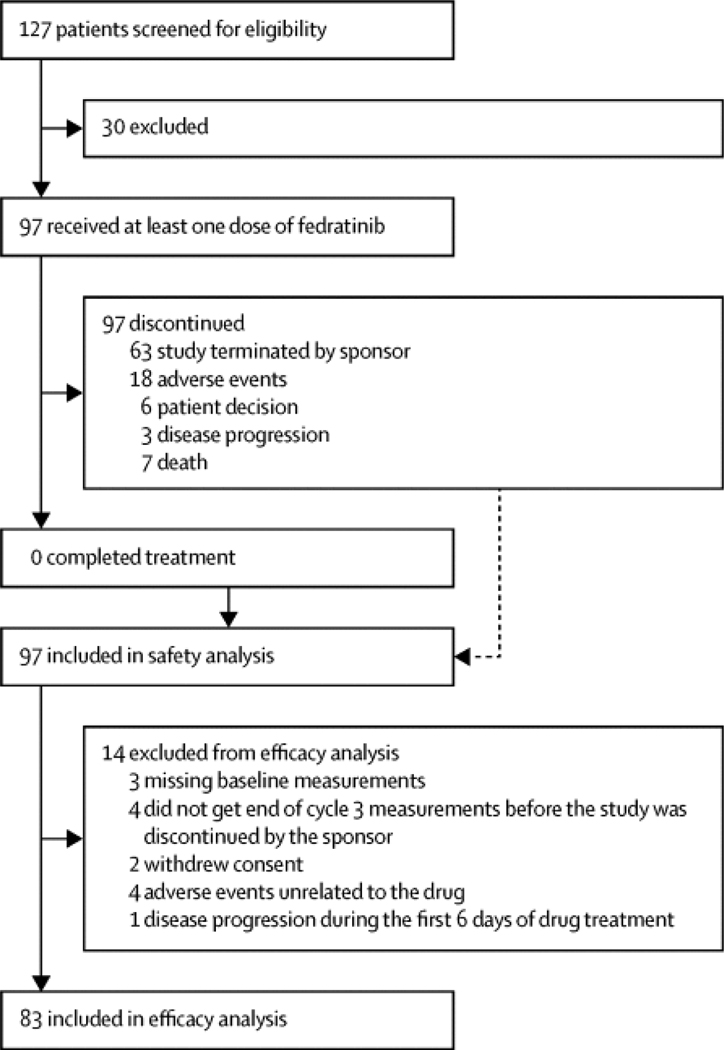
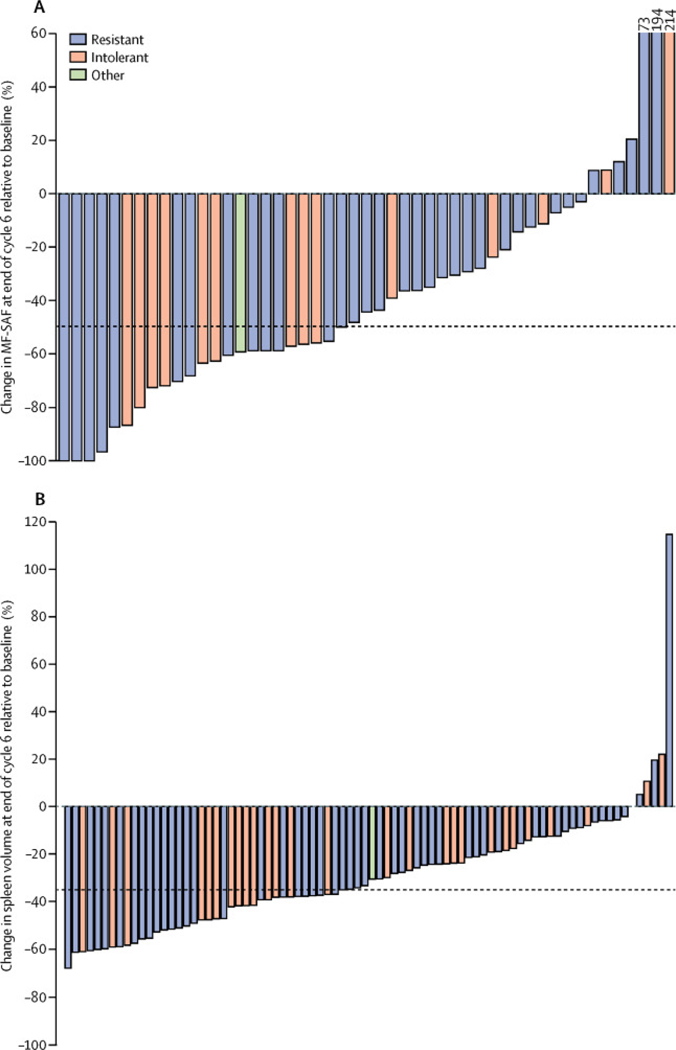
Between May 8, 2012, and Aug 29, 2013, 97 patients were enrolled and received at least one dose of fedratinib. Of 83 assessable patients, 46 (55%, 95% CI 44-66) achieved a spleen response. Common grade 3-4 adverse events included anaemia (37 [38%] of 97 patients) and thrombocytopenia (21 [22%] of 97), with 18 (19%) patients discontinuing due to adverse events. Seven (7%) patients died during the study, but none of the deaths was drug related. Suspected cases of Wernicke's encephalopathy in other fedratinib trials led to study termination.
This phase 2 study met its primary endpoint, suggesting that patients with ruxolitinib-resistant or ruxolitinib-intolerant myelofibrosis might achieve significant clinical benefit with fedratinib, albeit at the cost of some potential toxicity, which requires further evaluation. Fedratinib development in this setting is currently being assessed.
Sanofi.
骨髓纤维化是一种慢性骨髓增殖性肿瘤,其特征为脾肿大、血细胞减少、骨髓纤维化以及包括疲劳、体重减轻和骨痛等使人衰弱的症状。约50%的患者存在Janus激酶2(JAK2)突变。唯一获批用于治疗骨髓纤维化的JAK2抑制剂是JAK1和JAK2双重抑制剂鲁索替尼。在目前的临床试验中,接受鲁索替尼治疗的患者中有58 - 71%未达到脾脏体积较基线水平经MRI或CT评估缩小35%或更多这一主要终点。此外,超过50%的患者在3 - 5年后停止鲁索替尼治疗。基于这一未满足的需求,我们研究了JAK2选择性抑制剂非格司亭在鲁索替尼耐药或不耐受的骨髓纤维化患者中的疗效和安全性。
这项单臂、开放标签、非随机的2期多中心研究在9个国家的31个地点进行,纳入目前诊断为中级或高危原发性骨髓纤维化、真性红细胞增多症后骨髓纤维化或原发性血小板增多症后骨髓纤维化的成年患者,这些患者在至少14天的治疗后被发现对鲁索替尼耐药或不耐受。其他主要纳入标准包括可触及的脾肿大(左肋缘下≥5 cm)、东部肿瘤协作组体能状态评分为2或更低以及预期寿命为6个月或更短。患者接受口服非格司亭,起始剂量为400 mg,每日一次,连续进行六个28天周期。主要终点是脾脏反应(定义为在中央影像实验室通过盲法CT和MRI确定脾脏体积缩小≥35%的患者比例)。我们仅在符合方案人群(接受非格司亭治疗且有基线和至少一次基线后脾脏体积测量值的患者)中进行主要分析,并在所有接受至少一剂非格司亭的患者中进行安全性分析。该试验已在ClinicalTrials.gov注册,编号为NCT01523171。
在2012年5月8日至2013年8月29日期间,97名患者入组并接受了至少一剂非格司亭。在83名可评估患者中,46名(55%,95%CI 44 - 66)达到了脾脏反应。常见的3 - 4级不良事件包括贫血(97名患者中的37名[38%])和血小板减少(97名患者中的21名[22%]),18名(19%)患者因不良事件停药。7名(7%)患者在研究期间死亡,但无一例死亡与药物相关。其他非格司亭试验中疑似韦尼克脑病病例导致研究终止。
这项2期研究达到了其主要终点,表明鲁索替尼耐药或不耐受的骨髓纤维化患者使用非格司亭可能会获得显著的临床益处,尽管存在一些潜在毒性,这需要进一步评估。目前正在评估在这种情况下非格司亭的研发情况。
赛诺菲。