Mohammadin Setareh, Nguyen Thu-Phuong, van Weij Marco S, Reichelt Michael, Schranz Michael E
Biosystematics, Plant Sciences Group, Wageningen University and ResearchWageningen, Netherlands.
Department of Biochemistry, Max Planck Institute for Chemical EcologyJena, Germany.
Front Plant Sci. 2017 May 26;8:876. doi: 10.3389/fpls.2017.00876. eCollection 2017.
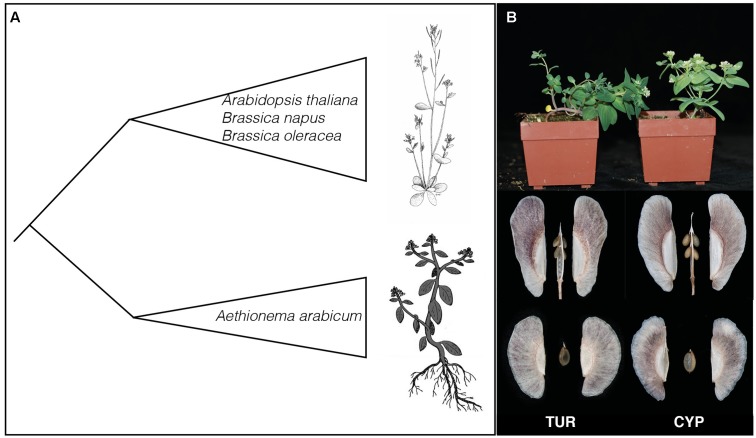
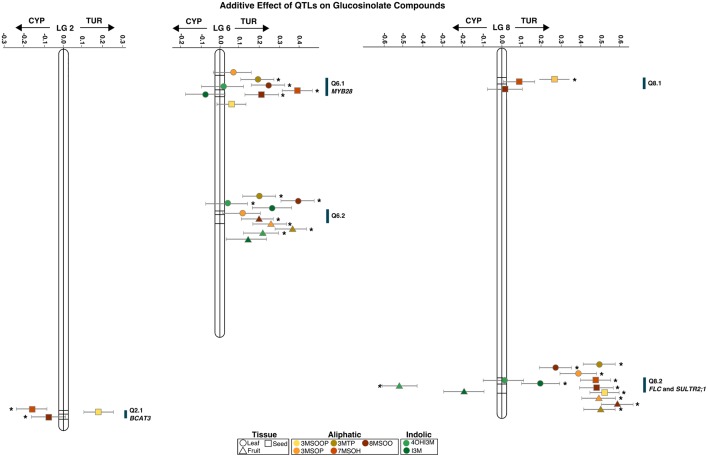
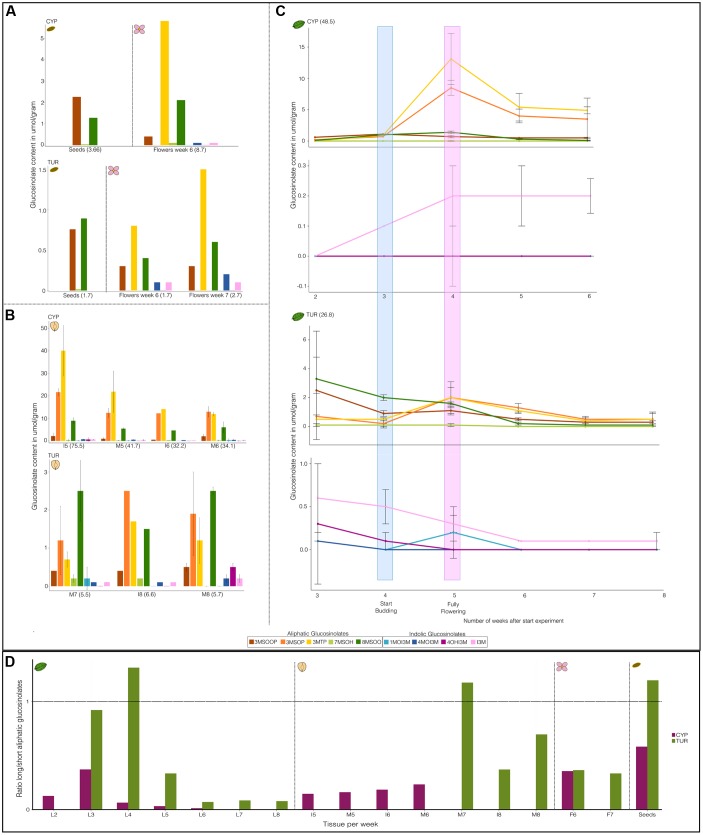
The biochemical defense of plants can change during their life-cycle and impact herbivore feeding and plant fitness. The annual species is part of the sister clade to all other Brassicaceae. Hence, it holds a phylogenetically important position for studying crucifer trait evolution. Glucosinolates (GS) are essentially Brassicales-specific metabolites involved in plant defense. Using two accessions (TUR and CYP) we identify substantial differences in glucosinolate profiles and quantities between lines, tissues and developmental stages. We find tissue specific side-chain modifications in aliphatic GS: methylthioalkyl in leaves, methylsulfinylalkyl in fruits, and methylsulfonylalkyl in seeds. We also find large differences in absolute glucosinolate content between the two accessions (up to 10-fold in fruits) that suggest a regulatory factor is involved that is not part of the quintessential glucosinolate biosynthetic pathway. Consistent with this hypothesis, we identified a single major multi-trait quantitative trait locus controlling total GS concentration across tissues in a recombinant inbred line population derived from TUR and CYP. With fine-mapping, we narrowed the interval to a 58 kb region containing 15 genes, but lacking any known GS biosynthetic genes. The interval contains homologs of both the sulfate transporter and . Both loci have diverse functions controlling plant physiological and developmental processes and thus are potential candidates regulating glucosinolate variation across the life-cycle of . Future work will investigate changes in gene expression of the candidates genes, the effects of GS variation on insect herbivores and the trade-offs between defense and reproduction.
植物的生化防御在其生命周期中会发生变化,并影响食草动物的取食和植物适应性。该一年生物种是所有其他十字花科植物姐妹进化枝的一部分。因此,它在研究十字花科植物性状进化方面具有重要的系统发育地位。芥子油苷(GS)是十字花目特有的参与植物防御的代谢产物。利用两个种质(TUR和CYP),我们鉴定出不同株系、组织和发育阶段之间芥子油苷谱和含量的显著差异。我们发现脂肪族芥子油苷存在组织特异性侧链修饰:叶片中为甲硫基烷基,果实中为甲亚磺酰基烷基,种子中为甲磺酰基烷基。我们还发现两个种质之间芥子油苷绝对含量存在很大差异(果实中高达10倍),这表明存在一个调控因子,它不是典型芥子油苷生物合成途径的一部分。与这一假设一致,我们在一个由TUR和CYP衍生的重组自交系群体中鉴定出一个控制各组织总GS浓度的单一主要多性状数量性状基因座。通过精细定位,我们将区间缩小到一个包含15个基因的58 kb区域,但缺乏任何已知芥子油苷生物合成基因。该区间包含硫酸盐转运蛋白和的同源物。这两个基因座具有控制植物生理和发育过程的多种功能,因此是调控芥子油苷在整个生命周期中变化的潜在候选基因。未来的工作将研究候选基因的基因表达变化、芥子油苷变异对昆虫食草动物的影响以及防御与繁殖之间的权衡。