Hwang In-Chang, Kim Yong-Jin, Park Jun-Bean, Yoon Yeonyee E, Lee Seung-Pyo, Kim Hyung-Kwan, Cho Goo-Yeong, Sohn Dae-Won
Cardiovascular Center and Department of Internal Medicine, Seoul National University Hospital and Seoul National University College of Medicine, 101 Daehak-ro, Jongno-gu, Seoul, Republic of Korea.
Division of Cardiology, Department of Internal Medicine, Seoul National University Bundang Hospital, Seongnam-si, Gyeonggi-do, Republic of Korea.
BMC Cardiovasc Disord. 2017 Jun 12;17(1):150. doi: 10.1186/s12872-017-0576-4.
Previous studies suggested that phosphodiesterase 5 inhibitors (PDE5i) have a beneficial effect in patients with heart failure (HF), although the results were inconsistent. We performed a meta-analysis to evaluate the effect of PDE5i in HF patients, and investigated the relationship between PDE5i effects and pulmonary hemodynamics.
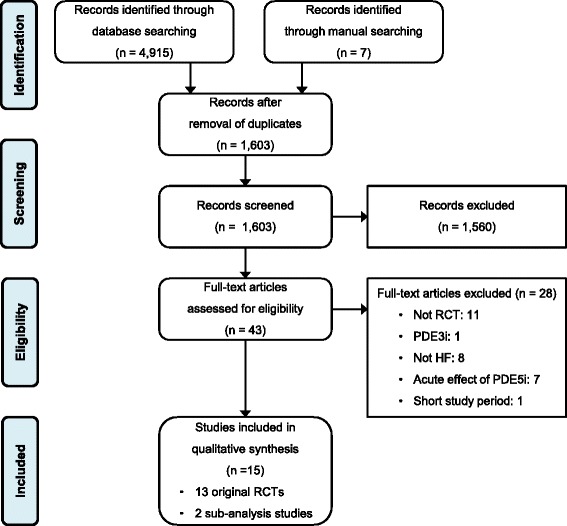
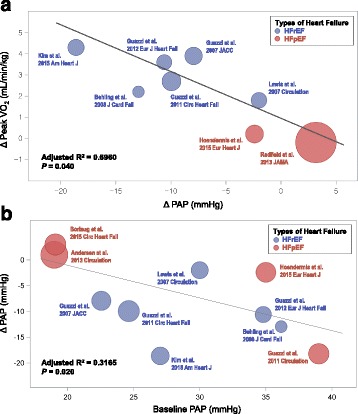
We searched PubMed, EMBASE and the Cochrane Library for randomized controlled trials (RCTs) that compared PDE5i with placebo in HF with reduced ejection fraction (HFrEF) or HF with preserved EF (HFpEF). PDE5i effects were interpolated according to baseline pulmonary arterial pressure (PAP) or according to changes in PAP after PDE5i treatment.
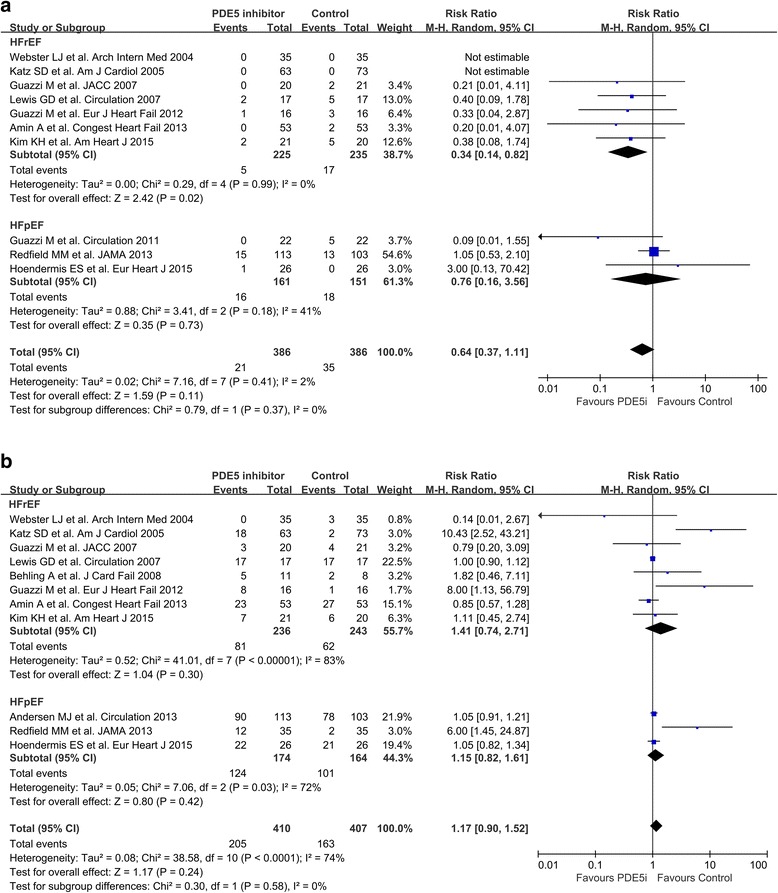
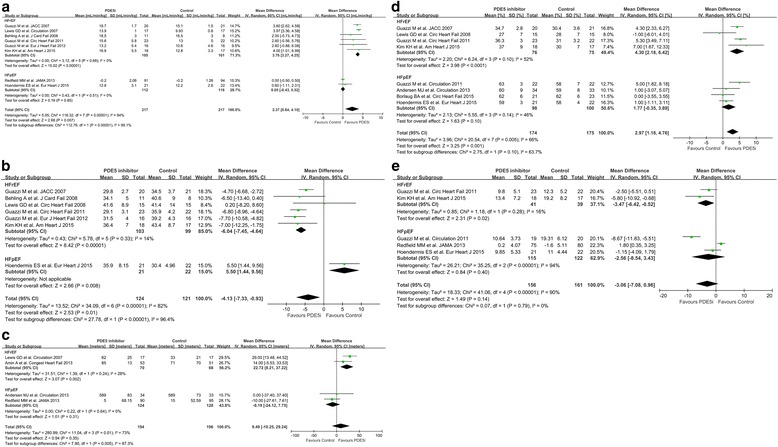
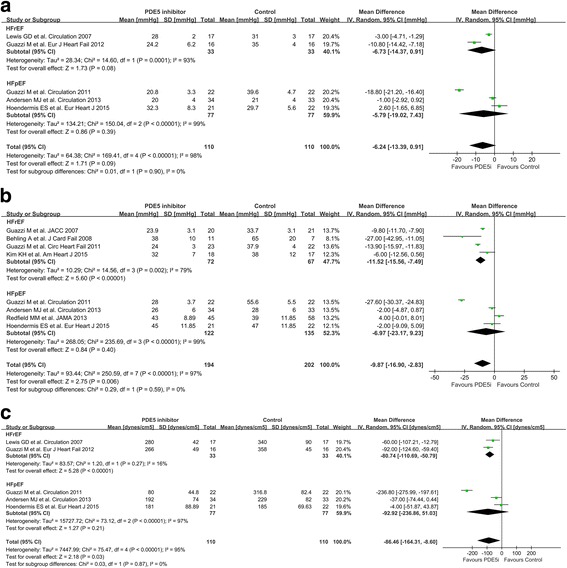
Thirteen RCTs enrolling 898 HF patients, and two sub-analysis studies with different study outcomes, were included in the meta-analysis. Among patients with HFrEF, PDE5i improved peak VO (mean difference [MD], 3.76 mL/min/kg; 95% confidence interval [CI], 3.27 to 4.25; P < 0.00001), VE/VCO slope (MD, -6.04; 95% CI, -7.45 to -4.64; P < 0.00001), LVEF (MD, 4.30%; 95% CI, 2.18 to 6.42; P < 0.0001), and pulmonary vascular resistance (MD, -80.74 dyn·sec/cm; 95% CI, -110.69 to -50.79; P < 0.00001). The effects of PDE5i in patients with HFpEF were heterogeneous. Meta-regression analyses indicated that the beneficial effect of PDE5i was related to the baseline PAP as well as the extent of PDE5i-mediated PAP decrease.
PDE5i improved pulmonary hemodynamics and exercise capacity in patients with HFrEF, but not in HFpEF. The relationship between the benefits by PDE5i with the baseline PAP and the changes in PAP indicates the therapeutic potential of PDE5i in HF according to pulmonary hemodynamics.
既往研究表明,磷酸二酯酶5抑制剂(PDE5i)对心力衰竭(HF)患者有有益作用,尽管结果并不一致。我们进行了一项荟萃分析,以评估PDE5i对HF患者的影响,并研究PDE5i疗效与肺血流动力学之间的关系。
我们检索了PubMed、EMBASE和Cochrane图书馆,查找比较PDE5i与安慰剂在射血分数降低的心力衰竭(HFrEF)或射血分数保留的心力衰竭(HFpEF)患者中的随机对照试验(RCT)。根据基线肺动脉压(PAP)或PDE5i治疗后PAP的变化来推断PDE5i的疗效。
荟萃分析纳入了13项纳入898例HF患者的RCT以及两项具有不同研究结果的亚分析研究。在HFrEF患者中,PDE5i改善了峰值VO(平均差[MD],3.76 mL/min/kg;95%置信区间[CI],3.27至4.25;P < 0.00001)、VE/VCO斜率(MD,-6.04;95% CI,-7.45至-4.64;P < 0.00001)、左心室射血分数(LVEF,MD,4.30%;95% CI,2.18至6.42;P < 0.0001)和肺血管阻力(MD,-80.74 dyn·sec/cm;95% CI,-110.69至-50.79;P < 0.00001)。PDE5i在HFpEF患者中的疗效存在异质性。荟萃回归分析表明,PDE5i的有益作用与基线PAP以及PDE5i介导的PAP降低程度有关。
PDE5i改善了HFrEF患者的肺血流动力学和运动能力,但对HFpEF患者无效。PDE5i的益处与基线PAP以及PAP变化之间的关系表明,根据肺血流动力学,PDE5i在HF治疗中具有治疗潜力。