Cull G, Hall D, Fabis-Pedrini M J, Carroll W M, Forster L, Robins F, Ghassemifar R, Crosbie C, Walters S, James I, Augustson B, Kermode A K
Department of Haematology, Sir Charles Gairdner Hospital, Queen Elizabeth II Medical Centre, Australia.
Centre for Neuromuscular and Neurological Disorders, Western Australian Neuroscience Research Institute, The University of Western Australia, Sir Charles Gairdner Hospital, Queen Elizabeth II Medical Centre, Australia.
Mult Scler J Exp Transl Clin. 2017 Mar 23;3(1):2055217317700167. doi: 10.1177/2055217317700167. eCollection 2017 Jan-Mar.
Autologous stem cell transplantation (ASCT) for progressive multiple sclerosis (MS) may reset the immune repertoire.
The objective of this paper is to analyse lymphocyte recovery in patients with progressive MS treated with ASCT.
Patients with progressive MS not responding to conventional treatment underwent ASCT following conditioning with high-dose cyclophosphamide and antithymocyte globulin. Lymphocyte subset analysis was performed before ASCT and for two years following ASCT. Neurological function was assessed by the EDSS before ASCT and for three years post-ASCT.
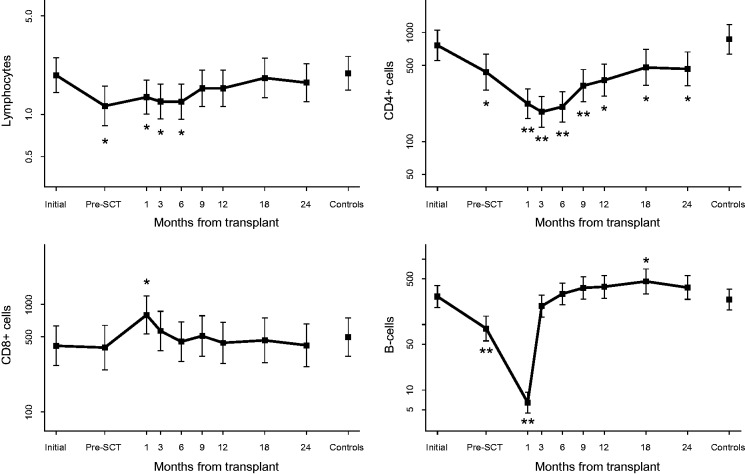
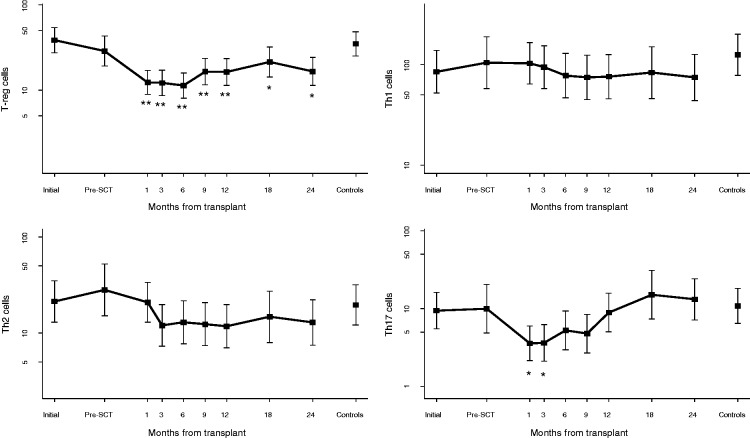
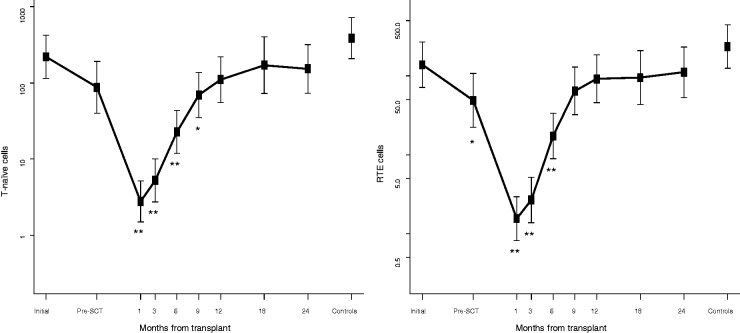
CD4+ T-cells fell significantly post-transplant and did not return to baseline levels. Recent thymic emigrants and naïve T-cells fell sharply post-transplant but returned to baseline by nine months and twelve months, respectively. T-regulatory cells declined post-transplant and did not return to baseline levels. Th1 and Th2 cells did not change significantly while Th17 cells fell post-transplant but recovered to baseline by six months. Neurological function remained stable in the majority of patients. Progression-free survival was 69% at three years.
This study demonstrates major changes in the composition of lymphocyte subsets following ASCT for progressive MS. In particular, ablation and subsequent recovery of thymic output is consistent with the concept that ASCT can reset the immune repertoire in MS patients.
自体干细胞移植(ASCT)用于治疗进展性多发性硬化症(MS)可能会重置免疫库。
本文旨在分析接受ASCT治疗的进展性MS患者的淋巴细胞恢复情况。
对常规治疗无反应的进展性MS患者在接受大剂量环磷酰胺和抗胸腺细胞球蛋白预处理后进行ASCT。在ASCT前及ASCT后两年进行淋巴细胞亚群分析。在ASCT前及ASCT后三年通过扩展残疾状态量表(EDSS)评估神经功能。
移植后CD4+T细胞显著下降且未恢复至基线水平。近期胸腺迁出细胞和初始T细胞在移植后急剧下降,但分别在9个月和12个月时恢复至基线水平。调节性T细胞在移植后下降且未恢复至基线水平。Th1和Th2细胞无显著变化,而Th17细胞在移植后下降,但在6个月时恢复至基线水平。大多数患者的神经功能保持稳定。三年无进展生存率为69%。
本研究表明进展性MS患者接受ASCT后淋巴细胞亚群组成发生了重大变化。特别是,胸腺输出的消除及随后的恢复与ASCT可重置MS患者免疫库的概念相符。