Murray Rosalind L, Herridge Elizabeth J, Ness Rob W, Bussière Luc F
Department of Biology, University of Toronto Mississauga, Mississauga, ON, Canada.
Ecology and Evolutionary Biology, University of Toronto, Toronto, ON, Canada.
PLoS One. 2017 Jun 13;12(6):e0178364. doi: 10.1371/journal.pone.0178364. eCollection 2017.
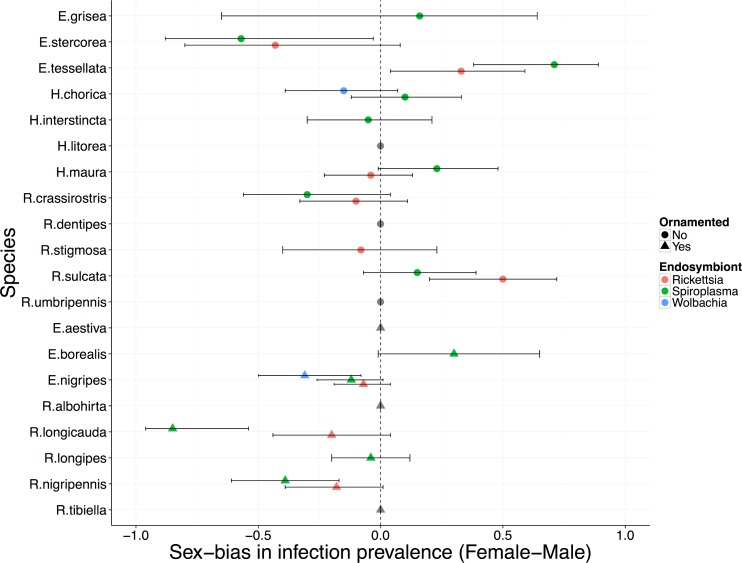
Maternally inherited bacterial endosymbionts are common in many arthropod species. Some endosymbionts cause female-biased sex ratio distortion in their hosts that can result in profound changes to a host's mating behaviour and reproductive biology. Dance flies (Diptera: Empidinae) are well known for their unusual reproductive biology, including species with female-specific ornamentation and female-biased lek-like swarming behaviour. The cause of the repeated evolution of female ornaments in these flies remains unknown, but is probably associated with female-biased sex ratios in individual species. In this study we assessed whether dance flies harbour sex ratio distorting endosymbionts that might have driven these mating system evolutionary changes. We measured the incidence and prevalence of infection by three endosymbionts that are known to cause female-biased sex ratios in other insect hosts (Wolbachia, Rickettsia and Spiroplasma) across 20 species of dance flies. We found evidence of widespread infection by all three symbionts and variation in sex-specific prevalence across the taxa sampled. However, there was no relationship between infection prevalence and adult sex ratio measures and no evidence that female ornaments are associated with high prevalences of sex-biased symbiont infections. We conclude that the current distribution of endosymbiont infections is unlikely to explain the diversity in mating systems among dance fly species.
母系遗传的细菌内共生体在许多节肢动物物种中很常见。一些内共生体会导致其宿主出现雌性偏向的性别比例扭曲,这可能会给宿主的交配行为和生殖生物学带来深刻变化。舞虻(双翅目:舞虻科)以其独特的生殖生物学而闻名,包括具有雌性特异性装饰和雌性偏向的求偶场样群聚行为的物种。这些苍蝇中雌性装饰反复进化的原因尚不清楚,但可能与个别物种中雌性偏向的性别比例有关。在这项研究中,我们评估了舞虻是否携带可能驱动这些交配系统进化变化的性别比例扭曲内共生体。我们测量了已知会在其他昆虫宿主中导致雌性偏向性别比例的三种内共生体(沃尔巴克氏体、立克次氏体和螺原体)在20种舞虻中的感染发生率和流行率。我们发现了所有三种共生体广泛感染的证据,以及所采样分类群中性别特异性流行率的差异。然而,感染流行率与成年性别比例指标之间没有关系,也没有证据表明雌性装饰与性别偏向共生体感染的高流行率有关。我们得出结论,内共生体感染的当前分布不太可能解释舞虻物种间交配系统的多样性。