Saffert Paul, Enenkel Cordula, Wendler Petra
Department of Biochemistry, Institute of Biochemistry and Biology, University of PotsdamPotsdam, Germany.
Department of Biochemistry, University of TorontoToronto, ON, Canada.
Front Mol Biosci. 2017 May 29;4:33. doi: 10.3389/fmolb.2017.00033. eCollection 2017.
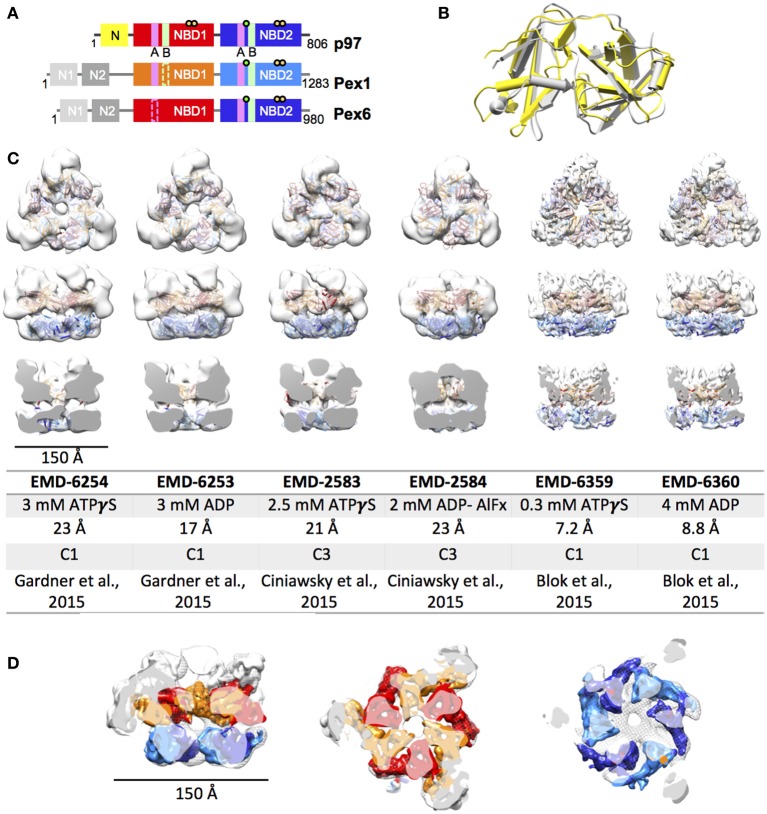
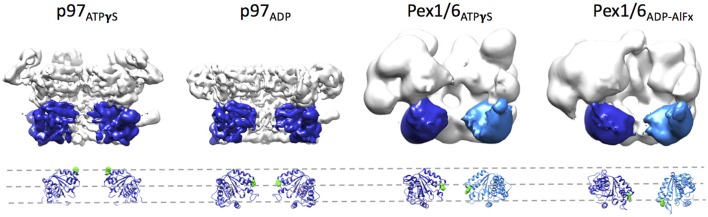
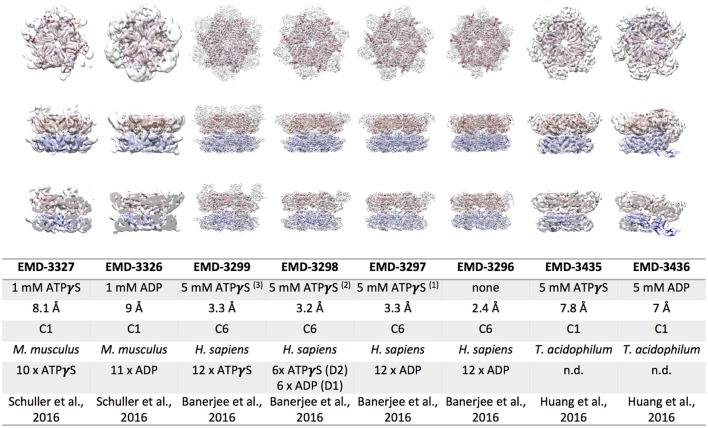
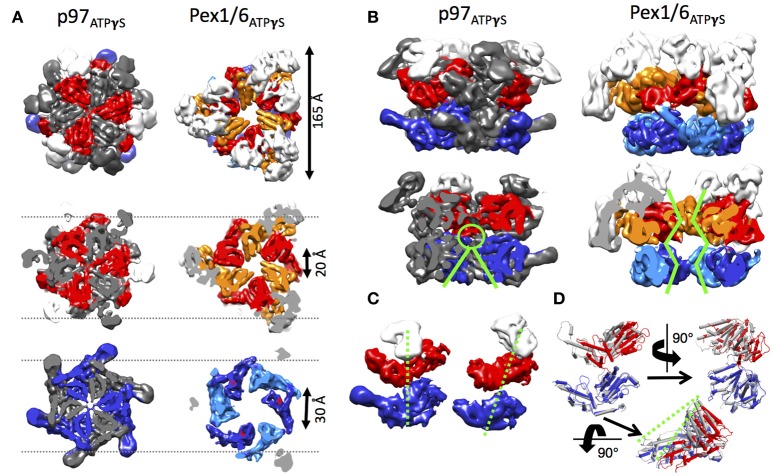
Protein complexes of the Type II AAA+ (ATPases associated with diverse cellular activities) family are typically hexamers of 80-150 kDa protomers that harbor two AAA+ ATPase domains. They form double ring assemblies flanked by associated domains, which can be N-terminal, intercalated or C-terminal to the ATPase domains. Most prominent members of this family include NSF (N-ethyl-maleimide sensitive factor), p97/VCP (valosin-containing protein), the Pex1/Pex6 complex and Hsp104 in eukaryotes and ClpB in bacteria. Tremendous efforts have been undertaken to understand the conformational dynamics of protein remodeling type II AAA+ complexes. A uniform mode of action has not been derived from these works. This review focuses on p97/VCP and the Pex1/6 complex, which both structurally remodel ubiquitinated substrate proteins. P97/VCP plays a role in many processes, including ER- associated protein degradation, and the Pex1/Pex6 complex dislocates and recycles the transport receptor Pex5 from the peroxisomal membrane during peroxisomal protein import. We give an introduction into existing knowledge about the biochemical and cellular activities of the complexes before discussing structural information. We particularly emphasize recent electron microscopy structures of the two AAA+ complexes and summarize their structural differences.
II型AAA+(与多种细胞活动相关的ATP酶)家族的蛋白质复合物通常是由80 - 150 kDa亚基组成的六聚体,每个亚基含有两个AAA+ ATP酶结构域。它们形成双环组装体,两侧是相关结构域,这些结构域可以位于ATP酶结构域的N端、插入其中或C端。该家族最著名的成员包括真核生物中的NSF(N - 乙基 - 马来酰亚胺敏感因子)、p97/VCP(含缬酪肽蛋白)、Pex1/Pex6复合物和Hsp104以及细菌中的ClpB。人们已经付出了巨大努力来了解蛋白质重塑型II型AAA+复合物的构象动力学。但尚未从这些研究中得出统一的作用模式。本综述聚焦于p97/VCP和Pex1/6复合物,它们都对泛素化底物蛋白进行结构重塑。p97/VCP在许多过程中发挥作用,包括内质网相关蛋白降解,而Pex1/Pex6复合物在过氧化物酶体蛋白导入过程中,使转运受体Pex5从过氧化物酶体膜上解离并循环利用。在讨论结构信息之前,我们先介绍一下关于这些复合物的生化和细胞活性的现有知识。我们特别强调这两种AAA+复合物最近的电子显微镜结构,并总结它们的结构差异。