Lintermans Lucas L, Rutgers Abraham, Stegeman Coen A, Heeringa Peter, Abdulahad Wayel H
Department of Rheumatology and Clinical Immunology, University of Groningen, University Medical Center Groningen, Hanzeplein 1, 9713 GZ, Groningen, The Netherlands.
Department of Internal Medicine, Division of Nephrology, University of Groningen, University Medical Center Groningen, Hanzeplein 1, 9713 GZ, Groningen, The Netherlands.
Arthritis Res Ther. 2017 Jun 14;19(1):136. doi: 10.1186/s13075-017-1343-8.
Persistent expansion of circulating CD4 effector memory T cells (T) in patients with granulomatosis with polyangiitis (GPA) suggests their fundamental role in disease pathogenesis. Recent studies have shown that distinct functional CD4 T cell subsets can be identified based on expression patterns of chemokine receptors. The current study aimed to determine different CD4 T cell subsets based on chemokine receptor expression in peripheral blood of GPA patients. Identification of particular circulating CD4 T cells subsets may reveal distinct contributions of specific CD4 T subsets to the disease pathogenesis in GPA.
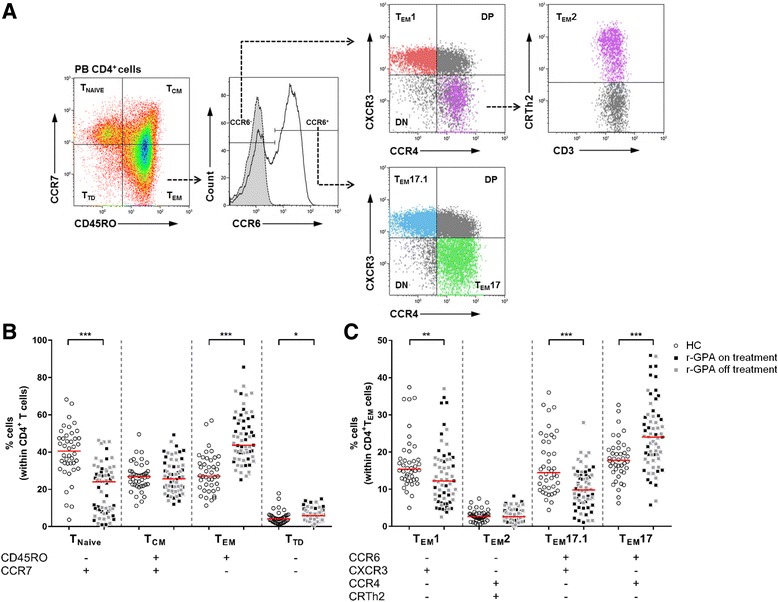
Peripheral blood of 63 GPA patients in remission and 42 age- and sex-matched healthy controls was stained immediately after blood withdrawal with fluorochrome-conjugated antibodies for cell surface markers (CD3, CD4, CD45RO) and chemokine receptors (CCR4, CCR6, CCR7, CRTh2, CXCR3) followed by flow cytometry analysis. CD4 T memory cells (CD3CD4CD45ROCCR7) were gated, and the expression patterns of chemokine receptors CXCR3CCR4CCR6CRTh2, CXCR3CCR4CCR6CRTh2, CXCR3CCR4CCR6CRTh2, and CXCR3CCR4CCR6CRTh2 were used to distinguish T1, T2, T17, and T17.1 cells, respectively.
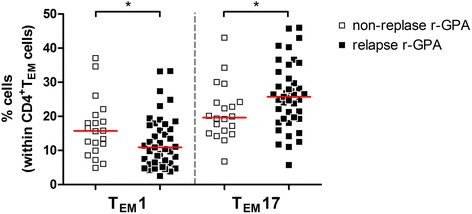
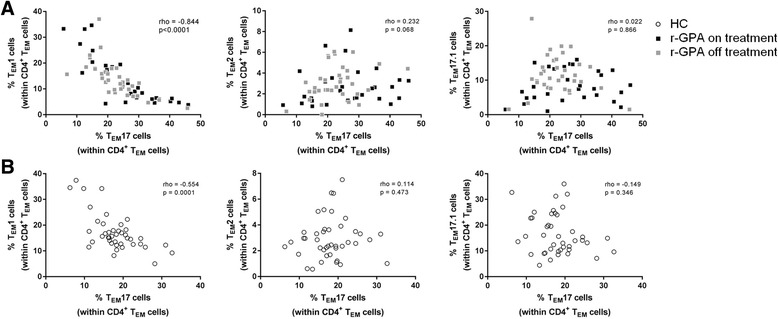
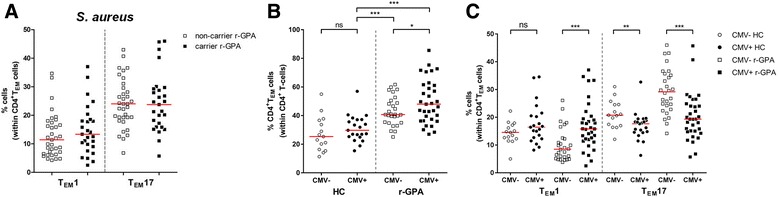
The percentage of CD4 T cells was significantly increased in GPA patients in remission compared to HCs. Chemokine receptor co-expression analysis within the CD4 T cell population demonstrated a significant increase in the proportion of T17 cells with a concomitant significant decrease in the T1 cells in GPA patients compared to HC. The percentage of T17 cells correlated negatively with T1 cells in GPA patients. Moreover, the circulating proportion of T17 cells showed a positive correlation with the number of organs involved and an association with the tendency to relapse in GPA patients. Interestingly, the aberrant distribution of T1 and T17 cells is modulated in CMV- seropositive GPA patients.
Our data demonstrates the identification of different CD4 T cell subsets in peripheral blood of GPA patients based on chemokine receptor co-expression analysis. The aberrant balance between T1 and T17 cells in remission GPA patients, showed to be associated with disease pathogenesis in relation to organ involvement, and tendency to relapse.
肉芽肿性多血管炎(GPA)患者循环CD4效应记忆T细胞(T细胞)持续扩增,提示其在疾病发病机制中起重要作用。最近的研究表明,可根据趋化因子受体的表达模式识别不同功能的CD4 T细胞亚群。本研究旨在根据GPA患者外周血中趋化因子受体的表达确定不同的CD4 T细胞亚群。识别特定的循环CD4 T细胞亚群可能揭示特定CD4 T亚群对GPA疾病发病机制的不同作用。
63例缓解期GPA患者和42例年龄及性别匹配的健康对照者的外周血在采血后立即用荧光素偶联抗体染色,检测细胞表面标志物(CD3、CD4、CD45RO)和趋化因子受体(CCR4、CCR6、CCR7、CRTh2、CXCR3),随后进行流式细胞术分析。圈定CD4 T记忆细胞(CD3CD4CD45ROCCR7),并用趋化因子受体CXCR3CCR4CCR6CRTh2、CXCR3CCR4CCR6CRTh2、CXCR3CCR4CCR6CRTh2和CXCR3CCR4CCR6CRTh2的表达模式分别区分T1、T2、T17和T17.1细胞。
与健康对照相比,缓解期GPA患者CD4 T细胞百分比显著升高。CD4 T细胞群体内的趋化因子受体共表达分析显示,与健康对照相比,GPA患者T17细胞比例显著增加,同时T1细胞比例显著降低。GPA患者中,T17细胞百分比与T1细胞呈负相关。此外,T17细胞的循环比例与GPA患者受累器官数量呈正相关,且与复发倾向相关。有趣的是,巨细胞病毒血清阳性的GPA患者中,T1和T17细胞的异常分布受到调节。
我们的数据表明,基于趋化因子受体共表达分析可识别GPA患者外周血中不同的CD4 T细胞亚群。缓解期GPA患者T1和T17细胞之间的异常平衡,显示与疾病发病机制中器官受累及复发倾向相关。