Cozzolino Mario, Galassi Andrea, Conte Ferruccio, Mangano Michela, Di Lullo Luca, Bellasi Antonio
Department of Health Sciences, Renal Division, University of Milan, ASST Santi Paolo e Carlo, San Paolo Hospital, Milan.
U.O.C. Nefrologia e Dialisi, Ospedale L. Parodi Delfino, Colleferro, Roma.
Ther Clin Risk Manag. 2017 Jun 1;13:679-689. doi: 10.2147/TCRM.S108490. eCollection 2017.
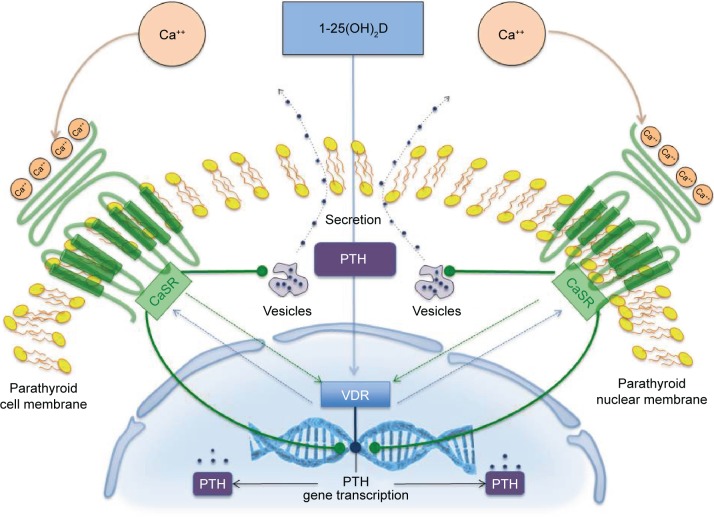
Secondary hyperparathyroidism (SHPT), a very frequent, severe, and worsening complication of chronic kidney disease, is characterized by high serum parathyroid hormone (PTH), parathyroid gland hyperplasia, and disturbances in mineral metabolism. Clinically, SHPT shows renal osteodystrophy, vascular calcification, cardiovascular damage, and fatal outcome. Calcium-sensing receptor (CaSR) is the main physiological regulator of PTH secretion; its activation by calcium rapidly inhibits PTH. Another important player in regulating mineral metabolism is vitamin D receptor (VDR), which is under the influence of vitamin D and influences the intestinal absorption of calcium and phosphate, PTH gene expression, and bone calcium mobilization. Serum phosphate levels influence fibroblast growth factor 23 (FGF-23) production, a phosphatonin that modulates serum phosphate reabsorption, PTH synthesis, and vitamin D production. Current therapeutic approaches consist of 1) phosphate intake control by diet or phosphate binders, 2) vitamin D by VDR activation, and 3) calcimimetic agents that activate CaSR. Recently, a new long-acting peptide (etelcalcetide) belonging to the calcimimetics class was approved for intravenous use in hemodialysis patients with SHPT. Etelcalcetide binds directly to CaSR, by a sulfide bond, inhibiting the production and secretion of PTH by parathyroid glands. After intravenous administration in rats, etelcalcetide is quickly distributed to the tissues and eliminated by kidneys, while in uremic animals the nonrenal excretion is only 1.2%. In hemodialysis patients, the treatment itself is the main route of elimination. Etelcalcetide in hemodialysis patients with SHPT was more effective than placebo and cinacalcet, with a PTH reduction of >30% in 76% of patients with etelcalcetide versus 10% with placebo. Particular attention was paid to the safety of the drug; the most common adverse event was asymptomatic blood calcium reduction, similar to cinacalcet, while gastrointestinal symptoms were less frequent. This promising new drug available for better control of SHPT will, together with drugs already in use, optimize the treatment to normalize the biochemical parameters.
继发性甲状旁腺功能亢进(SHPT)是慢性肾脏病一种非常常见、严重且不断恶化的并发症,其特征为血清甲状旁腺激素(PTH)水平升高、甲状旁腺增生以及矿物质代谢紊乱。临床上,SHPT表现为肾性骨营养不良、血管钙化、心血管损害及致命后果。钙敏感受体(CaSR)是PTH分泌的主要生理调节因子;钙对其激活可迅速抑制PTH分泌。调节矿物质代谢的另一个重要因素是维生素D受体(VDR),它受维生素D影响,进而影响肠道对钙和磷的吸收、PTH基因表达以及骨钙动员。血清磷水平会影响成纤维细胞生长因子23(FGF - 23)的产生,FGF - 23是一种磷调节素,可调节血清磷重吸收、PTH合成及维生素D生成。目前的治疗方法包括:1)通过饮食或磷结合剂控制磷摄入;2)通过激活VDR补充维生素D;3)使用激活CaSR的拟钙剂。最近,一种属于拟钙剂类的新型长效肽(依特卡肽)被批准用于静脉注射治疗SHPT的血液透析患者。依特卡肽通过硫键直接与CaSR结合,抑制甲状旁腺产生和分泌PTH。大鼠静脉注射后,依特卡肽迅速分布至各组织并经肾脏清除,而在尿毒症动物中,非肾排泄仅占1.2%。在血液透析患者中,治疗本身是主要的清除途径。依特卡肽治疗SHPT的血液透析患者比安慰剂和西那卡塞更有效,76%接受依特卡肽治疗的患者PTH降低>30%,而接受安慰剂治疗的患者这一比例为10%。特别关注了该药物的安全性;最常见的不良事件是无症状性血钙降低,与西那卡塞类似,而胃肠道症状较少见。这种有望更好控制SHPT的新药将与现有药物一起,优化治疗以实现生化指标正常化。