Milliren Carly E, Richmond Tracy K, Evans Clare R, Dunn Erin C, Johnson Renee M
Center for Applied Pediatric Quality Analytics, Boston Children's Hospital, Boston, MA, USA.
Division of Adolescent/Young Adult Medicine, Boston Children's Hospital, Boston, MA, USA.
Subst Abuse. 2017 Jun 6;11:1178221817711417. doi: 10.1177/1178221817711417. eCollection 2017.
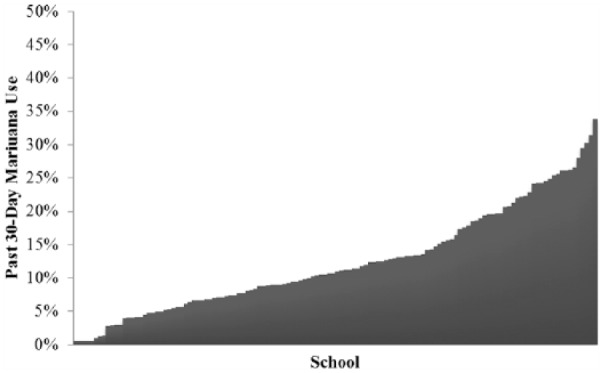
Little is known about the unique contribution of schools vs neighborhoods in driving adolescent marijuana use. This study examined the relative contribution of each setting and the influence of school and neighborhood socioeconomic status on use. We performed a series of cross-classified multilevel logistic models predicting past 30-day adolescent (N = 18 329) and young adult (N = 13 908) marijuana use using data from Add Health. Marijuana use differed by age, sex, race/ethnicity, and public assistance in adjusted models. Variance parameters indicated a high degree of clustering by school (σ2 = 0.30) and less pronounced clustering by neighborhood (σ2 = 0.06) in adolescence when accounting for both levels simultaneously in a cross-classified multilevel model. Clustering by school persisted into young adulthood (σ2 = 0.08). Parental receipt of public assistance increased the likelihood of use during adolescence (odds ratio = 1.39; 95% confidence interval: 1.19-1.59), and higher parental education was associated with increased likelihood of use in young adulthood. These findings indicate that both contexts may be promising locations for intervention.
关于学校和社区在促使青少年使用大麻方面的独特作用,我们了解得很少。本研究考察了每个环境的相对作用以及学校和社区社会经济地位对大麻使用的影响。我们使用“青少年健康纵向研究”(Add Health)的数据,进行了一系列交叉分类的多层次逻辑模型分析,以预测过去30天内青少年(N = 18329)和青年成年人(N = 13908)的大麻使用情况。在调整后的模型中,大麻使用情况因年龄、性别、种族/民族和公共援助情况而异。方差参数表明,在交叉分类多层次模型中同时考虑两个层次时,青少年时期学校层面的聚类程度较高(σ2 = 0.30),而社区层面的聚类程度不那么明显(σ2 = 0.06)。学校层面的聚类在青年成年期仍然存在(σ2 = 0.08)。父母领取公共援助会增加青少年时期使用大麻的可能性(优势比 = 1.39;95%置信区间:1.19 - 1.59),而父母受教育程度较高与青年成年期使用大麻可能性增加有关。这些发现表明,这两种环境都可能是有前景的干预场所。