Randhawa Nistara, Gulland Frances, Ylitalo Gina M, DeLong Robert, Mazet Jonna A K
Wildlife Health Center, One Health Institute, School of Veterinary Medicine, University of California, Davis, CA 95616, USA.
The Marine Mammal Center, Sausalito, CA 94965-2619, USA.
One Health. 2015 Sep 14;1:37-43. doi: 10.1016/j.onehlt.2015.08.003. eCollection 2015 Dec.
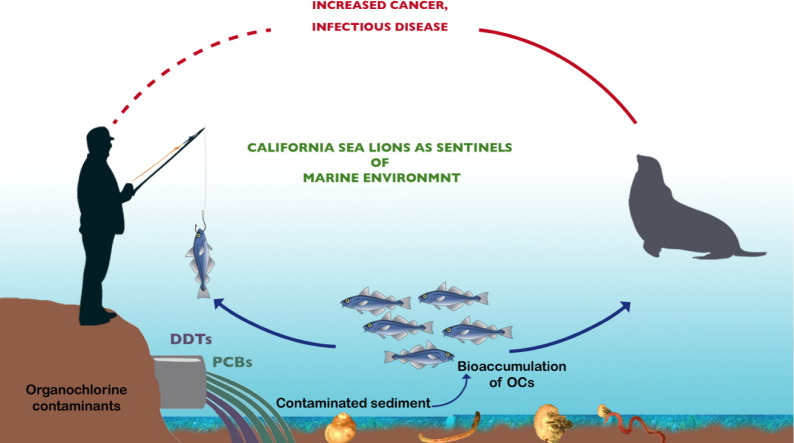
Organochlorine contaminants (OCs), like polychlorinated biphenyls (PCBs) and dichlorodiphenyltrichloroethanes (DDTs), are widespread marine pollutants resulting from massive historical use and environmental persistence. Exposure to and health effects of these OCs in the marine environment may be examined by studying California sea lions ), which are long lived, apex predators capable of accumulating OCs.
We evaluated PCB and DDT levels in 310 sea lions sampled between 1992 and 2007: 204 individuals stranded along the coast of central California, 60 healthy males from Washington State, and 46 healthy females from southern California. Lipid-normalized contaminant concentrations were analyzed using general linear models and logistic regression to ascertain temporal trends; differences between stranded and healthy sea lions; and association of organochlorines with sex, age, and presence of cancer or fatal infectious disease.
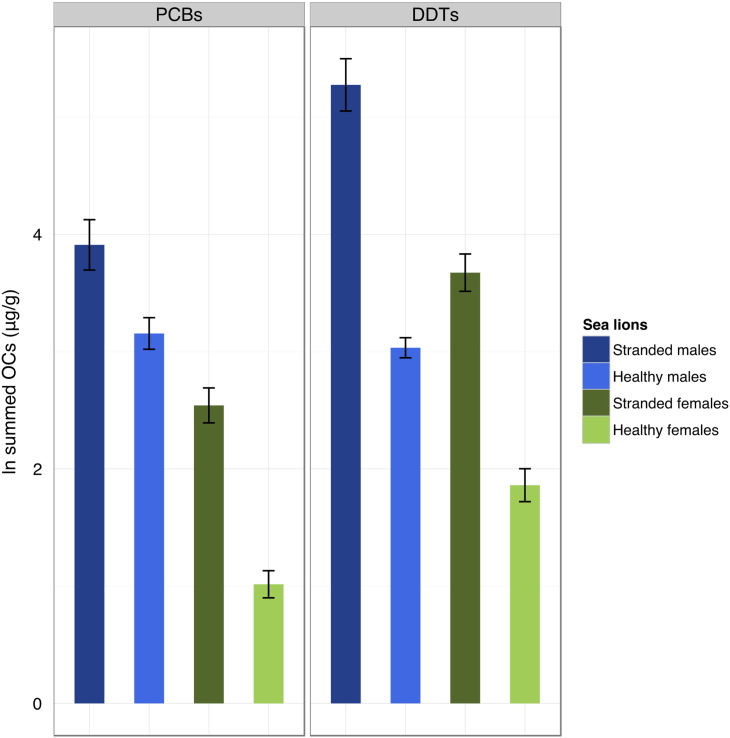
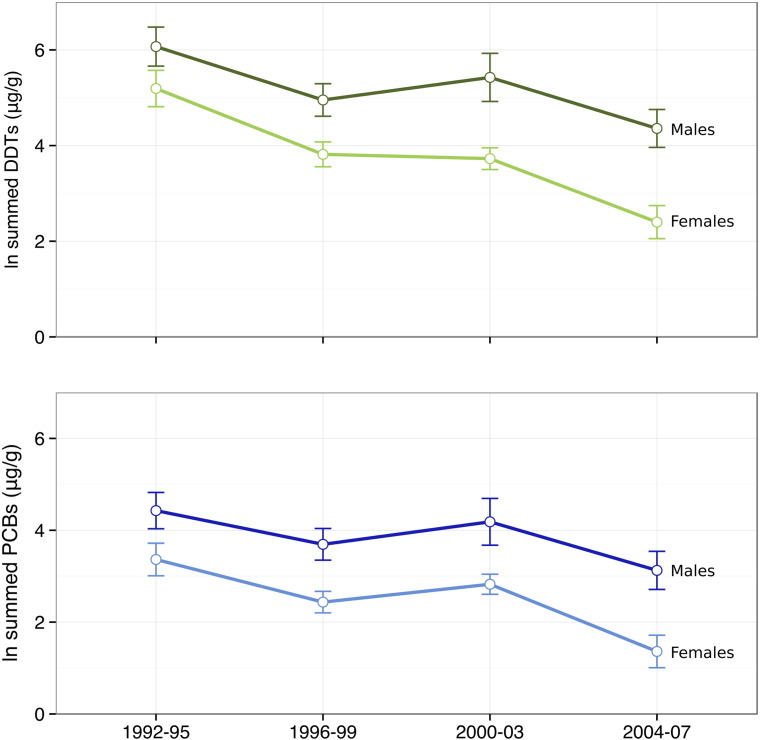
Concentrations of the contaminants in stranded adults decreased over time in the study period (adjusted for sex, as adult males had higher mean blubber concentrations than adult females and juveniles). Cancer was almost eight and six times more likely in animals with higher summed PCBs and DDTs, compared to those with lower levels (95% CI 5.55-10.51 and 4.54-7.99, respectively). Fatal infectious diseases were similarly seven and five times more likely in animals with higher contaminant burdens (95% CI 4.20-10.89 and 3.27-7.86, respectively). Mean contaminant loads were significantly higher in stranded sea lions than in healthy live captured animals ( < 0.001).
Organochlorine contamination has significant associations with health outcomes in California sea lions, raising concerns for humans and other animals eating tainted seafood. While environmental exposure to these organochlorines appears to be decreasing over time based on levels in sea lion tissues, their persistence in the environment and food web for all predators, including humans, and the associated serious health risks, warrant monitoring, possibly through sentinel species like marine mammals.
有机氯污染物(OCs),如多氯联苯(PCBs)和滴滴涕(DDTs),是由于历史上的大量使用和环境持久性而广泛存在的海洋污染物。通过研究加利福尼亚海狮可以考察这些有机氯污染物在海洋环境中的暴露情况及其对健康的影响,加利福尼亚海狮寿命长,是能够积累有机氯污染物的顶级捕食者。
我们评估了1992年至2007年间采集的310只海狮体内的多氯联苯和滴滴涕水平:204只在加利福尼亚中部海岸搁浅的个体,60只来自华盛顿州的健康雄性海狮,以及46只来自南加利福尼亚的健康雌性海狮。使用一般线性模型和逻辑回归分析脂质标准化的污染物浓度,以确定时间趋势;搁浅海狮与健康海狮之间的差异;以及有机氯与性别、年龄、癌症或致命传染病存在之间的关联。
在研究期间,搁浅成年海狮体内污染物浓度随时间下降(根据性别进行了调整,因为成年雄性海狮的平均脂肪浓度高于成年雌性海狮和幼年海狮)。与污染物水平较低的动物相比,多氯联苯和滴滴涕总量较高的动物患癌症的可能性几乎高出八倍和六倍(95%置信区间分别为5.55 - 10.51和4.54 - 7.99)。同样,污染物负荷较高的动物患致命传染病的可能性高出七倍和五倍(95%置信区间分别为4.20 - 10.89和3.27 - 7.86)。搁浅海狮的平均污染物负荷显著高于健康的活体捕获动物(P < 0.001)。
有机氯污染与加利福尼亚海狮的健康状况存在显著关联,这引发了人们对食用受污染海鲜的人类和其他动物的担忧。虽然根据海狮组织中的水平来看,随着时间推移环境中这些有机氯污染物的暴露似乎在减少,但它们在环境和包括人类在内的所有捕食者的食物网中的持久性以及相关的严重健康风险,需要进行监测,可能通过海洋哺乳动物等指示物种来进行。