Teramoto Tomohiko, Tsuchikane Etsuo, Yamamoto Masanori, Matsuo Hitoshi, Kawase Yoshiaki, Suzuki Yoriyasu, Kanou Seiji, Shimura Tetsurou, Sato Hirotomo, Habara Maoto, Nasu Kenya, Kimura Masashi, Kinoshita Yoshihisa, Terashima Mitsuyasu, Matsubara Tetsuo, Suzuki Takahiko
Department of Cardiovascular Medicine, Toyohashi Heart Center, Toyohashi, Aichi, Japan.
Department of Cardiovascular Medicine, Gifu Heart Center, Gifu, Japan.
Int J Cardiol Heart Vasc. 2016 Dec 1;14:28-32. doi: 10.1016/j.ijcha.2016.11.001. eCollection 2017 Mar.
Following the development of breakthrough techniques for percutaneous coronary intervention (PCI) in the treatment of chronic total occlusions (CTO), the initial success rate of PCI in CTO lesions (CTO-PCI) has improved; however, there are few reports regarding the effects of successful CTO revascularization on long-term mortality in Japan. The aim of this study was to compare the long-term clinical outcomes of patients with successful versus failed CTO recanalization and to identify related factors.
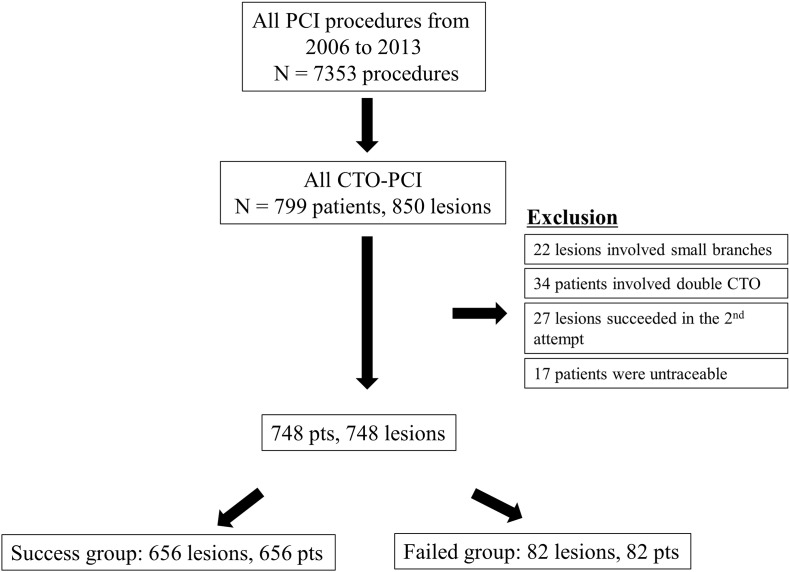
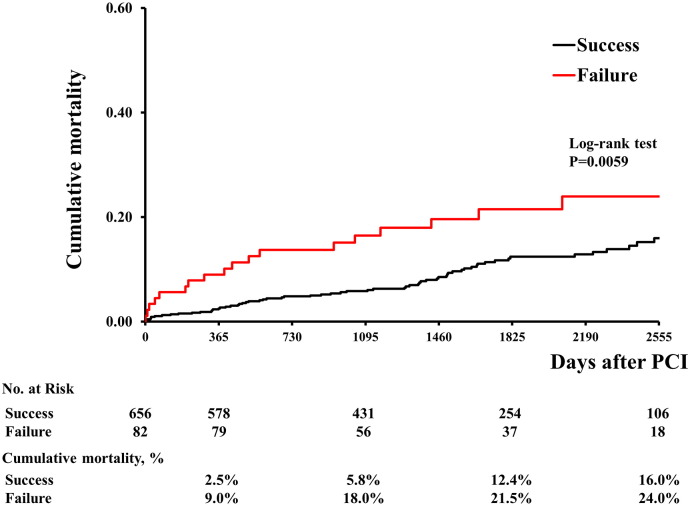
From all PCI procedures performed in our hospital between 2006 and 2013, CTO-PCIs were extracted and classified into two groups: PCI success (n = 656 patients) and PCI failure (n = 82 patients). Patients with successful procedures only on a second attempt, CTO-PCI in small branches, or CTOs in more than one vessel were excluded. Survival was determined from a telephone interview or the consultation history in the outpatient clinic. Initial angiographic success was achieved in 88.9% of the patients. A Kaplan-Meier plot with log-rank analysis showed that cumulative all-cause death was significantly lower in the success group than in the failure group (p = 0.0003; average follow-up duration in success group vs. failure group was 1531.3 ± 33.5 vs. 1565.3 ± 97.5 days, p = 0.7). Moreover, the rate of evident cardiac death was significantly lower in the success group than in the failure group (3.5% [23/656] vs. 15.9% [13/82], p < 0.0001).
This study suggests that successful revascularization in patients with CTO improves their long-term clinical outcomes.
随着经皮冠状动脉介入治疗(PCI)在慢性完全闭塞病变(CTO)治疗中的突破性技术发展,CTO病变的PCI初始成功率(CTO-PCI)有所提高;然而,在日本,关于成功的CTO血运重建对长期死亡率影响的报道较少。本研究的目的是比较CTO再通成功与失败患者的长期临床结局,并确定相关因素。
从2006年至2013年在我院进行的所有PCI手术中,提取CTO-PCI并分为两组:PCI成功组(n = 656例患者)和PCI失败组(n = 82例患者)。仅在第二次尝试时成功的患者、小分支的CTO-PCI或多支血管的CTO患者被排除。通过电话访谈或门诊咨询病史确定生存情况。88.9%的患者实现了初始血管造影成功。Kaplan-Meier曲线和对数秩分析显示,成功组的累积全因死亡率显著低于失败组(p = 0.0003;成功组与失败组的平均随访时间分别为1531.3±33.5天和1565.3±97.5天,p = 0.7)。此外,成功组的明显心源性死亡率显著低于失败组(3.5% [23/656] vs. 15.9% [13/82],p < 0.0001)。
本研究表明,CTO患者成功的血运重建可改善其长期临床结局。