Khajavi Mehrdad, Zhou Yi, Birsner Amy E, Bazinet Lauren, Rosa Di Sant Amanda, Schiffer Alex J, Rogers Michael S, Krishnaji Subrahmanian Tarakkad, Hu Bella, Nguyen Vy, Zon Leonard, D'Amato Robert J
The Vascular Biology Program and Department of Surgery, Boston Children's Hospital, Harvard Medical School, Boston, Massachusetts, United States of America.
Division of Hematology/Oncology, Boston Children's Hospital, Harvard Stem Cell Institute, Harvard Medical School, Boston, Massachusetts, United States of America.
PLoS Genet. 2017 Jun 15;13(6):e1006848. doi: 10.1371/journal.pgen.1006848. eCollection 2017 Jun.
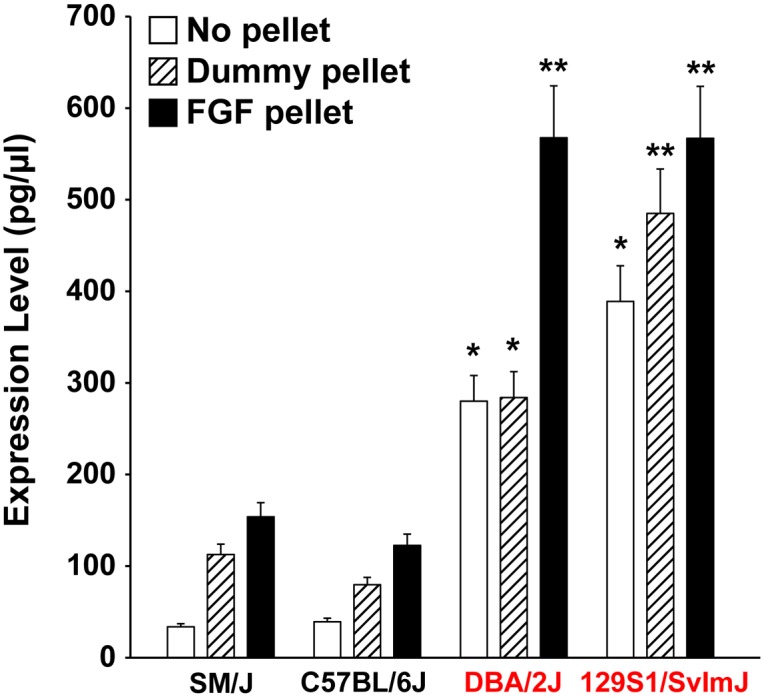
Recent findings indicate that growth factor-driven angiogenesis is markedly influenced by genetic variation. This variation in angiogenic responsiveness may alter the susceptibility to a number of angiogenesis-dependent diseases. Here, we utilized the genetic diversity available in common inbred mouse strains to identify the loci and candidate genes responsible for differences in angiogenic response. The corneal micropocket neovascularization assay was performed on 42 different inbred mouse strains using basic fibroblast growth factor (bFGF) pellets. We performed a genome-wide association study utilizing efficient mixed-model association (EMMA) mapping using the induced vessel area from all strains. Our analysis yielded five loci with genome-wide significance on chromosomes 4, 8, 11, 15 and 16. We further refined the mapping on chromosome 4 within a haplotype block containing multiple candidate genes. These genes were evaluated by expression analysis in corneas of various inbred strains and in vitro functional assays in human microvascular endothelial cells (HMVECs). Of these, we found the expression of peptidyl arginine deiminase type II (Padi2), known to be involved in metabolic pathways, to have a strong correlation with a haplotype shared by multiple high angiogenic strains. In addition, inhibition of Padi2 demonstrated a dosage-dependent effect in HMVECs. To investigate its role in vivo, we knocked down Padi2 in transgenic kdrl:zsGreen zebrafish embryos using morpholinos. These embryos had disrupted vessel formation compared to control siblings. The impaired vascular pattern was partially rescued by human PADI2 mRNA, providing evidence for the specificity of the morphant phenotype. Taken together, our study is the first to indicate the potential role of Padi2 as an angiogenesis-regulating gene. The characterization of Padi2 and other genes in associated pathways may provide new understanding of angiogenesis regulation and novel targets for diagnosis and treatment of a wide variety of angiogenesis-dependent diseases.
最近的研究结果表明,生长因子驱动的血管生成受到基因变异的显著影响。这种血管生成反应性的变异可能会改变对多种血管生成依赖性疾病的易感性。在此,我们利用常见近交系小鼠品系中存在的遗传多样性,来确定负责血管生成反应差异的基因座和候选基因。使用碱性成纤维细胞生长因子(bFGF)微球,对42种不同的近交系小鼠品系进行角膜微袋血管生成试验。我们利用高效混合模型关联(EMMA)图谱,对所有品系的诱导血管面积进行全基因组关联研究。我们的分析在4号、8号、11号、15号和16号染色体上产生了5个具有全基因组显著性的基因座。我们在一个包含多个候选基因的单倍型块内,进一步细化了4号染色体上的图谱。通过对各种近交系品系角膜的表达分析以及在人微血管内皮细胞(HMVECs)中的体外功能试验,对这些基因进行了评估。其中,我们发现已知参与代谢途径的II型肽基精氨酸脱亚氨酶(Padi2)的表达,与多个高血管生成品系共有的一个单倍型有很强的相关性。此外,Padi2的抑制在HMVECs中表现出剂量依赖性效应。为了研究其在体内的作用,我们使用吗啉代寡核苷酸在转基因kdrl:zsGreen斑马鱼胚胎中敲低Padi2。与对照同胞相比,这些胚胎的血管形成受到破坏。人PADI2 mRNA部分挽救了受损的血管模式,为吗啡啉表型的特异性提供了证据。综上所述,我们的研究首次表明Padi2作为血管生成调节基因的潜在作用。Padi2和相关途径中其他基因的表征,可能为血管生成调节提供新的认识,并为诊断和治疗多种血管生成依赖性疾病提供新的靶点。