Cabrera-Villalba Sonia, Gomara María José, Cañete Juan D, Ramírez Julio, Salvador Georgina, Ruiz-Esquide Virginia, Hernández Maria Victoria, Inciarte-Mundo José, Haro Isabel, Sanmartí Raimon
Unidad de Artritis, Servicio de Reumatología Hospital Clínic de Barcelona, Villarroel 170, 08036, Barcelona, Spain.
Unidad de Síntesis y Aplicaciones Biomédicas de Péptidos, IQAC-CSIC, Barcelona, Spain.
Arthritis Res Ther. 2017 Jun 15;19(1):141. doi: 10.1186/s13075-017-1329-6.
To analyze differences in the recognition of anti-citrullinated peptide/protein antibody (ACPA) citrullinated epitopes and isotypes in patients with palindromic rheumatism (PR) and rheumatoid arthritis (RA).
ACPA fine specificities (citrullinated peptides of enolase, fibrin, and vimentin) and isotypes (IgG, IgM, and IgA) were analyzed in 54 patients with longstanding PR and 54 patients with established RA.
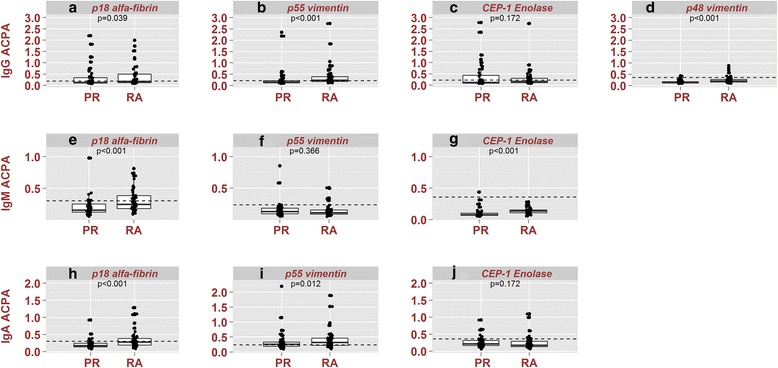
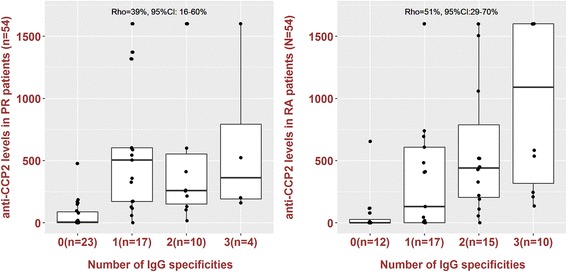
CCP2 tested positive in 66.7% of patients with PR and RA. The ACPA distribution of fine specificities and isotypes differed between PR and RA patients. PR patients had a lower frequency of fine ACPA specificities than RA patients, which was significant in the case of a peptide derived from vimentin (PR 24.1% vs. 59.3% RA; p < 0.001). The mean number of ACPA specificities was lower in PR than in RA patients, and only 25.9% of PR patients recognized ≥2 additional specificities compared with 46.3% of RA patients. Significantly less isotype usage, especially IgA, was observed in PR patients.
The ACPA immune response differed in patients with PR and RA, with fewer fine specificities and isotype usage in patients with PR. Some patients with PR may have impaired maturation of the B-cell response against citrullinated peptides with no progression to RA.
分析回纹型风湿病(PR)和类风湿关节炎(RA)患者在抗瓜氨酸化肽/蛋白抗体(ACPA)瓜氨酸化表位和亚型识别上的差异。
对54例病程较长的PR患者和54例确诊的RA患者分析ACPA精细特异性(烯醇化酶、纤维蛋白和波形蛋白的瓜氨酸化肽)和亚型(IgG、IgM和IgA)。
CCP2在66.7%的PR和RA患者中检测呈阳性。PR和RA患者在ACPA精细特异性和亚型的分布上存在差异。PR患者的ACPA精细特异性频率低于RA患者,在源自波形蛋白的肽的情况下差异显著(PR为24.1%,RA为59.3%;p<0.001)。PR患者的ACPA特异性平均数量低于RA患者,只有25.9%的PR患者识别出≥2种额外的特异性,而RA患者为46.3%。在PR患者中观察到亚型使用明显较少,尤其是IgA。
PR和RA患者的ACPA免疫反应不同,PR患者的精细特异性和亚型使用较少。一些PR患者可能存在针对瓜氨酸化肽的B细胞反应成熟受损,且未进展为RA。