Niphadkar Madhura, Nagendra Harini, Tarantino Cristina, Adamo Maria, Blonda Palma
Ashoka Trust for Research in Ecology and the EnvironmentBangalore, India.
Manipal UniversityManipal, India.
Front Plant Sci. 2017 May 31;8:892. doi: 10.3389/fpls.2017.00892. eCollection 2017.
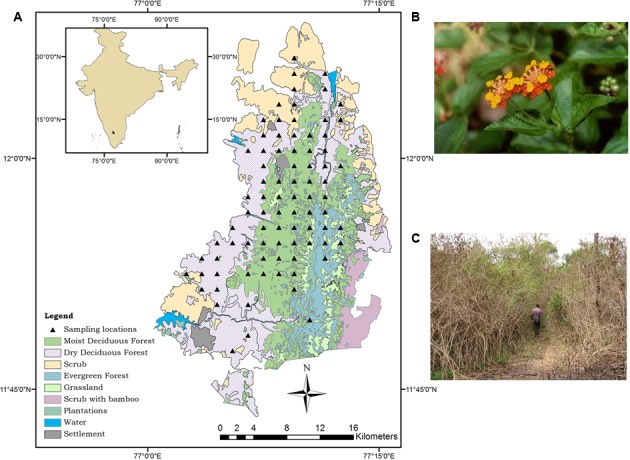
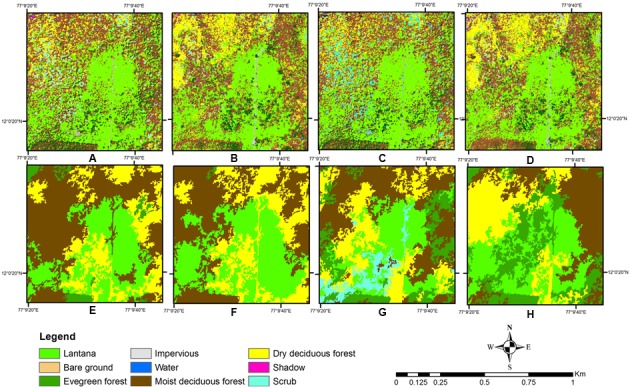
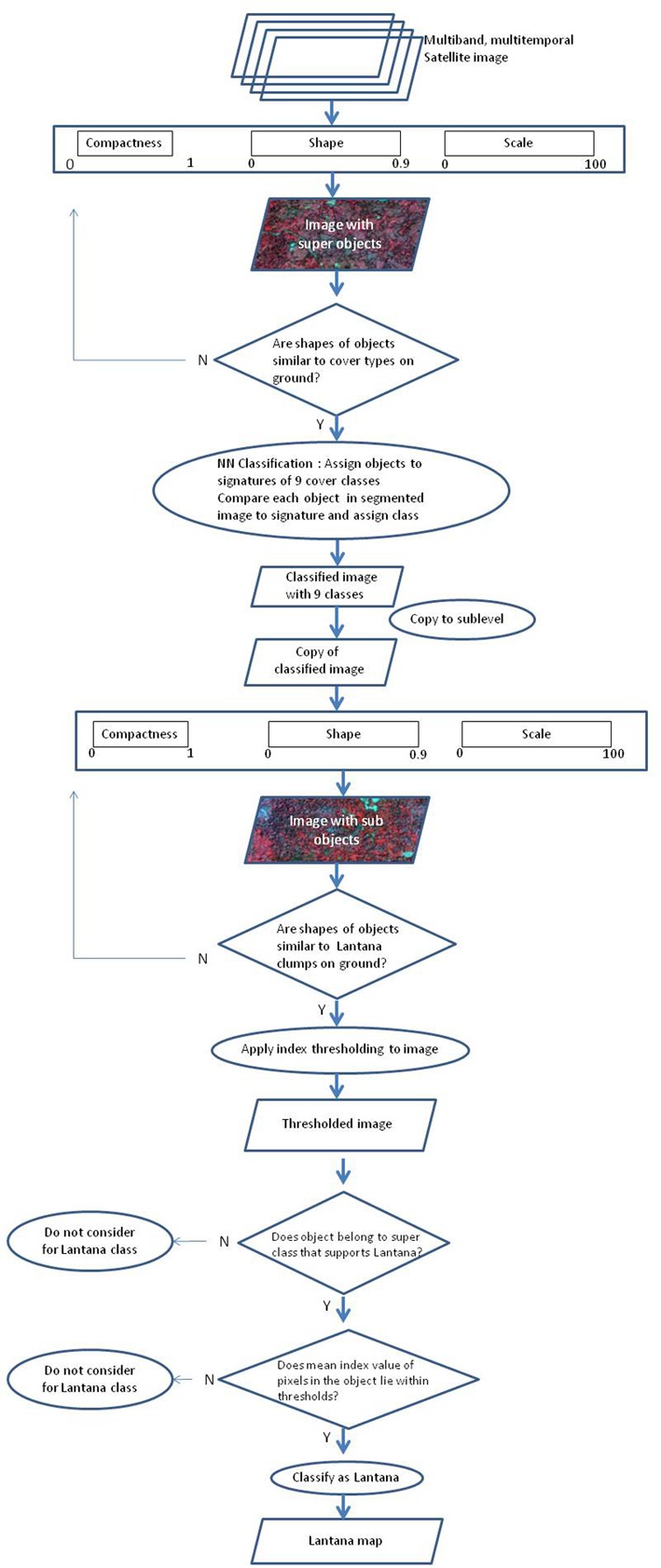
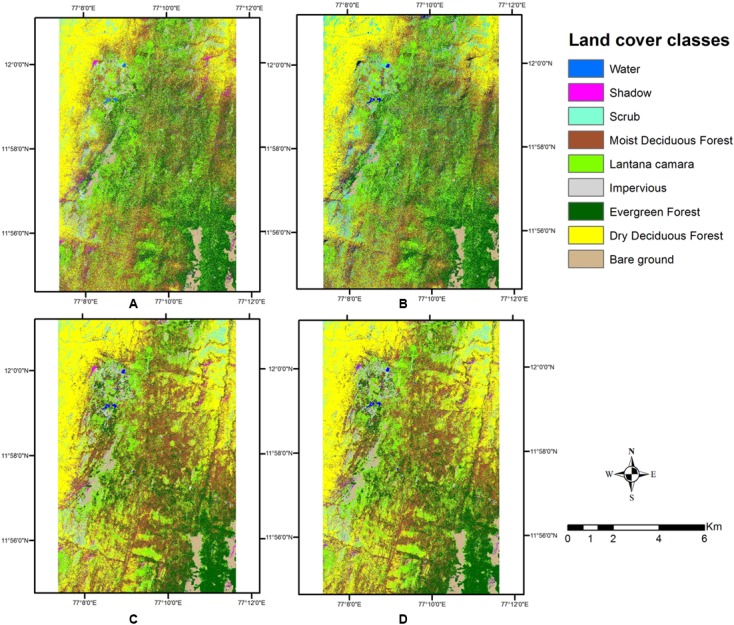
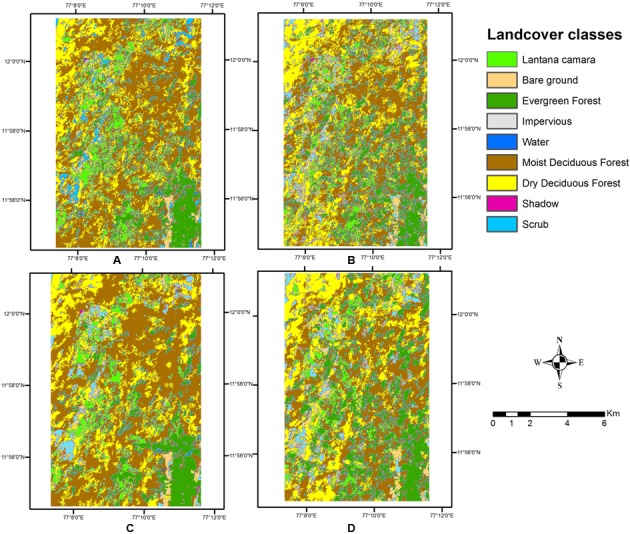
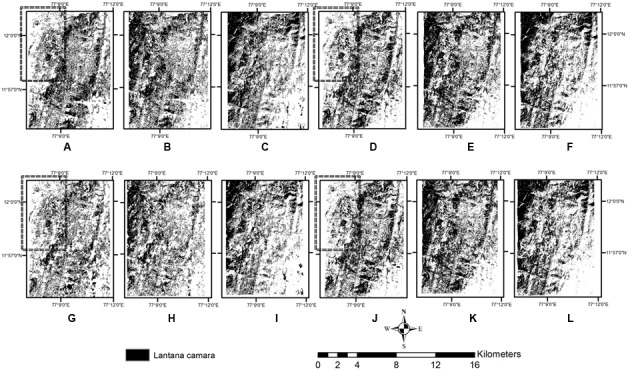
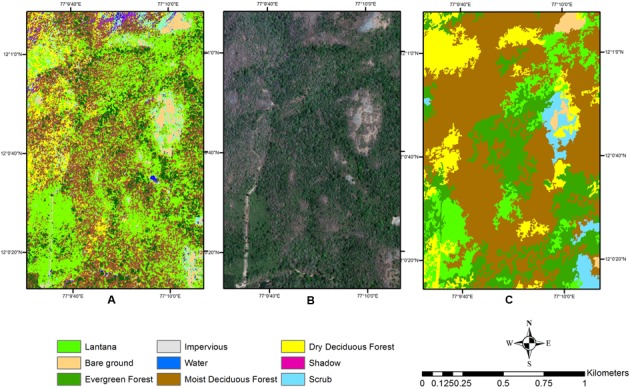
The establishment of invasive alien species in varied habitats across the world is now recognized as a genuine threat to the preservation of biodiversity. Specifically, plant invasions in understory tropical forests are detrimental to the persistence of healthy ecosystems. Monitoring such invasions using Very High Resolution (VHR) satellite remote sensing has been shown to be valuable in designing management interventions for conservation of native habitats. Object-based classification methods are very helpful in identifying invasive plants in various habitats, by their inherent nature of imitating the ability of the human brain in pattern recognition. However, these methods have not been tested adequately in dense tropical mixed forests where invasion occurs in the understorey. This study compares a pixel-based and object-based classification method for mapping the understorey invasive shrub () in a tropical mixed forest habitat in the Western Ghats biodiversity hotspot in India. Overall, a hierarchical approach of mapping top canopy at first, and then further processing for the understorey shrub, using measures such as texture and vegetation indices proved effective in separating out from other cover types. In the first method, we implement a simple parametric supervised classification for mapping cover types, and then process within these types for delineation. In the second method, we use an object-based segmentation algorithm to map cover types, and then perform further processing for separating . The improved ability of the object-based approach to delineate structurally distinct objects with characteristic spectral and spatial characteristics of their own, as well as with reference to their surroundings, allows for much flexibility in identifying invasive understorey shrubs among the complex vegetation of the tropical forest than that provided by the parametric classifier. Conservation practices in tropical mixed forests can benefit greatly by adopting methods which use high resolution remotely sensed data and advanced techniques to monitor the patterns and effective functioning of native ecosystems by periodically mapping disturbances such as invasion.
外来入侵物种在世界各地不同栖息地的定殖,如今已被公认为是对生物多样性保护的一种切实威胁。具体而言,热带林下森林中的植物入侵对健康生态系统的持续存在不利。利用甚高分辨率(VHR)卫星遥感监测此类入侵,已证明在设计保护原生栖息地的管理干预措施方面具有重要价值。基于对象的分类方法在识别各种栖息地中的入侵植物方面非常有帮助,因为其本质上能够模仿人类大脑的模式识别能力。然而,这些方法在热带茂密混交林的林下入侵区域尚未得到充分测试。本研究比较了基于像元和基于对象的分类方法,用于绘制印度西高止山脉生物多样性热点地区热带混交林栖息地林下入侵灌木()的分布图。总体而言,首先绘制顶级树冠层,然后使用纹理和植被指数等措施对林下灌木进行进一步处理的分层方法,在将与其他覆盖类型区分开来方面证明是有效的。在第一种方法中,我们实施一种简单的参数化监督分类来绘制覆盖类型,然后在这些类型中进行处理以进行的 delineation。在第二种方法中,我们使用基于对象的分割算法来绘制覆盖类型,然后进行进一步处理以分离。基于对象的方法能够更好地描绘具有自身特征光谱和空间特征以及参考其周围环境的结构上不同的对象,这使得在热带森林复杂植被中识别林下入侵灌木时比参数分类器具有更大的灵活性。通过采用利用高分辨率遥感数据和先进技术的方法,定期绘制诸如入侵等干扰情况,以监测原生生态系统的模式和有效功能,热带混交林的保护实践将受益匪浅。