Soares Walter Barbalho, Dos Santos Eriton Barros, Bottino Cássio Machado de Campos, Elkis Helio
Old Age Research Group, Department and Institute of Psychiatry, University of São Paulo Medical School (Proter-Ipq-FMUSP), São Paulo, Brazil.
Institute of Mathematics and Statistic, University of São Paulo (IME-USP), São Paulo, Brazil.
PLoS One. 2017 Jun 16;12(6):e0178471. doi: 10.1371/journal.pone.0178471. eCollection 2017.
Studies of the incidence of psychotic symptoms in elderly people at risk of dementia are scarce. This is a seven year follow up study aiming to determine the incidence of psychotic symptoms and their correlation with other clinical aspects, in particular the rate of development of cognitive impairment.
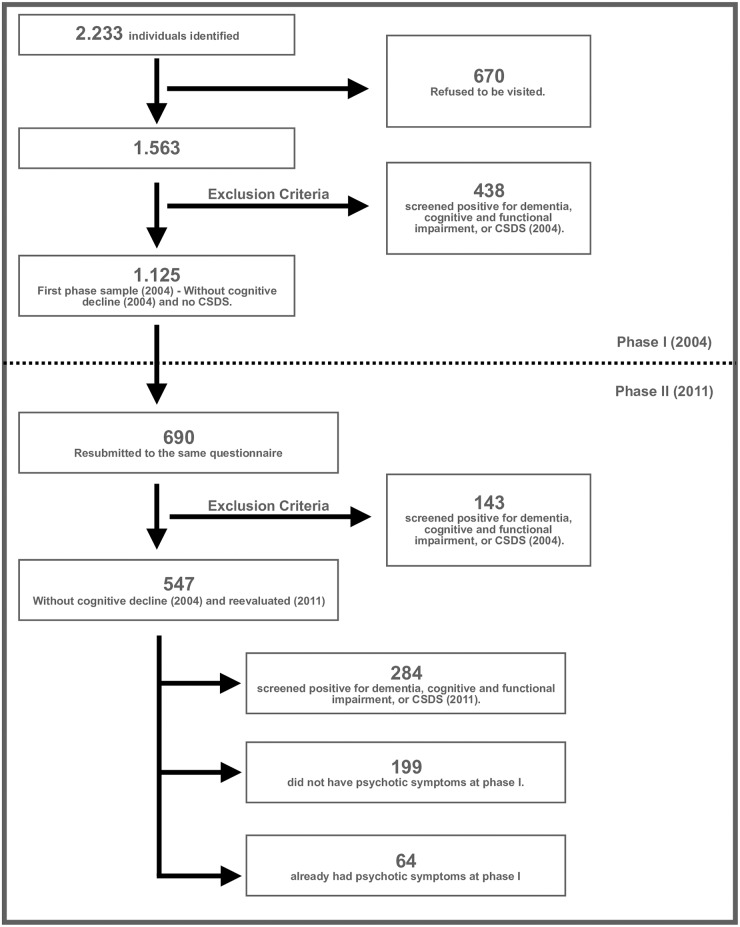
Cohort study of a community-based sample of elderly subjects. At study entry in 2004, the sample was composed of 1,125 individuals aged 60 years and older. Of this total, 547 subjects were re-evaluated in 2011 and submitted to the original study protocol. Of these, 199 showed no psychotic symptoms at phase I, while 64 already had psychotic symptoms in 2004.
The incidence of at least one psychotic symptom in the 7 year period was 8.0% (Visual/tactile hallucinations: 4.5%; Persecutory delusions: 3.0%; Auditory hallucinations: 2.5%). Development of psychotic symptoms was associated with epilepsy (OR: 7.75 and 15.83), lower MMSE (OR: 0.72) and reported depression (OR: 6.48). A total of 57.8% of individuals with psychotic symptoms developed cognitive impairment after 7 years. Visual/tactile hallucinations were the only psychotic symptom predictive of this impairment, which was related to lower MMSE and greater functional impairment.
The incidence of psychotic symptoms and the conversion rate to cognitive impairment was in the upper range when compared with previous reports. Visual/tactile hallucinations were the most frequent symptoms and were predictive of cognitive impairment over the 7 year period. A significant relationship was found between the incidence of psychotic symptoms and low MMSE scores, as well as clinical comorbities such as epilepsy, reported depression, diabetes and syphilis.
关于有患痴呆症风险的老年人中精神病症状发生率的研究很少。这是一项为期七年的随访研究,旨在确定精神病症状的发生率及其与其他临床方面的相关性,特别是认知障碍的发展速度。
对一个基于社区的老年受试者样本进行队列研究。在2004年研究开始时,样本由1125名60岁及以上的个体组成。其中,547名受试者在2011年接受了重新评估并遵循了原始研究方案。在这些人中,199人在第一阶段没有精神病症状,而64人在2004年就已经有精神病症状。
在7年期间至少出现一种精神病症状的发生率为8.0%(视觉/触觉幻觉:4.5%;被害妄想:3.0%;幻听:2.5%)。精神病症状的出现与癫痫(比值比:7.75和15.83)、较低的简易精神状态检查表(MMSE)得分(比值比:0.72)以及报告的抑郁症(比值比:6.48)相关。7年后,共有57.8%有精神病症状的个体出现了认知障碍。视觉/触觉幻觉是唯一能预测这种障碍的精神病症状,这与较低的MMSE得分和更严重的功能障碍有关。
与之前的报告相比,精神病症状的发生率和向认知障碍的转化率处于较高水平。视觉/触觉幻觉是最常见的症状,并且在7年期间能预测认知障碍。发现精神病症状的发生率与低MMSE得分以及癫痫、报告的抑郁症、糖尿病和梅毒等临床合并症之间存在显著关系。