Division of Pharmacotherapy and Experimental Therapeutics, UNC Eshelman School of Pharmacy, University of North Carolina at Chapel Hill, Chapel Hill, North Carolina, USA.
Duke Clinical Research Institute, Durham, North Carolina, USA.
CPT Pharmacometrics Syst Pharmacol. 2017 Sep;6(9):625-634. doi: 10.1002/psp4.12218. Epub 2017 Jul 24.
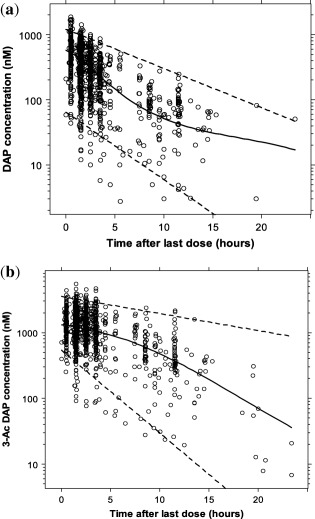
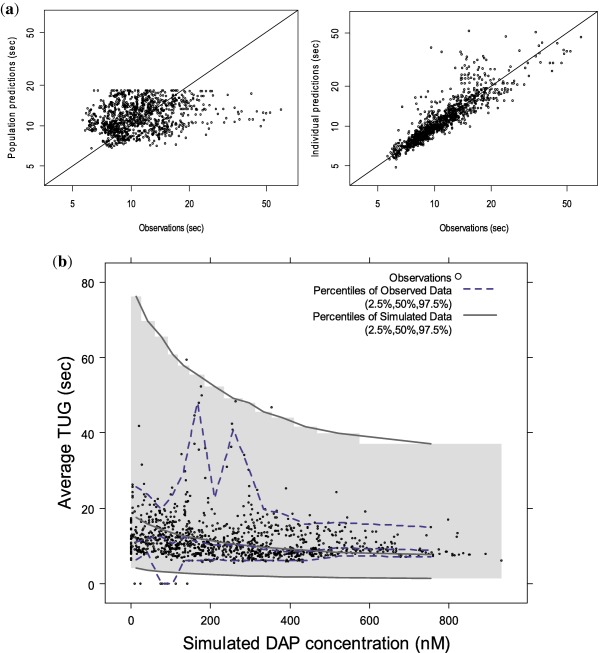
Lambert-Eaton myasthenia (LEM) is a rare autoimmune disorder associated with debilitating muscle weakness. There are limited treatment options and 3,4-diaminopyridine (3,4-DAP) free base is an investigational orphan drug used to treat LEM-related weakness. We performed a population pharmacokinetic/pharmacodynamic (PK/PD) analysis using 3,4-DAP and metabolite concentrations collected from a phase II study in patients with LEM. The Triple Timed Up & Go (3TUG) assessment, which measures lower extremity weakness, was the primary outcome measure. A total of 1,270 PK samples (49 patients) and 1,091 3TUG data points (32 randomized patients) were included in the PK/PD analysis. A two-compartment and one-compartment model for parent and metabolite, respectively, described the PK data well. Body weight and serum creatinine partially explained the variability in clearance for the final PK model. A fractional inhibitory maximum effect (E ) model characterized the exposure-response relationship well. The PK/PD model was applied to identify a suggested dosing approach for 3,4-DAP free base.
Lambert-Eaton 肌无力症 (LEM) 是一种罕见的自身免疫性疾病,与进行性肌肉无力有关。目前治疗选择有限,而 3,4-二氨基吡啶(3,4-DAP)游离碱是一种用于治疗 LEM 相关肌无力的研究用孤儿药。我们使用来自 LEM 患者的 II 期研究中收集的 3,4-DAP 和代谢物浓度进行了群体药代动力学/药效学(PK/PD)分析。测量下肢无力的三向计时起立测试(3TUG)是主要的终点测量指标。共有 1,270 个 PK 样本(49 名患者)和 1,091 个 3TUG 数据点(32 名随机患者)纳入 PK/PD 分析。母体和代谢物的两室和一室模型分别很好地描述了 PK 数据。体重和血清肌酐部分解释了最终 PK 模型中清除率的变异性。分数抑制最大效应 (E) 模型很好地描述了暴露-反应关系。PK/PD 模型用于确定 3,4-DAP 游离碱的建议给药方法。