Shen Jenny I, Saxena Anjali B, Vangala Sitaram, Dhaliwal Satvinder K, Winkelmayer Wolfgang C
Division of Nephrology and Hypertension, Los Angeles Biomedical Research Institute at Harbor-UCLA Medical Center, 1124 W. Carson St., C-1 Annex, Torrance, CA, 90502, USA.
Division of Nephrology, Department of Medicine, Stanford University School of Medicine, Palo Alto, CA, USA.
BMC Nephrol. 2017 Jun 17;18(1):196. doi: 10.1186/s12882-017-0616-4.
Although angiotensin-converting enzyme inhibitors (ACEI) and angiotensin-II receptor blockers (ARB) have been shown to preserve residual kidney function in a select group of Asian patients undergoing continuous ambulatory peritoneal dialysis (PD) in two small randomized clinical trials, the effectiveness of these drugs has yet to be demonstrated in a more diverse population of patients with multiple comorbid conditions. We investigated the association between ACEI/ARB use and development of recorded anuria in a cohort of patients initiating PD in the U.S.
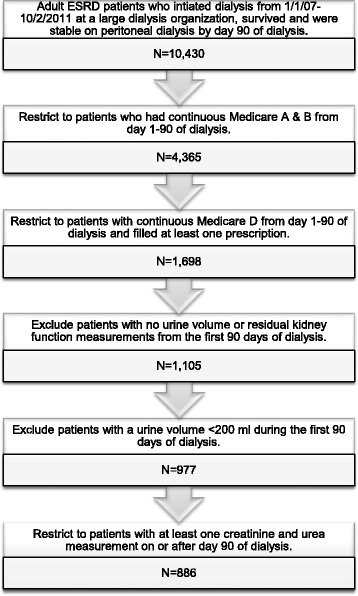
We conducted a retrospective observational cohort study using the US Renal Data System and electronic health records data from a large national dialysis provider. We identified adult patients who initiated PD from 2007 to 2011. Only patients who participated in the federal prescription drug benefit program, Medicare Part D, for the first 90 days of dialysis were included. Patients who filled a prescription for an ACEI or ARB during those 90 days were considered users. We applied Cox proportional hazards models to an inverse probability of treatment-weighted (IPTW) cohort to estimate the hazard ratio (HR) for anuria (24-h urine volume < 200 ml) in ACEI/ARB users vs. non-users.
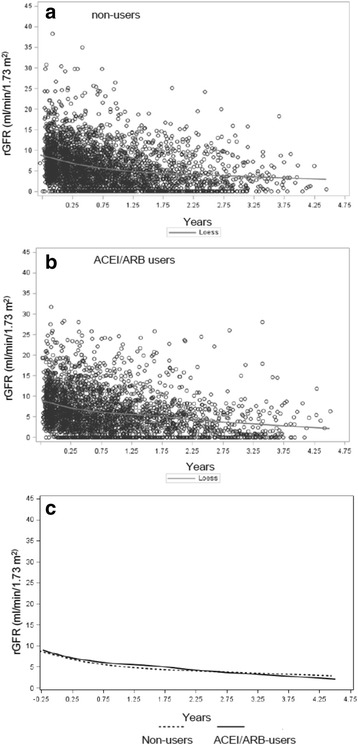
Among 886 patients, 389 (44%) used an ACEI/ARB. Almost a third of these patients were black or Hispanic, and more than a quarter had comorbidities that would have excluded them from the randomized clinical trials of ACEI/ARB. Two hundred eighty patients reached anuria over 840 person-years of follow-up, for a composite event rate of 33 events per 100 person-years. We found no clear association between ACEI/ARB use and progression to anuria [HR: 0.86, 95% CI: 0.73-1.02].
ACEI/ARB use is common in patients initiating PD in the U.S. but was not associated with a lower risk of anuria. Residual confounding by unmeasured variables is an important limitation of this observational study. Still, these findings suggest that pragmatic clinical trials are warranted to test the effectiveness of ACEI/ARB in slowing the decline of residual kidney function in a diverse population of peritoneal dialysis patients with multiple comorbid conditions.
尽管在两项小型随机临床试验中已表明,血管紧张素转换酶抑制剂(ACEI)和血管紧张素 II 受体阻滞剂(ARB)可在一部分接受持续性非卧床腹膜透析(PD)的亚洲患者中保留残余肾功能,但这些药物在患有多种合并症的更多样化患者群体中的有效性尚未得到证实。我们在美国一组开始进行 PD 的患者队列中,研究了使用 ACEI/ARB 与记录的无尿症发生之间的关联。
我们使用美国肾脏数据系统和一家大型全国性透析供应商的电子健康记录数据,进行了一项回顾性观察性队列研究。我们确定了 2007 年至 2011 年开始进行 PD 的成年患者。仅纳入在透析的前 90 天参加联邦处方药福利计划(医疗保险 D 部分)的患者。在这 90 天内开具 ACEI 或 ARB 处方的患者被视为使用者。我们将 Cox 比例风险模型应用于治疗加权逆概率(IPTW)队列,以估计 ACEI/ARB 使用者与非使用者中无尿症(24 小时尿量<200 ml)的风险比(HR)。
在 886 名患者中,389 名(44%)使用了 ACEI/ARB。这些患者中近三分之一为黑人或西班牙裔,超过四分之一患有合并症,这些合并症会使他们被排除在 ACEI/ARB 的随机临床试验之外。在 840 人年的随访中,280 名患者出现无尿症,复合事件发生率为每 100 人年 33 例。我们发现使用 ACEI/ARB 与进展至无尿症之间没有明显关联[HR:0.86,95%CI:0.73 - 1.02]。
在美国开始进行 PD 的患者中,使用 ACEI/ARB 很常见,但与无尿症风险较低无关。未测量变量的残留混杂是这项观察性研究的一个重要局限性。尽管如此,这些发现表明有必要进行务实的临床试验,以测试 ACEI/ARB 在减缓患有多种合并症的不同腹膜透析患者群体残余肾功能下降方面的有效性。