Wang Guoping, Xu Mengyun, Wang Wenyi, Galili Gad
College of Horticulture, South China Agricultural University, Guangzhou 510642, China.
Department of Plant Science, Weizmann Institute of Science, Rehovot 76100, Israel.
Int J Mol Sci. 2017 Jun 19;18(6):1306. doi: 10.3390/ijms18061306.
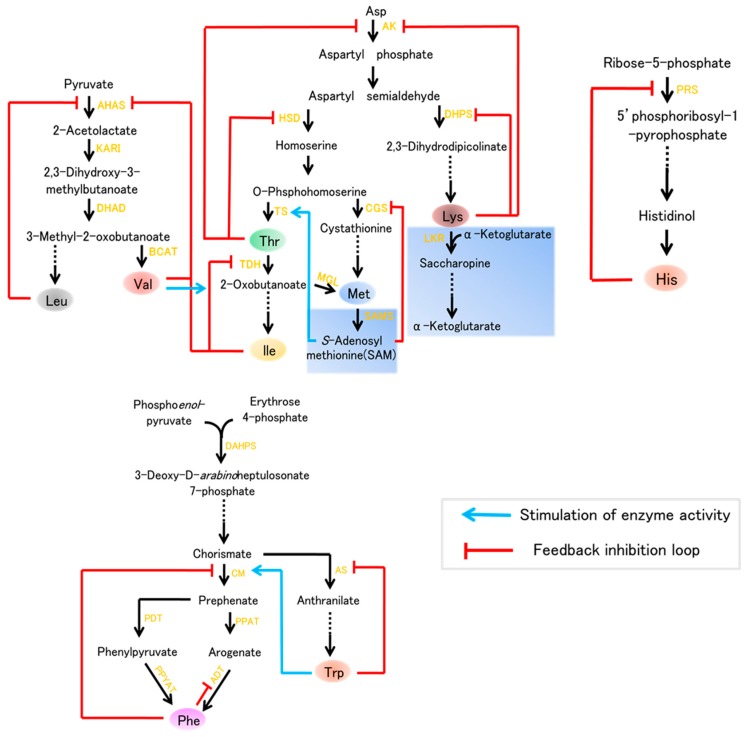
To feed the world's growing population, increasing the yield of crops is not the only important factor, improving crop quality is also important, and it presents a significant challenge. Among the important crops, horticultural crops (particularly fruits and vegetables) provide numerous health compounds, such as vitamins, antioxidants, and amino acids. Essential amino acids are those that cannot be produced by the organism and, therefore, must be obtained from diet, particularly from meat, eggs, and milk, as well as a variety of plants. Extensive efforts have been devoted to increasing the levels of essential amino acids in plants. Yet, these efforts have been met with very little success due to the limited genetic resources for plant breeding and because high essential amino acid content is generally accompanied by limited plant growth. With a deep understanding of the biosynthetic pathways of essential amino acids and their interactions with the regulatory networks in plants, it should be possible to use genetic engineering to improve the essential amino acid content of horticultural plants, rendering these plants more nutritionally favorable crops. In the present report, we describe the recent advances in the enhancement of essential amino acids in horticultural plants and possible future directions towards their bio-fortification.
为了养活世界上不断增长的人口,提高作物产量并非唯一重要因素,改善作物品质同样重要,且这是一项重大挑战。在重要作物中,园艺作物(尤其是水果和蔬菜)能提供多种对健康有益的成分,如维生素、抗氧化剂和氨基酸。必需氨基酸是生物体自身无法合成的氨基酸,因此必须从饮食中获取,特别是从肉类、蛋类、奶类以及多种植物中获取。人们已投入大量精力来提高植物中必需氨基酸的含量。然而,由于植物育种的遗传资源有限,且高必需氨基酸含量通常伴随着植物生长受限,这些努力收效甚微。深入了解必需氨基酸的生物合成途径及其与植物调控网络的相互作用后,利用基因工程提高园艺植物中必需氨基酸的含量、使这些植物成为营养更丰富的作物应该是可行的。在本报告中,我们描述了园艺植物中必需氨基酸强化方面的最新进展以及未来可能的生物强化方向。