Li Jia-Qi, Qiu Yi-Ling, Gong Jing-Yu, Dou Li-Min, Lu Yi, Knisely A S, Zhang Mei-Hong, Luan Wei-Sha, Wang Jian-She
Department of Pediatrics, Jinshan Hospital of Fudan University, Shanghai, 201508, China.
The Center for Pediatric Liver Diseases, Children's Hospital of Fudan University, Shanghai, 201102, China.
BMC Gastroenterol. 2017 Jun 19;17(1):77. doi: 10.1186/s12876-017-0636-3.
Underlying causes in Chinese children with recurrent acute liver failure (RALF), including liver crises less than full acute liver failure, are incompletely understood. We sought to address this by searching for genes mutated in such children.
Five unrelated Chinese boys presenting between 2012 and 2015 with RALF of unexplained etiology were studied. Results of whole exome sequencing were screened for mutations in candidate genes. Mutations were verified in patients and their family members by Sanger sequencing. All 5 boys underwent liver biopsy.
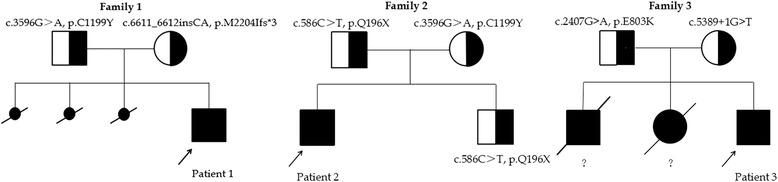
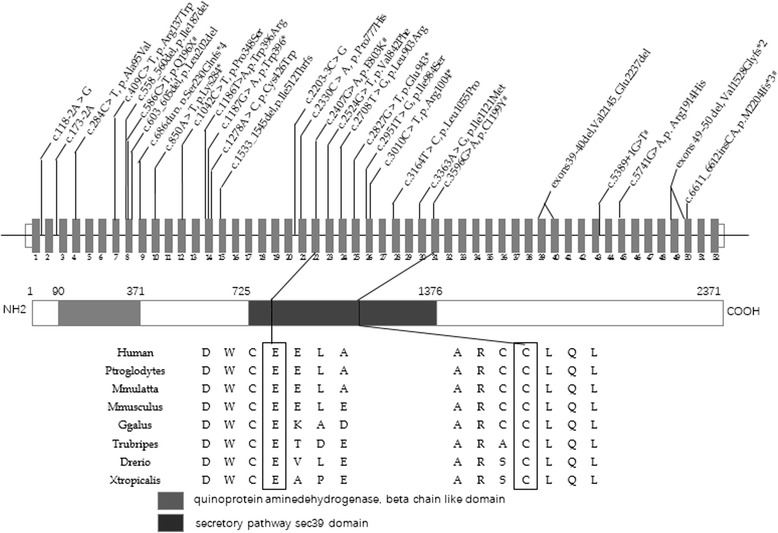
NBAS was the only candidate gene mutated in more than one patient (biallelic mutations, 3 of 5 patients; 5 separate mutations). All NBAS mutations were novel and predictedly pathogenic (frameshift insertion mutation c.6611_6612insCA, missense mutations c.2407G > A and c.3596G > A, nonsense mutation c.586C > T, and splicing-site mutation c.5389 + 1G > T). Of these mutations, 3 lay in distal (C-terminal) regions of NBAS, a novel distribution. Unlike the 2 patients without NBAS mutations, the 3 patients with confirmed NBAS mutations all suffered from a febrile illness before each episode of liver crisis (fever-related RALF), with markedly elevated alanine aminotransferase and aspartate aminotransferase activities 24-72 h after elevation of body temperature, succeeded by severe coagulopathy and mild to moderate jaundice.
As in other countries, so too in China; NBAS disease is a major cause of fever-related RALF in children. The mutation spectrum of NBAS in Chinese children seems different from that described in other populations.
中国儿童复发性急性肝衰竭(RALF,包括程度不及完全性急性肝衰竭的肝危象)的潜在病因尚未完全明确。我们试图通过寻找此类儿童中发生突变的基因来解决这一问题。
对2012年至2015年间出现病因不明的RALF的5名无血缘关系的中国男孩进行了研究。对全外显子测序结果进行筛选,以寻找候选基因中的突变。通过桑格测序在患者及其家庭成员中验证突变。所有5名男孩均接受了肝活检。
NBAS是唯一在不止一名患者中发生突变的候选基因(双等位基因突变,5名患者中有3名;共5个不同的突变)。所有NBAS突变均为新发现的且预测具有致病性(移码插入突变c.6611_6612insCA、错义突变c.2407G>A和c.3596G>A、无义突变c.586C>T以及剪接位点突变c.5389+1G>T)。在这些突变中,有3个位于NBAS的远端(C端)区域,这是一种新的分布情况。与2名无NBAS突变的患者不同,3名确诊为NBAS突变的患者在每次肝危象发作前均患有发热性疾病(发热相关的RALF)、体温升高后24 - 72小时丙氨酸氨基转移酶和天冬氨酸氨基转移酶活性显著升高,随后出现严重凝血功能障碍和轻至中度黄疸。
与其他国家一样,在中国,NBAS疾病也是儿童发热相关RALF的主要原因。中国儿童中NBAS的突变谱似乎与其他人群中描述的不同。