Fábos Beáta, Farkas Katalin, Tóth Lola, Sulák Adrienn, Tripolszki Kornélia, Tihanyi Mariann, Németh Réka, Vas Krisztina, Csoma Zsanett, Kemény Lajos, Széll Márta, Nagy Nikoletta
Mór Kaposi Teaching Hospital of the Somogy County, Kaposvár, Hungary.
MTA-SZTE Dermatological Research Group, University of Szeged, Szeged, Hungary.
Eur J Med Res. 2017 Jun 19;22(1):20. doi: 10.1186/s40001-017-0262-0.
Oculocutaneous albinism (OCA) is a clinically and genetically heterogenic group of pigmentation abnormalities characterized by variable hair, skin, and ocular hypopigmentation. Six known genes and a locus on human chromosome 4q24 have been implicated in the etiology of isolated OCA forms (OCA 1-7).
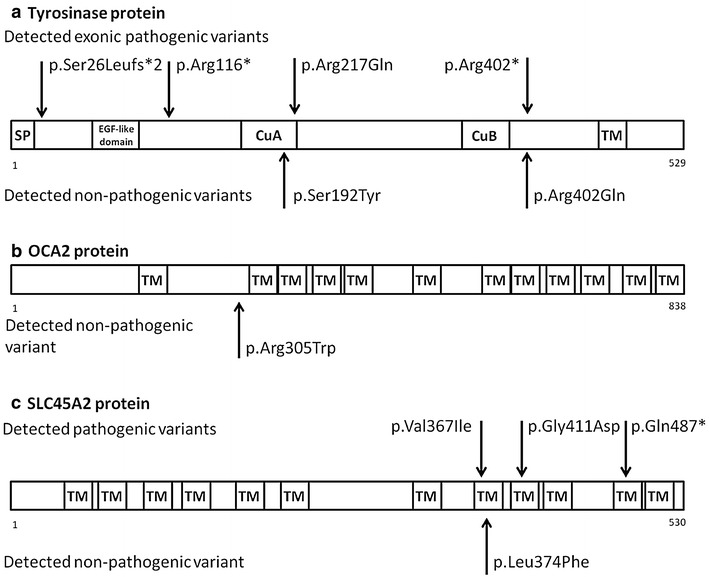
The most frequent OCA types among Caucasians are OCA1, OCA2, and OCA4. We aimed to investigate genes responsible for the development of these OCA forms in Hungarian OCA patients (n = 13). Mutation screening and polymorphism analysis were performed by direct sequencing on TYR, OCA2, SLC45A2 genes.
Although the clinical features of the investigated Hungarian OCA patients were identical, the molecular genetic data suggested OCA1 subtype in eight cases and OCA4 subtype in two cases. The molecular diagnosis was not clearly identifiable in three cases. In four patients, two different heterozygous known pathogenic or predicted to be pathogenic mutations were present. Seven patients had only one pathogenic mutation, which was associated with non-pathogenic variants in six cases. In two patients no pathogenic mutation was identified.
Our results suggest that the concomitant screening of the non-pathogenic variants-which alone do not cause the development of OCA, but might have clinical significance in association with a pathogenic variant-is important. Our results also show significant variation in the disease spectrum compared to other populations. These data also confirm that the concomitant analysis of OCA genes is critical, providing new insights to the phenotypic diversity of OCA and expanding the mutation spectrum of OCA genes in Hungarian patients.
眼皮肤白化病(OCA)是一组临床和遗传异质性的色素沉着异常疾病,其特征为毛发、皮肤和眼部色素减退程度各异。已知有六个基因以及人类染色体4q24上的一个基因座与孤立型OCA(OCA 1 - 7)的病因有关。
在白种人中最常见的OCA类型是OCA1、OCA2和OCA4。我们旨在研究匈牙利OCA患者(n = 13)中这些OCA类型发生发展的相关基因。通过直接测序对TYR、OCA2、SLC45A2基因进行突变筛查和多态性分析。
尽管所研究的匈牙利OCA患者临床特征相同,但分子遗传学数据显示8例为OCA1亚型,2例为OCA4亚型。3例的分子诊断不明确。4例患者存在两种不同的杂合已知致病或预测致病突变。7例患者仅有一个致病突变,其中6例与非致病变异相关。2例患者未鉴定出致病突变。
我们的结果表明,对非致病变异进行联合筛查很重要,这些变异单独不会导致OCA的发生,但与致病变异相关时可能具有临床意义。我们的结果还显示,与其他人群相比,疾病谱存在显著差异。这些数据也证实了对OCA基因进行联合分析至关重要,为OCA的表型多样性提供了新见解,并扩大了匈牙利患者中OCA基因的突变谱。