Prabhakaran Sangeetha, Rizk Victoria T, Ma Zhenjun, Cheng Chia-Ho, Berglund Anders E, Coppola Dominico, Khalil Farah, Mulé James J, Soliman Hatem H
H. Lee Moffitt Cancer Center and Research Institute, Tampa, FL, USA.
University of South Florida Morsani College of Medicine, Tampa, FL, USA.
Breast Cancer Res. 2017 Jun 19;19(1):71. doi: 10.1186/s13058-017-0864-z.
A unique 12-chemokine gene expression score (CS) accurately predicted the presence of tumor-localized, ectopic lymph node-like structures (TL-ELNs) and improved overall survival (OS) in primary colorectal cancer and metastatic melanoma. We analyzed the correlation between CS, clinicopathological variables, molecular data, and 366 survival in Moffitt Cancer Center's Total Cancer Care (TCC) patients with non-metastatic breast cancer.
Affymetrix gene expression profiles were used to interrogate the CS by the principal component method. Breast tumors were classified as high or low score based on median split, and correlations between clinicopathologic variables, PAM50 molecular subtype, and ELN formation were analyzed using the TCC dataset. Differences in overall survival (OS) and recurrence-free survival (RFS) in the larger KM Plot breast cancer public datasets were compared using Kaplan-Meier curves.
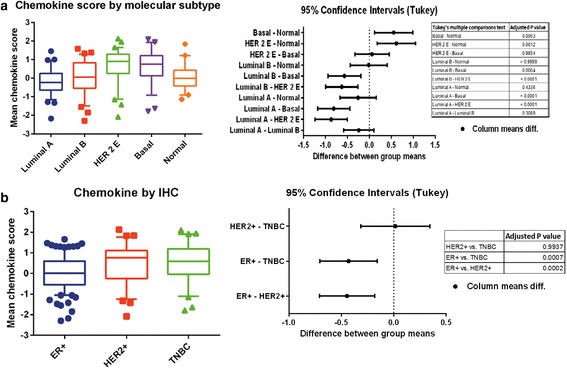
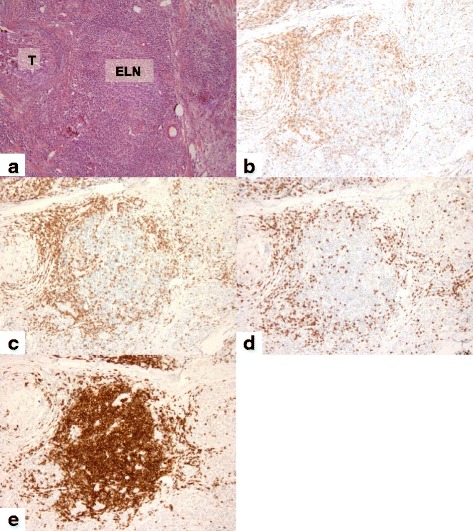
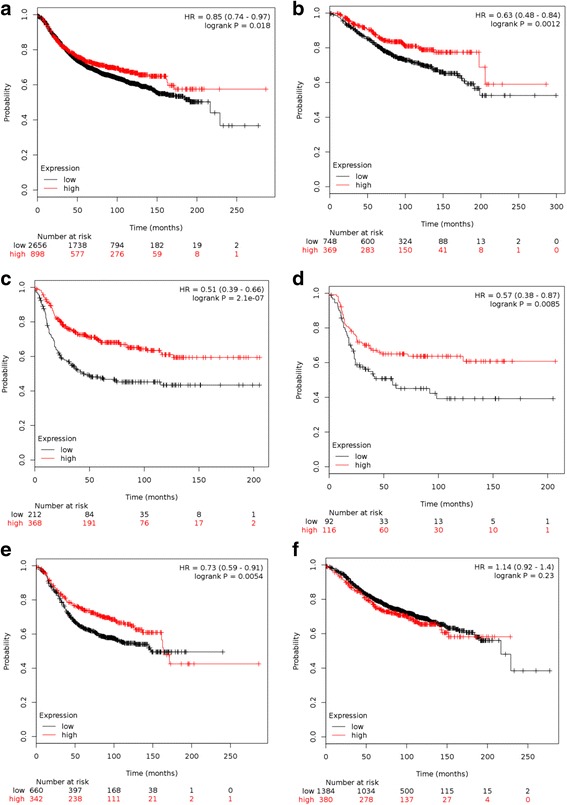
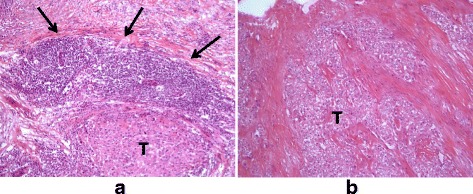
We divided the Total Cancer Care (TCC) breast cancer patients into two groups of high or low CS. Mean CS was 0.24 (range, 2.2-2.1). Patients with higher CS were more likely to be white (172 vs. 159; p = 0.03), had poorly differentiated tumors (112 vs. 59; p <0.0001), ER/PR negative (41 vs. 26) and HER2 positive (36 vs. 19; p = 0.001), and contain TL-ELNs. Higher CS scores were also seen in the basal and HER2+ molecular subtypes. In the KM Plot breast cancer datasets higher CS patients demonstrated superior OS (HR = 0.73, p = 0.008) and RFS (HR 0.76, p = <0.0001), especially in basal and HER2+ patients.
High CS breast tumors tend to be higher grade, basal or HER2+, and present more frequently in Caucasians. However, this group of patients also shows the presence of TL-ELNs within the tumor microenvironment and has better survival outcomes. The CS is a novel tool that can identify breast cancer patients with tumors of a unique intratumoral immune composition and better prognosis. Whether or not the CS is a predictive response marker in breast cancer patients undergoing immunotherapy remains to be determined.
一种独特的12种趋化因子基因表达评分(CS)能够准确预测原发性结直肠癌和转移性黑色素瘤中肿瘤局部异位淋巴结样结构(TL - ELN)的存在,并改善总生存期(OS)。我们分析了莫菲特癌症中心全面癌症护理(TCC)项目中,非转移性乳腺癌患者的CS、临床病理变量、分子数据与生存情况之间的相关性。
采用Affymetrix基因表达谱,通过主成分法来测定CS。根据中位数分割将乳腺肿瘤分为高分或低分,使用TCC数据集分析临床病理变量、PAM50分子亚型与ELN形成之间的相关性。使用Kaplan - Meier曲线比较更大规模的KM Plot乳腺癌公共数据集中总生存期(OS)和无复发生存期(RFS)的差异。
我们将全面癌症护理(TCC)项目中的乳腺癌患者分为CS高分组和低分组。平均CS为0.24(范围:2.2 - 2.1)。CS较高的患者更可能为白人(172例对159例;p = 0.03),肿瘤分化程度低(112例对59例;p < 0.0001),雌激素受体/孕激素受体(ER/PR)阴性(41例对26例)且人表皮生长因子受体2(HER2)阳性(36例对19例;p = 0.001),并且含有TL - ELN。在基底样和HER2 +分子亚型中也观察到较高的CS评分。在KM Plot乳腺癌数据集中,CS较高的患者表现出更好的总生存期(HR = 0.73,p = 0.008)和无复发生存期(HR 0.76,p < 0.0001),尤其是在基底样和HER2 +患者中。
CS高的乳腺肿瘤往往分级更高,属于基底样或HER2 +亚型,且在白种人中更常见。然而,这组患者在肿瘤微环境中也存在TL - ELN,并且生存结局更好。CS是一种新型工具,可识别具有独特瘤内免疫组成和更好预后的乳腺癌患者群体。CS是否为接受免疫治疗的乳腺癌患者的预测反应标志物仍有待确定。