Bjørnvad Charlotte R, Nielsen Mie E, Hansen Susanna E M, Nielsen Dorte H
Department of Veterinary Clinical and Animal Sciences, Faculty of Health and Medical Sciences, University of Copenhagen, Dyrlaegevej 16, 1870 Frederiksberg C, Denmark.
J Nutr Sci. 2017 May 15;6:e20. doi: 10.1017/jns.2017.16. eCollection 2017.
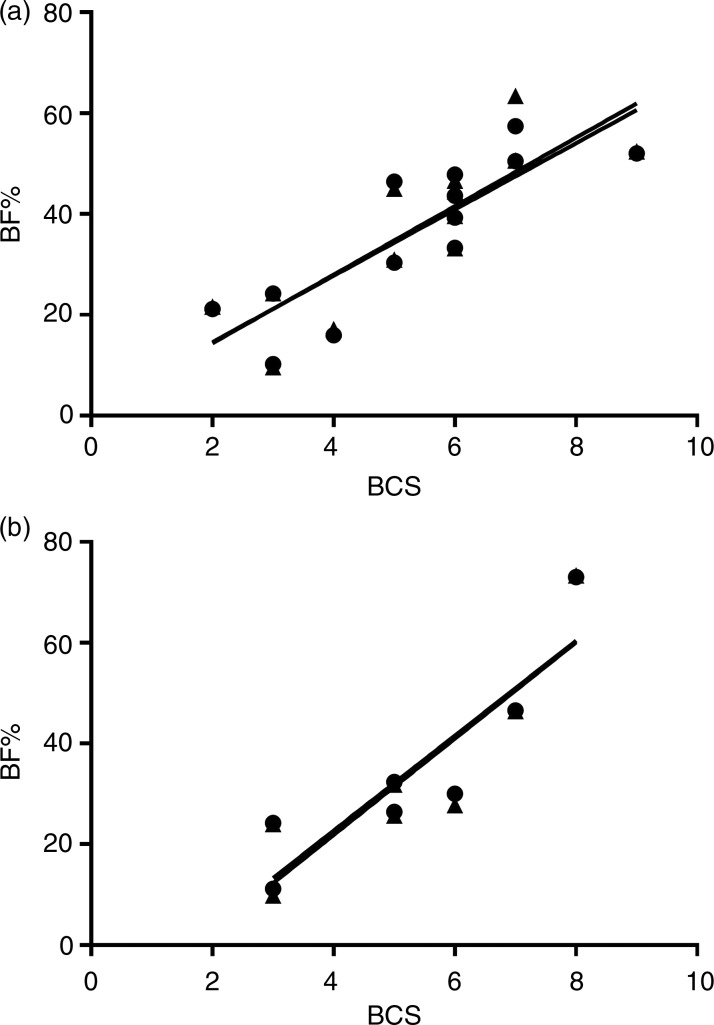
Dual-energy X-ray absorptiometry (DEXA) has been used to assess body composition in dogs and cats in several studies, but studies are difficult to compare for several reasons. The aim of the present study was to evaluate whether positioning of dogs or cats in either dorsal or ventral recumbency during DEXA scanning influences results. Dogs and cats that were brought to the University Hospital for Companion Animals for euthanasia during the period 15 September-6 November 2015 were consecutively recruited if owners signed a written consent. Following euthanasia and before rigor mortis, the animals were body condition scored (BCS, nine-point scale) and DEXA scanned. DEXA measurements of total body mass (TBM), bone mineral content (BMC), bone mineral density (BMD), lean soft tissue mass (LSTM) and body fat (BF) were performed five times in ventral and two times in dorsal recumbency on each animal. Differences between positioning were analysed using Student's test or Wilcoxon's test depending on normality of the data. A total of thirteen dogs and seven cats of different breeds, size, sexes and age were included. The CV for DEXA parameters in ventral or dorsal recumbency were, for dogs, TBM ≤ 0·1 %, BMC ≤ 1·63 %, BMD ≤ 1·29 %, LSTM ≤ 0·89 % and BF ≤ 1·52 %; and, for cats, TBM ≤ 0·08 %, BMC ≤ 0·61 %, BMD ≤ 0·49 %, LSTM ≤ 0·45 % and BF ≤ 0·88 %. In both positions, a good correlation was found for dogs ( 0·84-0·85; < 0·0003) and cats ( 0·89-0·90; < 0·0081) between the nine-point BCS system and BF percentage measured by DEXA. Ventral and dorsal recumbency provides comparable results, except that BMD measures were higher in dorsal recumbency ( < 0·0004).
在多项研究中,双能X线吸收法(DEXA)已被用于评估犬猫的身体成分,但由于多种原因,这些研究难以进行比较。本研究的目的是评估在DEXA扫描过程中,犬猫处于背卧位或腹卧位时的体位是否会影响结果。如果主人签署书面同意书,2015年9月15日至11月6日期间被带到大学动物医院安乐死的犬猫将被连续招募。安乐死后且在尸僵出现前,对动物进行身体状况评分(BCS,九分制)并进行DEXA扫描。对每只动物在腹卧位进行5次全身质量(TBM)、骨矿物质含量(BMC)、骨矿物质密度(BMD)、瘦软组织质量(LSTM)和体脂(BF)的DEXA测量,在背卧位进行2次测量。根据数据的正态性,使用学生t检验或威尔科克森检验分析体位之间的差异。共纳入了13只不同品种、大小、性别和年龄的犬和7只猫。犬在腹卧位或背卧位时DEXA参数的变异系数分别为:TBM≤0.1%,BMC≤1.63%,BMD≤1.29%,LSTM≤0.89%,BF≤1.52%;猫的分别为:TBM≤0.08%,BMC≤0.61%,BMD≤0.49%,LSTM≤0.45%,BF≤0.88%。在两个体位下,犬(r = 0.84 - 0.85;P < 0.0003)和猫(r = 0.89 - 0.90;P < 0.0081)的九分制BCS系统与通过DEXA测量的BF百分比之间均发现良好的相关性。腹卧位和背卧位提供了可比的结果,但背卧位的BMD测量值更高(P < 0.0004)。