Alexander Janet E, Colyer Alison, Morris Penelope J
WALTHAM Centre for Pet Nutrition, Waltham-on-the-Wolds, Melton Mowbray LE14 4RT, UK.
J Nutr Sci. 2017 May 24;6:e26. doi: 10.1017/jns.2017.26. eCollection 2017.
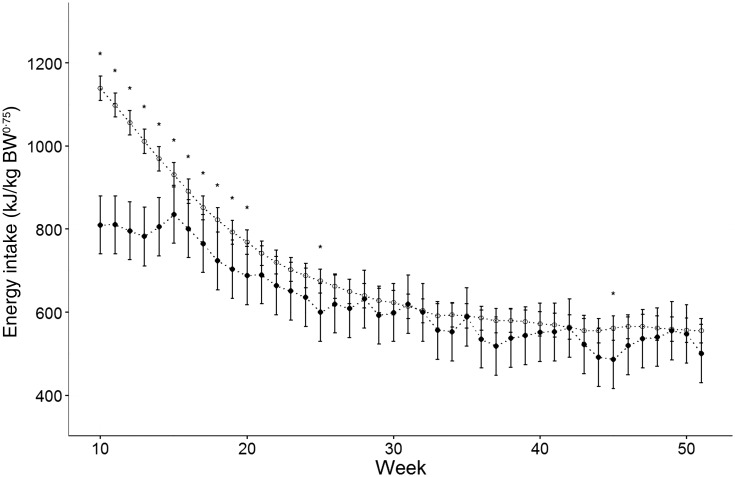
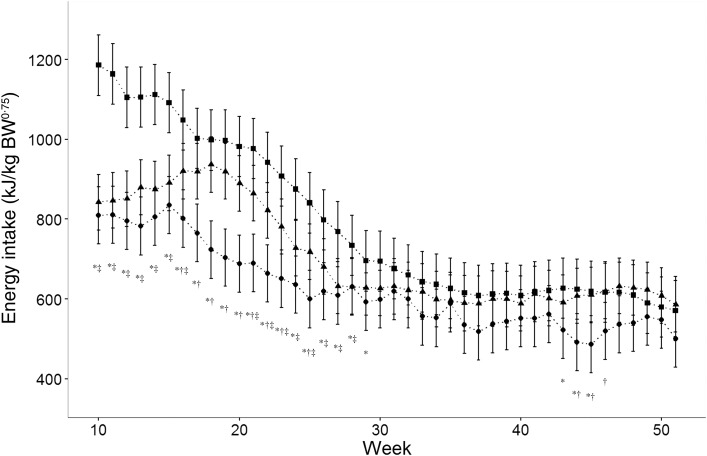
The 2006 National Research Council (NRC) equation calculating puppy energy requirements does not account for reported breed differences in growth pattern. Energy requirements of toy breed puppies are unknown and it is unclear whether feeding guidelines should differ between breeds. Energy requirements of Yorkshire terrier (YT) puppies were observed over their first year of life and compared with those predicted by the NRC and those previously observed in large (Labrador retriever) and medium (miniature Schnauzer; MS) breed puppies. Twenty-two puppies (from eight litters) were offered complete and balanced diets to maintain ideal body condition score (BCS). Energy intake, body weight and BCS were recorded from 10 to 52 weeks of age. Every 12 weeks, health was monitored by veterinary examination, routine haematology and plasma biochemistry. Puppies remained clinically healthy with normal skeletal development throughout. After analysis by linear mixed models it was observed that the NRC equation overestimates YT energy requirements between 10 and 20 weeks of age by up to 324·3 (95 % CI 390·4, 258·2) kJ/kg. Energy intake was lower ( < 0·05) in YT than Labradors until 29 weeks by up to 376·6 (95 % CI 477·4, 275·3) kJ/kg and lower than MS between 16 and 25 weeks by up to 216·3 (95 % CI 313·0, 119·7) kJ/kg ( < 0·05). Data indicate differences in toy, medium and large breed energy requirements for growth. The NRC equation for puppy energy requirements overestimated the requirements of this YT population, suggesting the need for breed-specific feeding guides for growth to avoid overfeeding.
2006年美国国家研究委员会(NRC)计算幼犬能量需求的公式未考虑已报道的不同品种在生长模式上的差异。玩具犬品种幼犬的能量需求未知,而且不同品种之间的喂养指南是否应该有所不同也不清楚。对约克夏梗(YT)幼犬出生后第一年的能量需求进行了观察,并与NRC预测的需求以及之前在大型犬(拉布拉多寻回犬)和中型犬(迷你雪纳瑞;MS)品种幼犬中观察到的需求进行了比较。给22只幼犬(来自8窝)提供完全均衡的饮食,以维持理想的身体状况评分(BCS)。记录了10至52周龄期间的能量摄入量、体重和BCS。每12周通过兽医检查、常规血液学和血浆生物化学监测健康状况。幼犬在整个过程中临床健康,骨骼发育正常。通过线性混合模型分析后发现,NRC公式在10至20周龄期间高估了YT的能量需求,最高可达324.3(95%可信区间390.4, 258.2)kJ/kg。在29周龄之前,YT的能量摄入量比拉布拉多犬低(<0.05),最高可达376.6(95%可信区间477.4, 275.3)kJ/kg,在16至25周龄期间比MS低,最高可达216.3(95%可信区间313.0, 119.7)kJ/kg(<0.05)。数据表明玩具犬、中型犬和大型犬在生长过程中的能量需求存在差异。NRC的幼犬能量需求公式高估了该YT群体的需求,这表明需要针对不同品种的生长喂养指南以避免过度喂养。