Department of Biochemistry and Molecular Biology, University of Maryland, Baltimore, Baltimore, MD 21201, USA.
Division of Cardiovascular Medicine, Department of Medicine, University of Maryland, Baltimore, Baltimore, MD 21201, USA.
Sci Adv. 2017 Jun 7;3(6):e1603081. doi: 10.1126/sciadv.1603081. eCollection 2017 Jun.
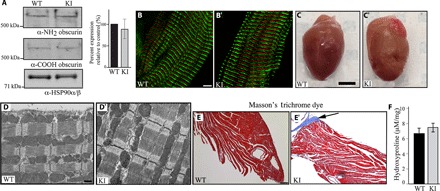
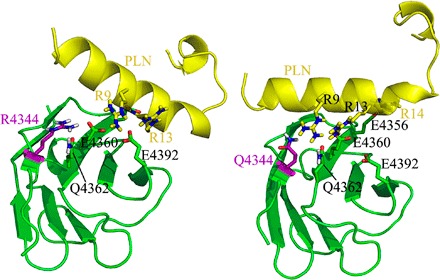
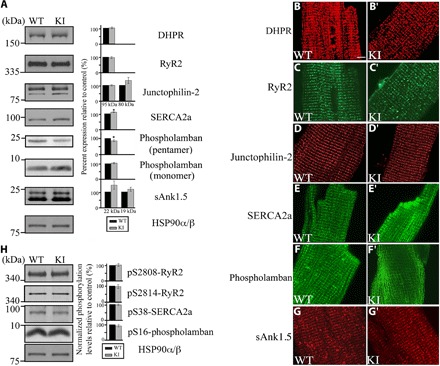
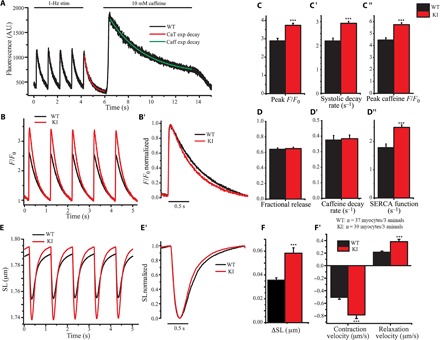
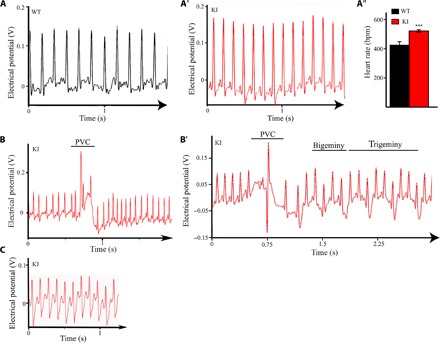
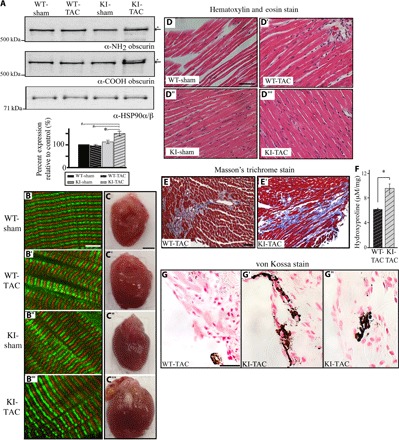
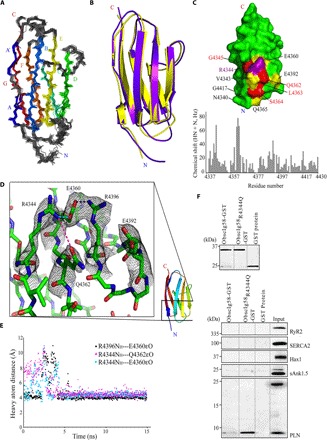
Obscurins are cytoskeletal proteins with structural and regulatory roles encoded by . Mutations in are associated with the development of hypertrophic cardiomyopathy (HCM) and dilated cardiomyopathy (DCM). Specifically, the R4344Q mutation present in immunoglobulin domain 58 (Ig58) was the first to be linked with the development of HCM. To assess the effects of R4344Q in vivo, we generated the respective knock-in mouse model. Mutant obscurins are expressed and incorporated normally into sarcomeres. The expression patterns of sarcomeric and Ca-cycling proteins are unaltered in sedentary 1-year-old knock-in myocardia, with the exception of sarco/endoplasmic reticulum Ca adenosine triphosphatase 2 (SERCA2) and pentameric phospholamban whose levels are significantly increased and decreased, respectively. Isolated cardiomyocytes from 1-year-old knock-in hearts exhibit increased Ca-transients and Ca-load in the sarcoplasmic reticulum and faster contractility kinetics. Moreover, sedentary 1-year-old knock-in animals develop tachycardia accompanied by premature ventricular contractions, whereas 2-month-old knock-in animals subjected to pressure overload develop a DCM-like phenotype. Structural analysis revealed that the R4344Q mutation alters the distribution of electrostatic charges over the Ig58 surface, thus interfering with its binding capabilities. Consistent with this, wild-type Ig58 interacts with phospholamban modestly, and this interaction is markedly enhanced in the presence of R4344Q. Together, our studies demonstrate that under sedentary conditions, the R4344Q mutation results in Ca deregulation and spontaneous arrhythmia, whereas in the presence of chronic, pathological stress, it leads to cardiac remodeling and dilation. We postulate that enhanced binding between mutant obscurins and phospholamban leads to SERCA2 disinhibition, which may underlie the observed pathological alterations.
obscurins 是一种细胞骨架蛋白,具有结构和调节作用,由 编码。 中的突变与肥厚型心肌病 (HCM) 和扩张型心肌病 (DCM) 的发展有关。具体来说,存在于免疫球蛋白结构域 58 (Ig58) 中的 R4344Q 突变是第一个与 HCM 发展相关的突变。为了评估 R4344Q 在体内的影响,我们生成了相应的敲入小鼠模型。突变 obscurins 正常表达并正常整合到肌节中。在静止的 1 岁敲入心肌中,除了肌浆网和 Ca 循环蛋白的表达模式没有改变,肌浆网 Ca 三磷酸腺苷酶 2 (SERCA2) 和五聚体磷酸化肌球蛋白轻链 2 的水平分别显著增加和减少。来自 1 岁敲入心脏的分离心肌细胞表现出增加的 Ca 瞬变和肌浆网中的 Ca 负荷以及更快的收缩动力学。此外,静止的 1 岁敲入动物发生心动过速伴室性期前收缩,而 2 个月大的敲入动物在受到压力超负荷后发展为 DCM 样表型。结构分析表明,R4344Q 突变改变了 Ig58 表面的静电电荷分布,从而干扰了其结合能力。与此一致的是,野生型 Ig58 与磷酸化肌球蛋白适度相互作用,而在存在 R4344Q 的情况下,这种相互作用明显增强。总之,我们的研究表明,在静止状态下,R4344Q 突变导致 Ca 失调和自发性心律失常,而在存在慢性病理应激的情况下,它导致心脏重塑和扩张。我们假设突变 obscurins 和磷酸化肌球蛋白之间增强的结合导致 SERCA2 去抑制,这可能是观察到的病理改变的基础。