Department of Medicine III, University Hospital, LMU Munich, Munich, Germany.
Hematology Department, Hôpital Claude Huriez, Unité GRITA, Lille University, Lille.
Ann Oncol. 2017 Sep 1;28(9):2169-2178. doi: 10.1093/annonc/mdx289.
Copanlisib is a pan-class I phosphatidylinositol 3-kinase inhibitor with predominant activity against the α- and δ-isoforms.
This phase II study evaluated the response rate of copanlisib administered intravenously on days 1, 8, and 15 of a 28-day cycle, in patients with indolent or aggressive malignant lymphoma. Archival tumor tissues were used for immunohistochemistry, gene-expression profiling, and mutation analysis.
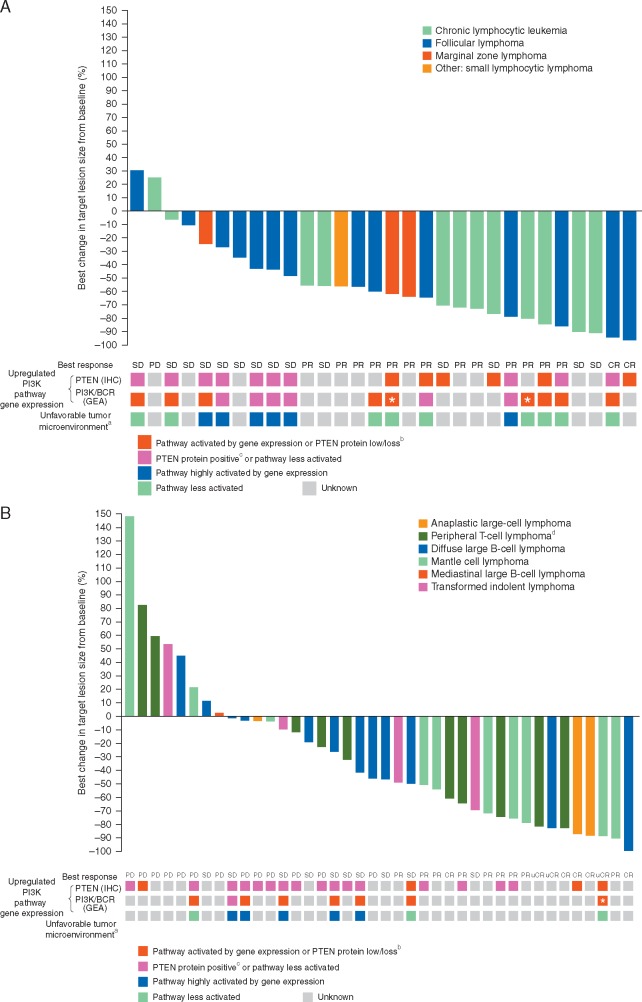
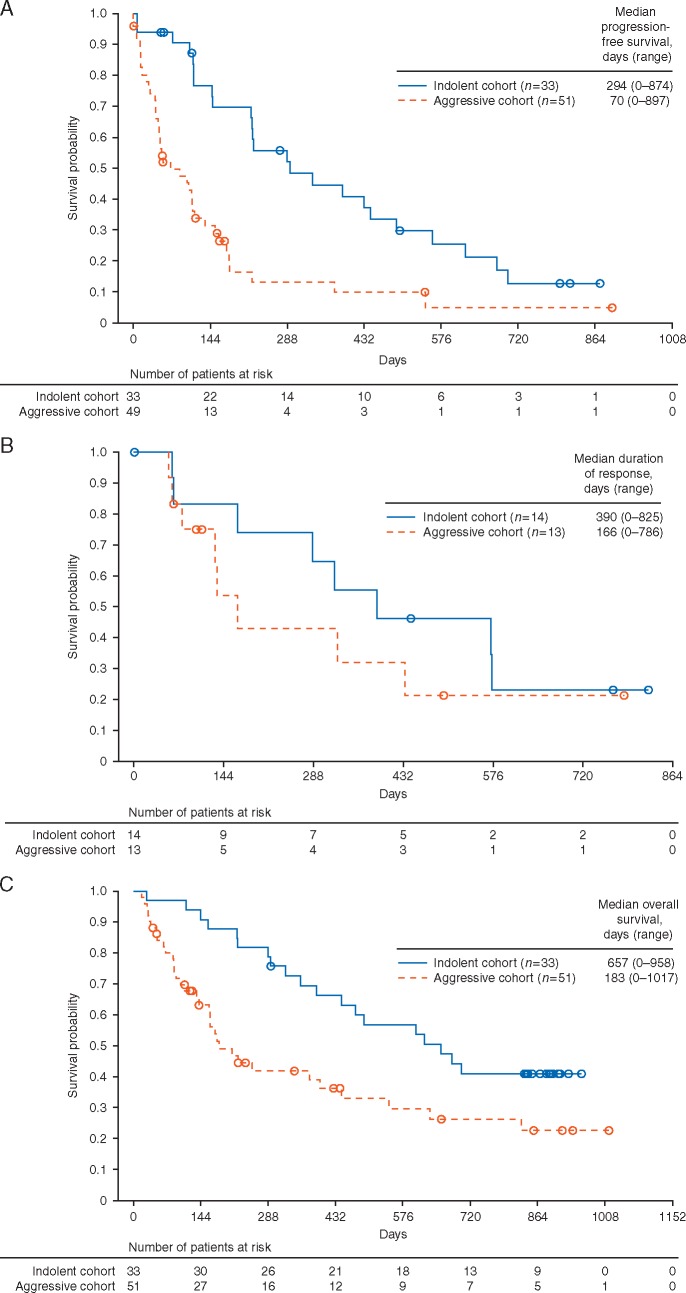
Thirty-three patients with indolent lymphoma and 51 with aggressive lymphoma received copanlisib. Follicular lymphoma (48.5%) and peripheral T-cell lymphoma (33.3%) were the most common histologic subtypes. Most patients (78.6%) had received prior rituximab and 54.8% were rituximab-refractory. Median duration of treatment was 23 and 8 weeks in the indolent and aggressive cohorts, respectively (overall range 2-138). Eighty patients were evaluated for efficacy. The objective response rate was 43.7% (14/32) in the indolent cohort and 27.1% (13/48) in the aggressive cohort; median progression-free survival was 294 days (range 0-874) and 70 days (range 0-897), respectively; median duration of response was 390 days (range 0-825) and 166 days (range 0-786), respectively. Common adverse events included hyperglycemia (57.1%; grade ≥3, 23.8%), hypertension (54.8%; grade ≥3, 40.5%), and diarrhea (40.5%; grade ≥3, 4.8%), all generally manageable. Neutropenia occurred in 28.6% of patients (grade 4, 11.9%). Molecular analyses showed enhanced antitumor activity in tumors with upregulated phosphatidylinositol 3-kinase pathway gene expression.
Intravenous copanlisib demonstrated promising efficacy and manageable toxicity in heavily pretreated patients with various subtypes of indolent and aggressive malignant lymphoma. Subtype-specific studies of copanlisib in patients with follicular, peripheral T-cell, and mantle cell lymphomas are ongoing. This trial is registered with ClinicalTrials.gov number NCT01660451 (Part A).
Copanlisib 是一种具有广泛活性的 I 类磷脂酰肌醇 3-激酶抑制剂,主要针对 α 和 δ 同工酶。
本 II 期研究评估了静脉注射 copanlisib 在 28 天周期的第 1、8 和 15 天给药的反应率,用于治疗惰性或侵袭性恶性淋巴瘤患者。使用存档的肿瘤组织进行免疫组织化学、基因表达谱分析和突变分析。
33 例惰性淋巴瘤患者和 51 例侵袭性淋巴瘤患者接受了 copanlisib 治疗。滤泡性淋巴瘤(48.5%)和外周 T 细胞淋巴瘤(33.3%)是最常见的组织学亚型。大多数患者(78.6%)接受过利妥昔单抗治疗,54.8%为利妥昔单抗难治性。惰性和侵袭性队列的中位治疗持续时间分别为 23 周和 8 周(总范围 2-138 周)。80 例患者接受了疗效评估。在惰性队列中,客观缓解率为 43.7%(14/32),在侵袭性队列中为 27.1%(13/48);无进展生存期的中位数分别为 294 天(范围 0-874 天)和 70 天(范围 0-897 天);中位缓解持续时间分别为 390 天(范围 0-825 天)和 166 天(范围 0-786 天)。常见的不良反应包括高血糖症(57.1%;≥3 级,23.8%)、高血压(54.8%;≥3 级,40.5%)和腹泻(40.5%;≥3 级,4.8%),均易于管理。中性粒细胞减少症发生在 28.6%的患者中(4 级,11.9%)。分子分析显示,在磷脂酰肌醇 3-激酶通路基因表达上调的肿瘤中,抗肿瘤活性增强。
静脉注射 copanlisib 在多种亚型的惰性和侵袭性恶性淋巴瘤的大量预处理患者中表现出有希望的疗效和可管理的毒性。正在对滤泡性、外周 T 细胞和套细胞淋巴瘤患者进行 copanlisib 的亚型特异性研究。该试验在 ClinicalTrials.gov 登记,编号为 NCT01660451(A 部分)。