Ravona-Springer Ramit, Heymann Anthony, Schmeidler James, Moshier Erin, Guerrero-Berroa Elizabeth, Soleimani Laili, Sano Mary, Leroith Derek, Preiss Rachel, Tzukran Ruth, Silverman Jeremy M, Beeri Michal Schnaider
The Joseph Sagol Neuroscience Center, Sheba Medical Center, Ramat Gan, Israel
Sackler Faculty of Medicine, Tel Aviv University, Tel Aviv, Israel.
Diabetes Care. 2017 Sep;40(9):1187-1193. doi: 10.2337/dc16-2754. Epub 2017 Jun 20.
This study aimed to analyze the relationship of variability in hemoglobin A (HbA) over years with subsequent depressive symptoms.
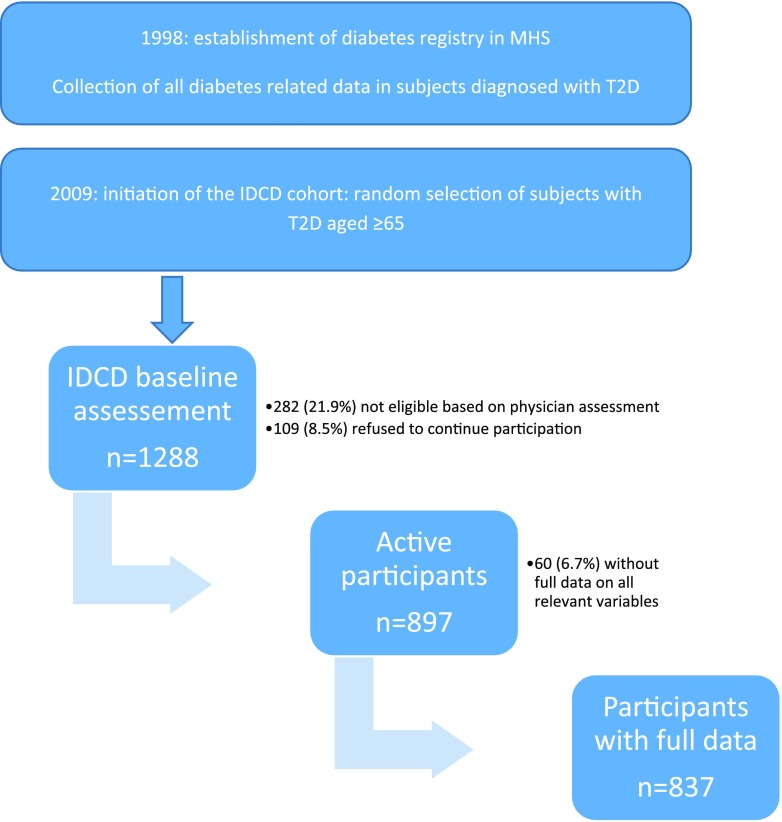
Subjects ( = 837) were participants of the Israel Diabetes and Cognitive Decline (IDCD) study, which aimed to examine the relationship of characteristics of long-term type 2 diabetes with cognitive decline. All pertain to a diabetes registry established in 1998, which contains an average of 18 HbA measurements per subject. The results presented here are based on the IDCD baseline examination. Symptoms of depression were assessed using the 15-item version of the Geriatric Depression Scale (GDS). To quantify the association between variability in glycemic control (measured as the SD of HbA measurements [HbA-SD]) since 1998 with the number of depression symptoms at IDCD baseline, incidence rate ratios (IRRs) and corresponding 95% CIs were estimated via negative binomial regression modeling and used to account for the overdispersion in GDS scores.
Subjects' ages averaged 72.74 years (SD 4.63 years), and the mean number of years in the diabetes registry was 8.7 (SD 2.64 years). The mean GDS score was 2.16 (SD 2.26); 10% of subjects had a GDS score ≥6, the cutoff for clinically significant depression. Mean HbA significantly correlated with HbA-SD ( = 0.6625; < 0.0001). The SD, but not the mean, of HbA measurements was significantly associated with the number of subsequent depressive symptoms. For each additional 1% increase in HbA-SD, the number of depressive symptoms increased by a factor of 1.31 (IRR = 1.31 [95% CI 1.03-1.67]; = 0.03).
Variability in glycemic control is associated with more depressive symptoms.
本研究旨在分析多年来血红蛋白A(HbA)变异性与随后出现的抑郁症状之间的关系。
研究对象(n = 837)为以色列糖尿病与认知衰退(IDCD)研究的参与者,该研究旨在探讨长期2型糖尿病特征与认知衰退之间的关系。所有数据均来自1998年建立的糖尿病登记处,每位受试者平均有18次HbA测量值。此处呈现的结果基于IDCD基线检查。使用老年抑郁量表(GDS)的15项版本评估抑郁症状。为了量化1998年以来血糖控制变异性(以HbA测量值的标准差[HbA-SD]衡量)与IDCD基线时抑郁症状数量之间的关联,通过负二项回归模型估计发病率比(IRR)及相应的95%置信区间(CI),并用于解释GDS分数中的过度离散现象。
受试者平均年龄为72.74岁(标准差4.63岁),在糖尿病登记处的平均年限为8.7年(标准差2.64年)。GDS平均得分为2.16(标准差2.26);10%的受试者GDS得分≥6,这是临床显著抑郁的临界值。平均HbA与HbA-SD显著相关(r = 0.6625;P < 0.0001)。HbA测量值的标准差而非平均值与随后的抑郁症状数量显著相关。HbA-SD每增加1%,抑郁症状数量增加1.31倍(IRR = 1.31 [95%CI 1.03 - 1.67];P = 0.03)。
血糖控制变异性与更多抑郁症状相关。