Zhou Ya-Li, Chen Chun-Li, Wang Yi-Xiao, Tong Yao, Fang Xiao-Ling, Li Lin, Wang Zhao-Yang
Department of Ophthalmology, Shanghai Ninth People's Hospital, Shanghai Jiaotong University School of Medicine, Shanghai, 200011, China.
Department of Ophthalmology, Shengli Oilfield Central Hospital, Dongying, Shandong, China.
BMC Ophthalmol. 2017 Jun 21;17(1):97. doi: 10.1186/s12886-017-0487-2.
Anti-angiogenesis treatments are the most commonly used treatments for the vision loss caused by exudative age-related macular degeneration (AMD), in which the anti-vascular endothelial growth factor (VEGF) drugs with ranibizumab and bevacizumab are current standard treatments. However, the outcome of anti-VEGF therapeutics is not uniform in all patients.
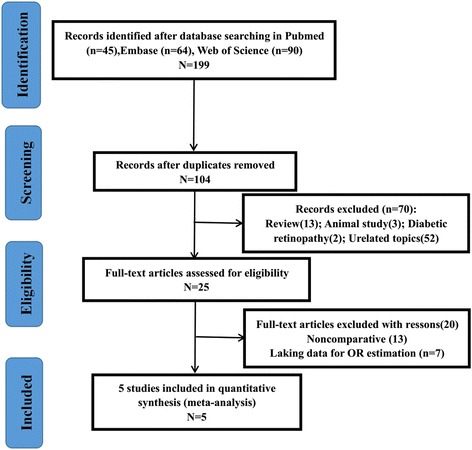
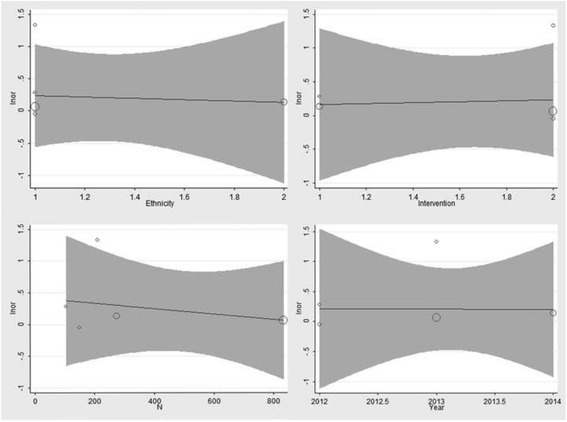
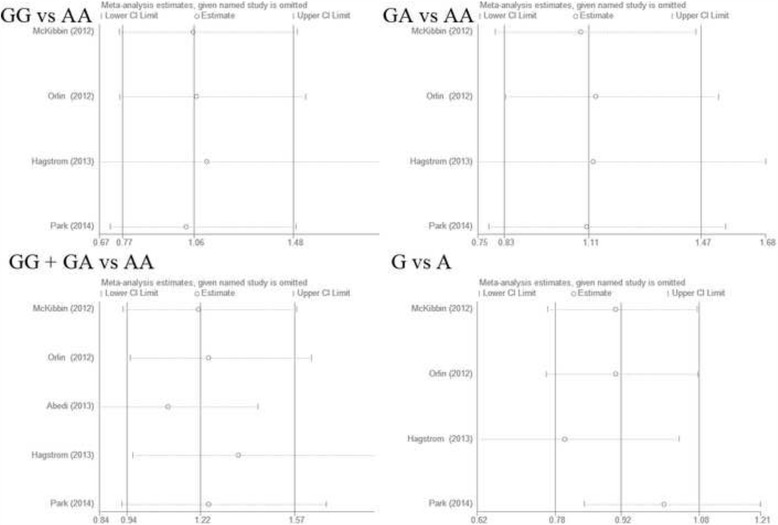
We performed a literature-based meta-analysis including, five published studies relevant to HTRA1 and response to anti-VEGF treatment (bevacizumab or ranibizumab). Summary odds ratios (ORs) and 95% confidence intervals (CIs) were estimated using fixed- and random-effects models. Sensitivity analysis and meta-regression were also performed. Q-statistic test and Egger's test was used to evaluate heterogeneity and publication bias respectively.
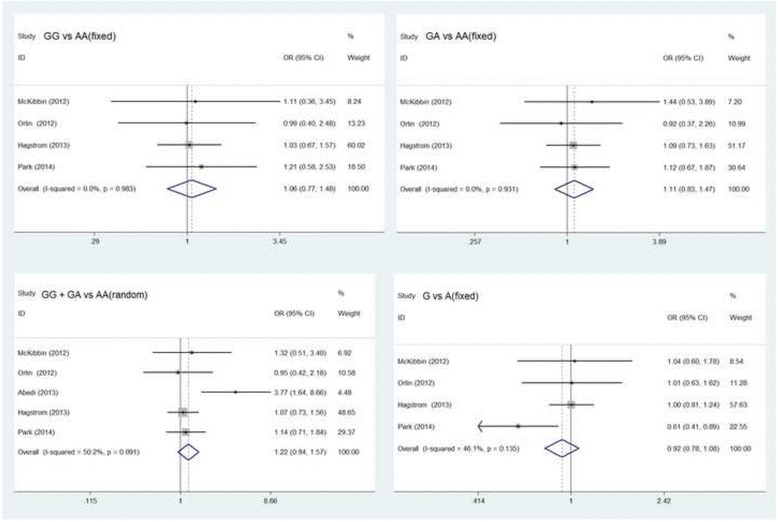
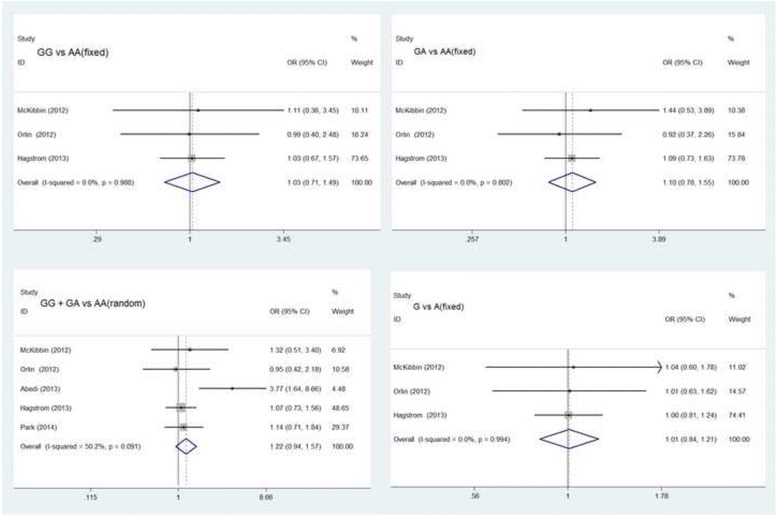
Overall, no association between the rs11200638 polymorphism in HTRA1 gene and the anti-VEGF treatment response was found in the genotype GG versus AA (OR = 1.06; 95% CI: 0.77 to 1.48; P = 0.98), genotype GA versus AA (OR = 1.11; 95% CI: 0.83 to 1.47; P = 0.93), genotype GG + GA versus AA (OR = 1.22; 95% CI: 0.94 to 1.57; P = 0.09), and allele G versus A (OR = 0.92; 95% CI: 0.78 to 1.08; P = 0.14). In the subgroup analysis by ethnicity Caucasian population, and a significant association was still not observed in all genetic models. Sensitivity analysis indicated the robustness of our findings, and no publication bias was observed in our meta-analysis.
This study shows that there was no association between the polymorphism rs11200638 in HTRA1 gene and response to anti-VEGF treatment of exudative AMD. However, more studies are needed to further prove the conclusion of present study, especially well-designed and high quality randomised controlled trials or intervention studies.
抗血管生成治疗是渗出性年龄相关性黄斑变性(AMD)导致视力丧失最常用的治疗方法,其中雷珠单抗和贝伐单抗等抗血管内皮生长因子(VEGF)药物是目前的标准治疗方法。然而,抗VEGF治疗在所有患者中的疗效并不一致。
我们进行了一项基于文献的荟萃分析,纳入了五项与HTRA1及抗VEGF治疗(贝伐单抗或雷珠单抗)反应相关的已发表研究。使用固定效应模型和随机效应模型估计汇总比值比(OR)和95%置信区间(CI)。还进行了敏感性分析和meta回归。分别使用Q统计检验和Egger检验评估异质性和发表偏倚。
总体而言,在HTRA1基因的rs11200638多态性与抗VEGF治疗反应之间,未发现基因型GG与AA(OR = 1.06;95% CI:0.77至1.48;P = 0.98)、基因型GA与AA(OR = 1.11;95% CI:0.83至1.47;P = 0.93)、基因型GG + GA与AA(OR = 1.22;95% CI:0.94至1.57;P = 0.09)以及等位基因G与A(OR = 0.92;95% CI:0.78至1.08;P = 0.14)之间存在关联。在按种族进行的亚组分析中,白种人群在所有遗传模型中仍未观察到显著关联。敏感性分析表明我们的研究结果具有稳健性,并且在我们的荟萃分析中未观察到发表偏倚。
本研究表明,HTRA基因中的rs11200638多态性与渗出性AMD的抗VEGF治疗反应之间无关联。然而,需要更多研究来进一步证实本研究的结论,尤其是设计良好且高质量的随机对照试验或干预研究。