Fang Cheng, Wang Wei, Zhang Yu, Feng Xingyu, Sun Jian, Zeng Yujie, Chen Ye, Li Yong, Chen Minhu, Zhou Zhiwei, Chen Jie
Department of Gastric Surgery, Sun Yat-sen University Cancer Center, State Key Laboratory of Oncology in South China, Collaborative Innovation Center for Cancer Medicine, 651 Dongfeng Road East, Guangzhou, 510060, Guangdong, P. R. China.
Department of Gastroenterology, The First Affiliated Hospital of Sun Yat-sen University, Guangzhou, 510080, Guangdong, P. R. China.
Chin J Cancer. 2017 Jun 21;36(1):51. doi: 10.1186/s40880-017-0218-3.
Gastroenteropancreatic neuroendocrine neoplasms (GEP-NENs) are a heterogeneous group of rare tumors. Many issues in terms of epidemiologic features, pathogenesis, and treatment of GEP-NENs are still under discussion. Our study aimed to analyze the clinicopathologic characteristics and prognosis of Chinese patients with GEP-NENs.
Complete clinicopathologic data and survival information of 1183 patients with GEP-NENs treated between 2005 and 2015 were collected from five medical centers in Guangdong Province, China. Patient survival was estimated using the Kaplan-Meier method and analyzed using the log-rank test; prognostic factors were analyzed using the Cox proportional hazards model.
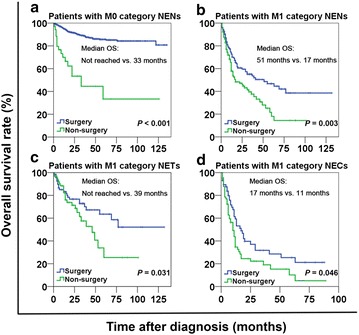
The most common tumor location was the rectum (37.4%), followed by the pancreas (28.1%), stomach (20.7%), small intestine (7.2%), appendix (3.4%), and colon (3.3%). After initial definitive diagnosis, 1016 (85.9%) patients underwent surgery. The 1-, 3-, and 5-year overall survival (OS) rates for the entire cohort were 87.9%, 78.5%, and 72.8%, respectively. The 3-year OS rates of patients with G1, G2, and G3 tumors were 93.1%, 82.7%, and 43.1%, respectively (P < 0.001). The 3-year OS rates of patients with stage I, II, III, and IV tumors were 96.0%, 87.3%, 64.0%, and 46.8%, respectively (P < 0.001). Patients with distant metastasis who underwent palliative surgery had a longer survival than those who did not (P = 0.003). Similar survival benefits of palliative surgery were observed in patients with neuroendocrine tumor (P = 0.031) or neuroendocrine carcinoma (P = 0.046). In multivariate analysis, age, grade, N category, M category, and surgery were found to be independent prognostic factors.
Patients with GEP-NENs who are women, younger than 50 years old, have smaller tumor size, have lower tumor grade, have lower T/N/M category, and who undergo surgery can have potentially longer survival time. Our data showed that surgery can improve the prognosis of GEP-NEN patients with distant metastasis. However, randomized controlled trials need to be conducted to establish the optimal criteria for selecting patients to undergo surgery.
胃肠胰神经内分泌肿瘤(GEP-NENs)是一组异质性罕见肿瘤。GEP-NENs在流行病学特征、发病机制和治疗方面的许多问题仍在讨论中。我们的研究旨在分析中国GEP-NENs患者的临床病理特征和预后。
收集了2005年至2015年期间在中国广东省五个医疗中心接受治疗的1183例GEP-NENs患者的完整临床病理数据和生存信息。采用Kaplan-Meier法估计患者生存率,并使用对数秩检验进行分析;使用Cox比例风险模型分析预后因素。
最常见的肿瘤部位是直肠(37.4%),其次是胰腺(28.1%)、胃(20.7%)、小肠(7.2%)、阑尾(3.4%)和结肠(3.3%)。在初次明确诊断后,1016例(85.9%)患者接受了手术。整个队列的1年、3年和5年总生存率(OS)分别为87.9%、78.5%和72.8%。G1、G2和G3肿瘤患者的3年OS率分别为93.1%、82.7%和43.1%(P<0.001)。I期、II期、III期和IV期肿瘤患者的3年OS率分别为96.0%、87.3%、64.0%和46.8%(P<0.001)。接受姑息性手术的远处转移患者的生存期比未接受姑息性手术的患者长(P=0.003)。在神经内分泌肿瘤(P=0.031)或神经内分泌癌(P=0.046)患者中也观察到了姑息性手术类似的生存获益。多因素分析发现,年龄、分级、N分期、M分期和手术是独立的预后因素。
女性患者、年龄小于50岁、肿瘤体积较小、肿瘤分级较低且T/N/M分期较低并接受手术的GEP-NENs患者可能有更长的生存时间。我们的数据表明,手术可以改善远处转移的GEP-NEN患者的预后。然而,需要进行随机对照试验以确定选择手术患者的最佳标准。