Tianjin Key Laboratory of Lung Cancer Metastasis and Tumor Microenvironment, Tianjin Lung Cancer Institute; Department of Lung Cancer Surgery, Tianjin Medical University General Hospital; Heping District, Tianjin, 300052, China.
Sci Rep. 2017 Jun 21;7(1):3947. doi: 10.1038/s41598-017-04296-2.
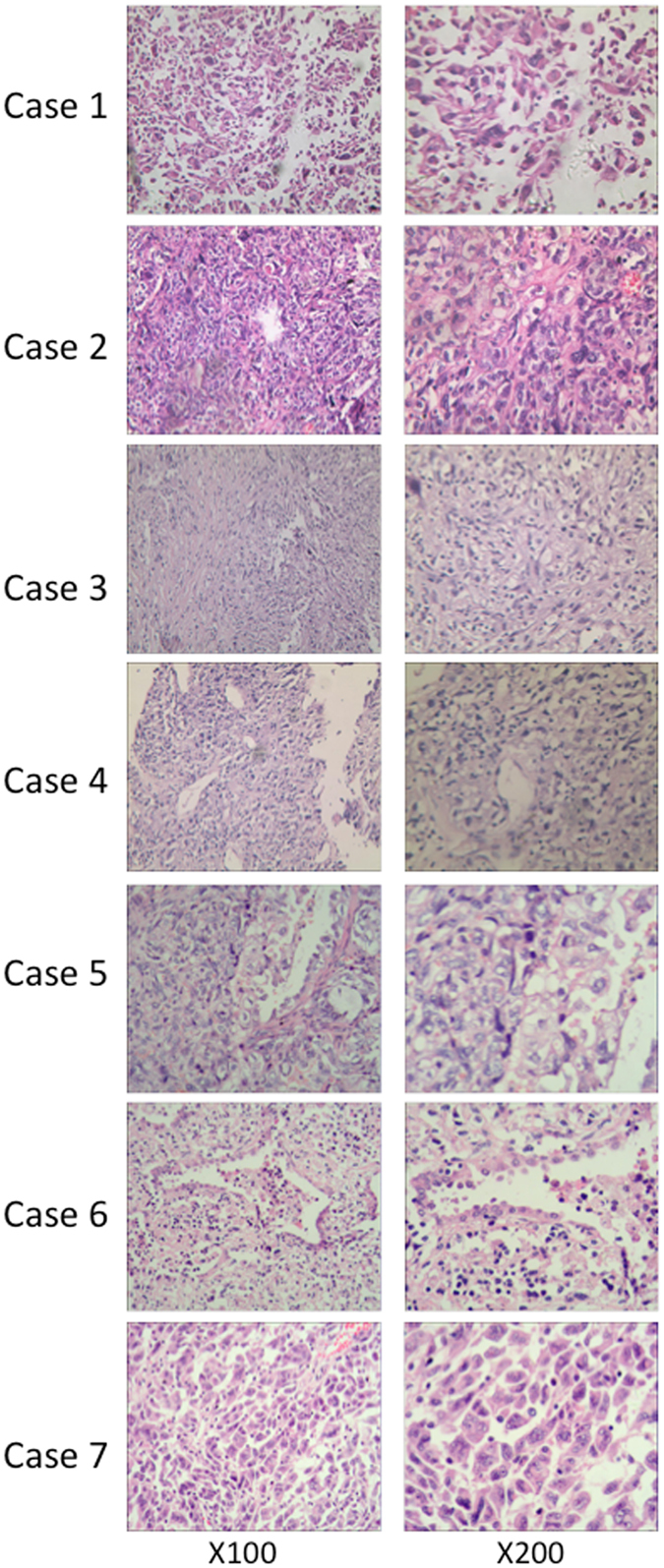
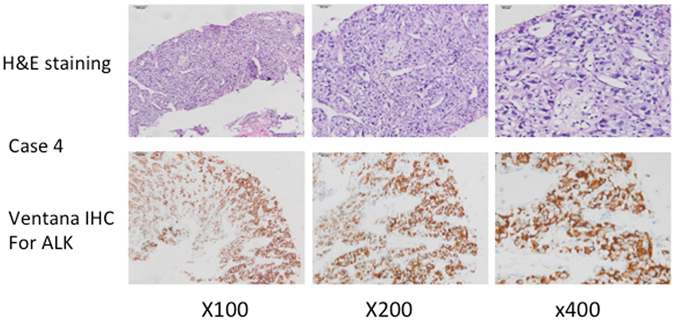
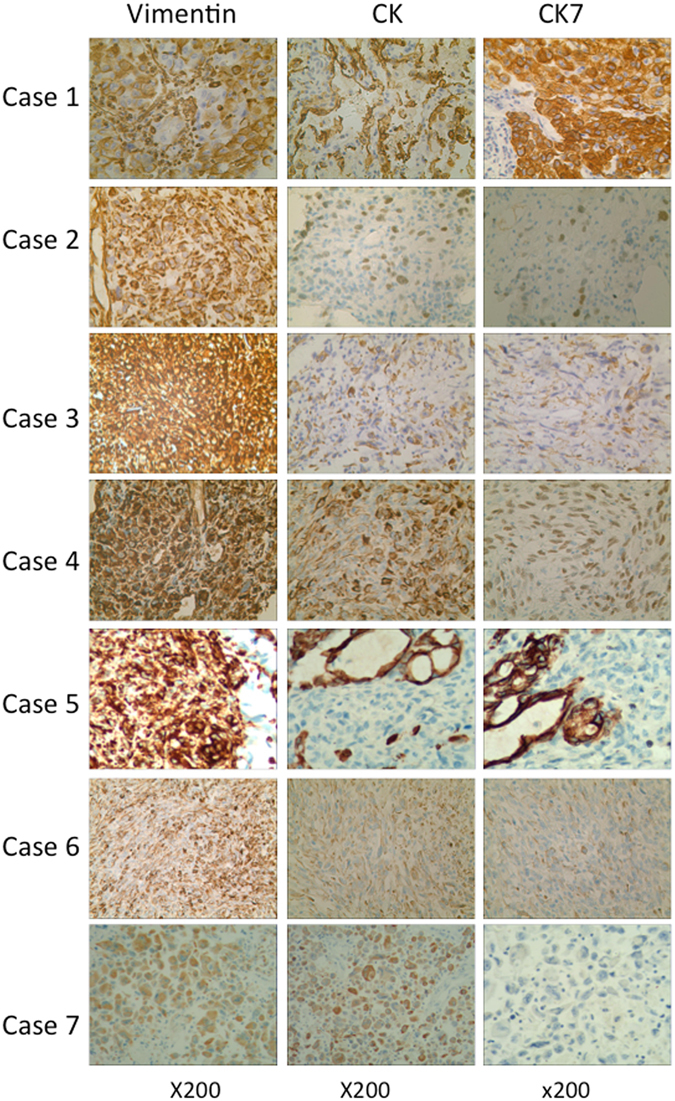
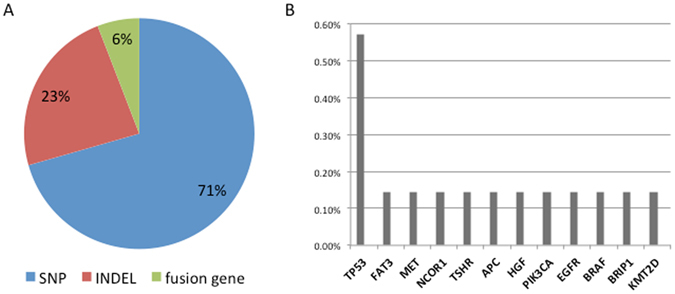
Pulmonary Sarcomatoid Carcinoma (PSC) constitutes a heterogeneous group of non-small-cell lung carcinomas (NSCLCs) with a poor prognosis. In this study, a group of 7 patients with PSC was studied. Microscope analysis of all 7 cases revealed a pleomorphic carcinoma subtype. Moreover, 5 cases (71.4%) were composed entirely of malignant sarcomatoid-like elements, and 2 cases (28.6%) were composed of malignant sarcomatoid-like elements and at least 10% adenocarcinoma-like elements. Immunohistochemically, the PSC components of all 7 cases were positive for vimentin and cytokeratins, including cytokeratin (CK) and cytokeratin 7 (CK7). Next-Generation Sequencing (NGS) was performed, and a total of 136 putative somatic variants and one gene fusion were identified, of which 16 variants were considered hot spot mutations, including the genes EGFR, EML4-ALK, MET, BRAF, PIK3CA, and TP53. Of these hot spot mutations, one sample expressing an EML4-ALK fusion was further confirmed by Ventana IHC, and one sample containing an EGFR exon 19 deletion was also confirmed. The NGS results imply that TP53 mutations occur often in PSCs and that EML4-ALK fusion events and EGFR exon deletions also occur in these rare tumors. Molecular targeted therapy may be a useful treatment strategy for these rare lung tumors.
肺肉瘤样癌(PSC)是一组异质性的非小细胞肺癌(NSCLCs),预后较差。本研究对 7 例 PSC 患者进行了研究。7 例患者的显微镜分析均显示为多形性癌亚型。此外,5 例(71.4%)完全由恶性肉瘤样样元素组成,2 例(28.6%)由恶性肉瘤样样元素和至少 10%的腺癌样元素组成。免疫组织化学分析显示,7 例患者的 PSC 成分均为波形蛋白和细胞角蛋白阳性,包括细胞角蛋白(CK)和细胞角蛋白 7(CK7)。进行了下一代测序(NGS),共鉴定出 136 个可能的体细胞变异和一个基因融合,其中 16 个变异被认为是热点突变,包括 EGFR、EML4-ALK、MET、BRAF、PIK3CA 和 TP53 基因。在这些热点突变中,1 个表达 EML4-ALK 融合的样本进一步通过 Ventana IHC 得到了确认,1 个含有 EGFR 外显子 19 缺失的样本也得到了确认。NGS 结果表明,TP53 突变在 PSCs 中经常发生,EML4-ALK 融合事件和 EGFR 外显子缺失也发生在这些罕见肿瘤中。分子靶向治疗可能是这些罕见肺肿瘤的一种有用的治疗策略。